Rinsen-ji Temple: A Soto Zen Mortuary Temple in Joetsu, Japan
Site at a Glance
- Rating
- 4.3
- Popularity
- Low
- Country
- Japan
- Primary era
- Modern
- External website
- Open
- Eras represented
- Medieval, Modern
- Civilizations
- Unclassified
- Site type
- Religious
On this page13 sections
History
Rinsen-ji Temple is a Soto Zen temple in Joetsu, Japan, founded in 1497 at the foot of Kasugayama Castle during the late medieval period. Nagao Nōkage established it for memorial rites on the seventeenth anniversary of his father’s death and invited a monk to become its founding abbot. Soto is one of the principal schools of Japanese Zen Buddhism, emphasizing seated meditation and disciplined monastic training.
The Nagao and Uesugi families
With the protection of Nōkage and his son, Nagao Tamekage, Rinsen-ji developed as the mortuary temple of the Nagao family, the hereditary deputy governors of Echigo Province. A mortuary temple was responsible for memorial rites and ancestral commemoration for a family or ruling house. The temple’s mountain name, Kasugayama, is the traditional honorific name used by many Japanese Buddhist temples alongside their proper names.
After Tamekage died in 1536, his youngest son, the future Uesugi Kenshin, was placed at Rinsen-ji when he was seven years old. He studied under the temple’s sixth abbot until he was recalled at fourteen for his coming-of-age ceremony, when he took the name Kagetora. After succeeding to the Uesugi family and adopting the name Uesugi Terutora, he continued Zen practice under the seventh abbot. When he shaved his head in 1570, he took the religious name Kenshin, using one character from his teacher’s personal name.
Uesugi Kenshin, a sixteenth-century warlord and head of the Uesugi family, died suddenly in 1578. His coffin was initially buried at a temple precinct within Kasugayama Castle. When his adopted son, Uesugi Kagekatsu, was transferred first to Aizu in 1598 and then to Yonezawa in 1601, Kenshin’s remains were moved to Yonezawa as well.
Relocation and later patronage
Rinsen-ji is commonly believed to have moved to Yonezawa with the Uesugi family, where a temple with the same name was established near Yonezawa Castle. The temple records do not present a uniform account of this relocation, and the tradition became widely known after the publication of Kenshin and Rinsen-ji in 1912. The Rinsen-ji in Joetsu nevertheless preserves robes and an alms bowl transmitted from its foundation. Such objects symbolize the continuation of a temple’s religious lineage between generations of clerics.
After the Uesugi transfer, the temple below Kasugayama Castle temporarily declined. Hori Hideharu, who became lord of Kasugayama Castle after Kagekatsu, revived it. Rinsen-ji later received mortuary recognition from the Hori family, the Matsudaira families who entered Takada Castle after the Hori family was dispossessed, and the Sakakibara family, which governed Takada Domain from the first half of the eighteenth century until the Meiji Restoration.
During the Edo period, the second shogun, Tokugawa Hidetada, granted Rinsen-ji an officially sealed estate valued at 224 koku. A koku was an Edo-period measure of rice-based land revenue used to assess the economic value of an estate. The lords of Takada Domain also gave the temple special protection through prohibitory regulations.
Fire, rebuilding, and continuing affiliation
Fires during the Kan’ei era and another fire in 1847 destroyed the main hall, mountain gate, and other buildings. The mountain gate was rebuilt in 1925 to commemorate the four-hundredth anniversary of Kenshin’s birth, and a new main hall was erected in 1997 for the temple’s five-hundredth anniversary.
Rinsen-ji remains formally affiliated with the Soto school and is known as a mortuary temple of the Echigo Nagao family and its descendants, the Uesugi family of Yonezawa. Memorial tablets and graves for three generations of the Hori family, Hori Hideshige, Hori Hidemasa, and Hori Hideharu, are also held at the temple.
Remains
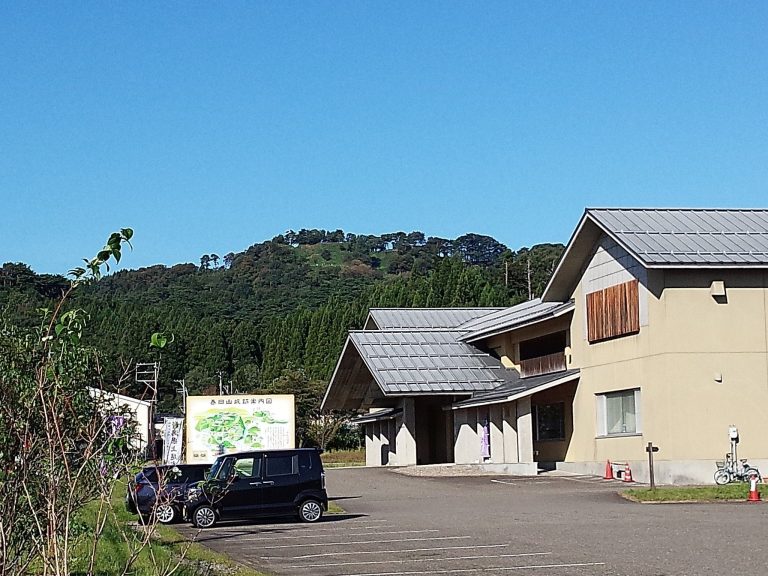
The temple complex stands beneath Kasugayama Castle and includes an outer gate, a two-story mountain gate, a main hall, memorial features, and objects associated with the temple’s religious lineage. Its principal image is Shakyamuni Buddha. The surviving buildings and commemorative features bring together the temple’s Buddhist function, its associations with the castle, and its role as a family mortuary temple.
Gates and main hall
Outer gate
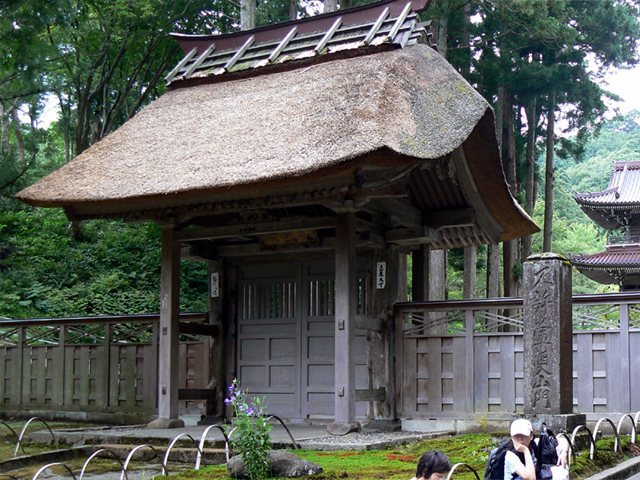
The outer gate is traditionally identified as the relocated rear gate of Kasugayama Castle. It is regarded as the only surviving architectural structure from the castle, giving the entrance a direct physical connection with the former stronghold above the temple.
Mountain gate
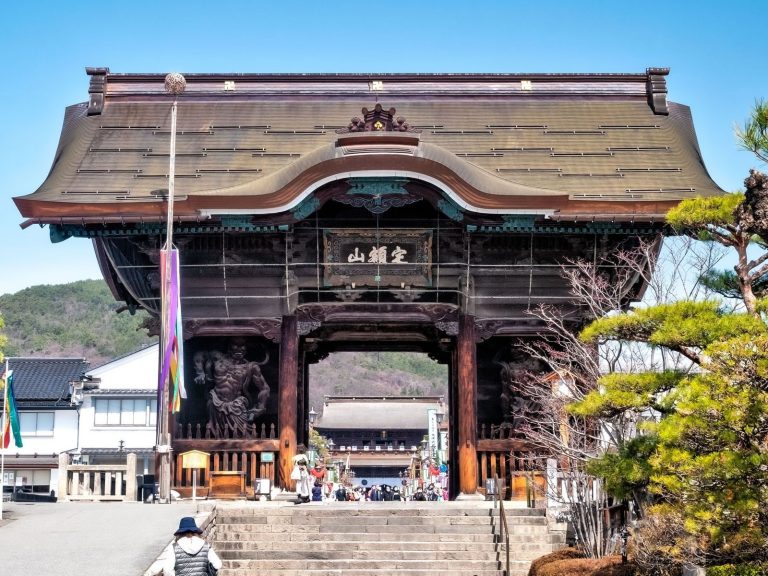
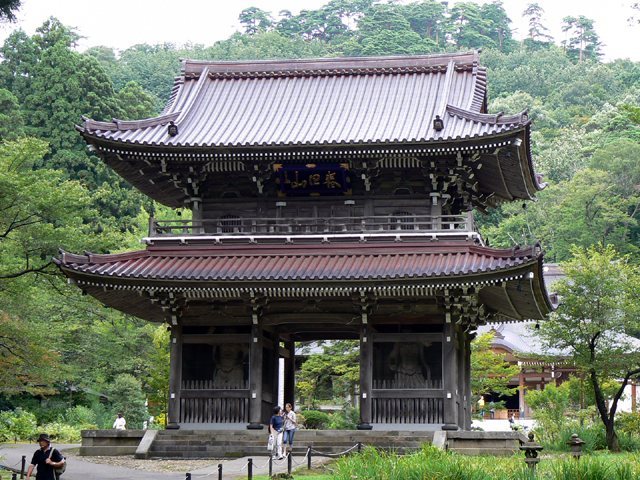
Rinsen-ji’s mountain gate is a two-story structure rebuilt in 1925. It contains a pair of Nio, imposing Buddhist guardian figures commonly placed at temple entrances. The statues were made by Takigawa Bido, a sculptor from Naoetsu, and reach nearly four meters in height when their pedestals are included.
Main hall
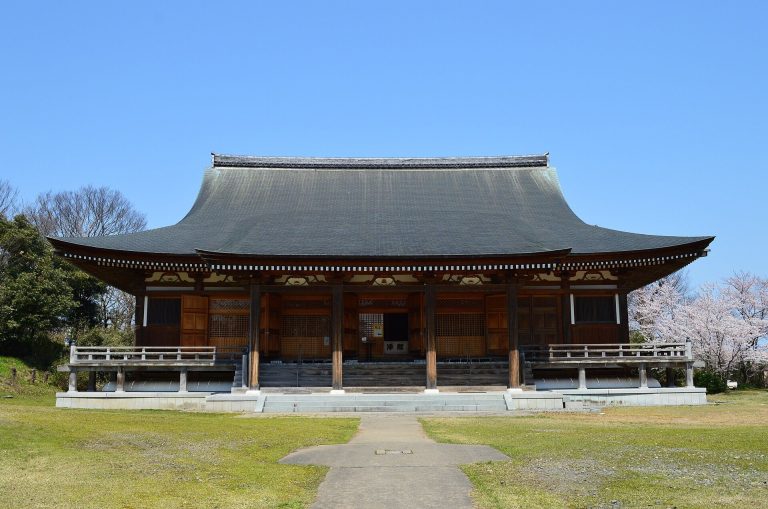
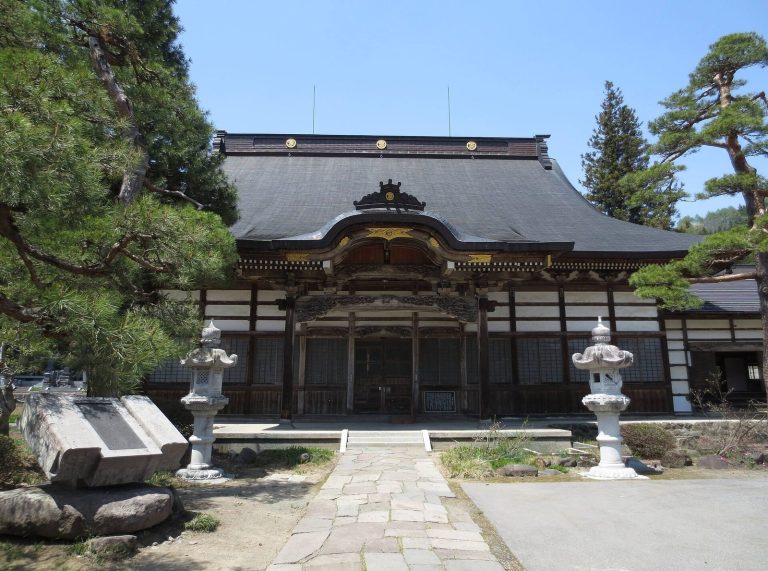
The main hall is a modern building erected in 1997 after the earlier hall was destroyed by fire. It serves the central religious functions of the temple, whose principal image is Shakyamuni Buddha.
Memorial features and temple objects
Kenshin’s grave and memorial tower
The grounds contain Uesugi Kenshin’s grave and a memorial tower dedicated to those killed in the Battles of Kawanakajima, the series of sixteenth-century conflicts with which Kenshin is traditionally associated. These features preserve the temple’s connection with the Uesugi leader and with the military history linked to his rule.
Lineage objects and inscription
Robes and an alms bowl transmitted from the temple’s foundation are preserved at Rinsen-ji. Along with the temple’s memorial features, they represent the continuity of its religious tradition. A plaque inscribed with the words “First Principle” bears Uesugi Kenshin’s handwriting. The original is kept in the treasure hall, while a replica is displayed at the gate.
Hori family memorials
Memorial tablets and graves for Hori Hideshige, Hori Hidemasa, and Hori Hideharu are located within the temple grounds. Together they reflect the later role of Rinsen-ji as a mortuary temple of the Hori family after Hideharu revived the institution below Kasugayama Castle.