Shibayama Kofun Cluster: A Sixth-Century Burial-Mound Complex in Japan
Site at a Glance
- Rating
- 4.3
- Popularity
- Very Low
- Country
- Japan
- Primary era
- Medieval
- External website
- Open
- Eras represented
- Medieval
- Civilizations
- Yamato
- Site type
- Burial
- Remains
- Necropolis
On this page8 sections
History
Shibayama Kofun Cluster is a group of ancient Japanese burial mounds in Yokoshibahikari, Japan, built during the latter half of the sixth century in the Kofun period. This era, conventionally dated from approximately the third through the seventh centuries, was marked by the construction of monumental burial mounds for members of the elite. The cluster includes the keyhole-shaped mounds Tonozuka and Himezuka, along with 13 circular mounds, and is especially important for the evidence provided by its haniwa arrangements.
Construction and Dating
The cluster is also known as the Nakadai Kofun Cluster, after the Nakadai neighborhood where it stands. Its name can otherwise cause confusion, because the site is not located in Shibayama Town. The two principal mounds were once placed between the late sixth and early seventh centuries, with Tonozuka considered earlier than Himezuka. Comparisons with nearby late-phase mounds, including Koike Otsuka Kofun and Gomatedai No. 16 Kofun, as well as with Danotsuka Kofun, probably built between AD 610 and 620, supported dating the cluster’s construction to the latter half of the sixth century.
Excavation and Protection
Waseda University excavated Tonozuka and Himezuka in 1956. The work recovered an almost complete procession of haniwa, clay figures and cylinders placed on and around burial mounds. Their arrangement could mark the mound and represent people, animals, buildings, weapons, armor, and equipment. At this site, the surviving sequence provided the first means of understanding the arrangement and meaning of figurative haniwa.
The cluster became a National Historic Site of Japan in 1958. Haniwa from Tonozuka and Himezuka were later designated nationally as Important Cultural Properties, while nine examples had already received designation as Chiba Prefecture tangible cultural properties in 1971. Many excavated objects are stored and displayed at the Shibayama Haniwa Museum, within the grounds of Kannonkyō-ji Temple in Shibayama Town.
Remains
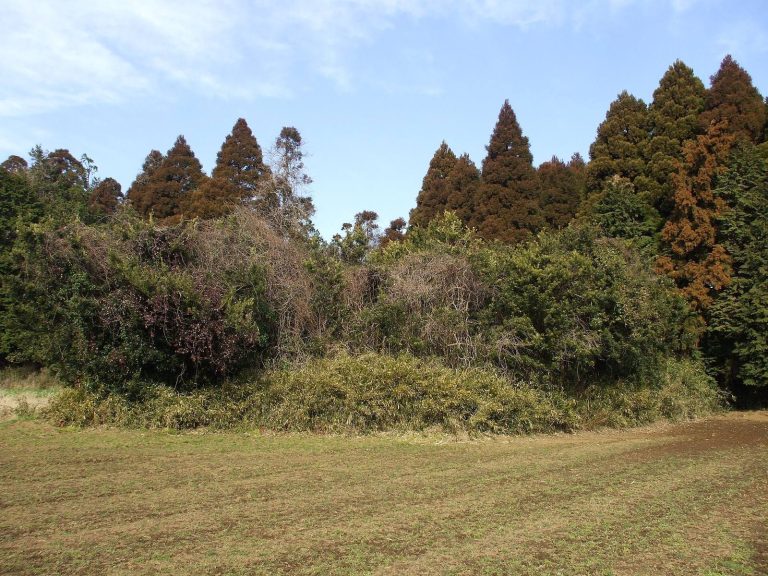
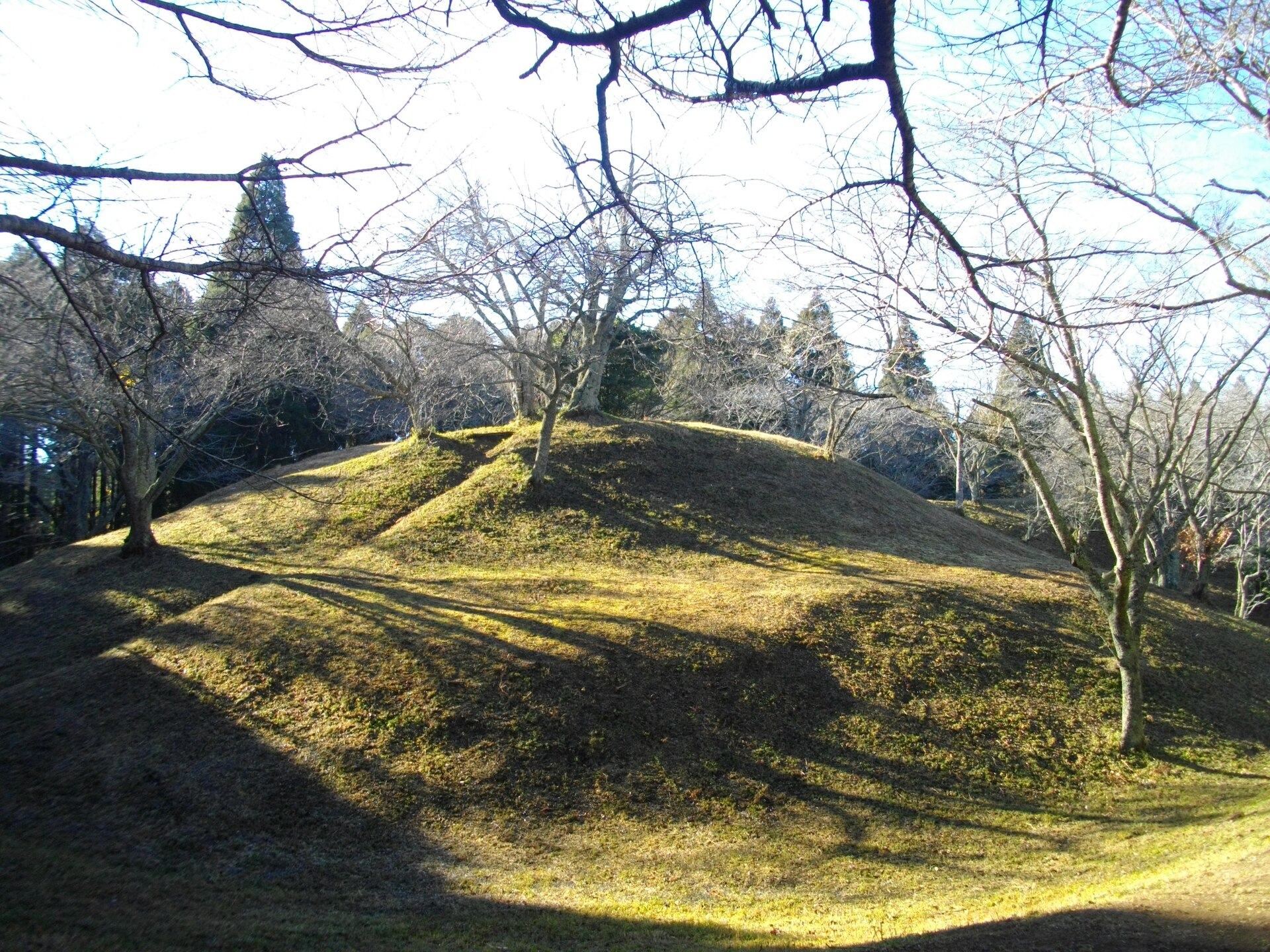
The cluster occupies a plateau on the east bank of the Kido River, which flows through the central Kujukuri Plain. Its principal remains are the two keyhole-shaped mounds, a form combining a rectangular front with a rounded rear section, together with 13 surrounding circular mounds. The circular mounds have basal diameters of approximately 20 meters and remain well preserved.
Keyhole-Shaped Mounds
Tonozuka
Tonozuka is a two-tiered keyhole-shaped mound measuring 88 meters in total length. Its square front projects westward, measuring 58 meters across and approximately 10 meters high. The rounded rear section is 58 meters in diameter and approximately 10.4 meters high. Two rectangular concentric ditches surround the mound, with an outer bank separating them.
Haniwa once furnished the mound. Cylindrical examples formed a ring around the upper level of the rear section, while others believed to have stood on the middle or lower levels had fallen into the moat. Animal figures from the north moat represented horses, dogs, cattle, a doe, wild boar, ducks, and other water birds. Near the narrow junction between the front and rear sections were figures of quivers, armor, houses, and other equipment. Numerous male and female figures were found toward the rear mound. The northern middle embankment also held cylindrical haniwa, including morning-glory-shaped examples, together with two human figures.
Tonozuka’s burial facility is a horizontal stone chamber opening on the south side of the rear mound. The surviving chamber is 3.4 meters long, while its burial space measures 2.74 meters in length and 2.5 meters in width. A double-sleeve entrance leads into the chamber, which was built from cut sandstone using staggered and interlocking masonry. Its interior was coated with vermilion. Associated objects included magatama, curved comma-shaped beads used as prestigious ornaments or burial objects, other beads, gold rings, a sword with a knobbed pommel, gilt-bronze bells, iron arrowheads, an iron knife, and a bronze bowl.
Himezuka
Himezuka lies approximately 30 meters north of Tonozuka and is aligned parallel to it. It is the smaller of the two keyhole-shaped mounds, with a total length of approximately 58.5 meters. A single shield-shaped moat surrounds it. The rounded rear section is 35 meters in diameter and 4.4 meters high, while the front section is 35 meters wide and 5 meters high, making the front higher than the rear.
Its horizontal stone burial chamber opens southward near the narrow junction on the south side of the front section. The chamber measures 5.72 meters in length, 1.65 meters in width, and 1.8 meters in height. It has a compound structure lined with sandstone slabs. Objects found with the burial included magatama and other beads, gold rings, a sword with gilt-bronze fittings, an iron blade, iron arrowheads, and additional gilt-bronze fittings, including horse equipment such as harness bosses and pendants.
Haniwa Procession
A highly preserved row of haniwa encircled the middle level of Himezuka. On the south side, near the burial-chamber opening, morning-glory-shaped and cylindrical haniwa stood in parallel. On the north side, figurative haniwa extended for approximately 50 meters from the front corner of the front section to a point behind the rear mound. Many had fallen but remained arranged in procession order.
The procession comprised four groups. A hat-wearing groom accompanied four saddled horses and five warriors. Next came 16 male figures with one equipment haniwa, followed by seven female figures and a final group of ten male figures. Among the individual figures were a bearded warrior, a farmer carrying a hoe, a kneeling man, and a person holding a koto on the knees. The row remained almost entirely in its original position, making it an exceptionally well-preserved example of haniwa arrangement. These figures belong to the latter half of the sixth century, when figurative haniwa expression reached its peak.