Enpuku-ji Temple: A Shingon Buddhist Pilgrimage Temple in Japan


Site at a Glance
- Rating
- 4.2
- Popularity
- Medium
- Country
- Japan
- Primary era
- Early Modern
- External website
- Open
- Eras represented
- Early Modern, Modern
- Civilizations
- Japanese, Tokugawa
- Site type
- Religious
- Remains
- Sanctuary
On this page20 sections
History
Enpuku-ji Temple is a Shingon Buddhist temple in Chōshi, Japan, traditionally founded during the Kōnin era, from 810 to 824, and associated with the Eleven-Headed Kannon. Shingon is an esoteric Buddhist tradition emphasizing ritual, sacred images, mantras, and symbolic teachings. Also known as Iinuma Kannon, the temple is the 27th stop on the Bandō Thirty-Three Kannon pilgrimage, a regional circuit of thirty-three temples in eastern Japan devoted to Kannon, the Buddhist bodhisattva associated with compassion.
Origins and Foundation Traditions
Temple tradition places the beginning of its sacred history in 724, when two fishermen are said to have drawn a statue of Eleven-Headed Kannon from their nets. This form of Kannon is represented with multiple heads, expressing the ability to perceive and respond to suffering in different directions. During the Tenpyō era, from 729 to 749, the wandering Buddhist priest Gyōki is said to have built an altar for the image. According to the legend, the statue bowed its head and entered the altar when the structure proved too small.
Kūkai, traditionally regarded as Enpuku-ji’s founder, is said to have visited the area during the Kōnin era and established a temple there. Kūkai, also known as Kōbō Daishi, established the Shingon school in Japan in the early ninth century. The temple’s traditional foundation date belongs to this religious tradition rather than to an archaeologically certain construction date.
Patronage and Pilgrimage
After the Kamakura period, Enpuku-ji flourished under the patronage of the Kaijō clan, the local ruling family. During the Edo period, pilgrims from the coastal settlements of Iinuma and Matsugishi helped Chōshi develop as a pilgrimage center. The temple’s devotional identity remained closely linked to Kannon, whose associated invocation is “On makakyarunikiya sowaka.” Its devotional verse refers to hearing the sound of waves at Iinuma.
In 1591, Tokugawa Ieyasu granted Enpuku-ji a red-seal authorization. Such a document formally recognized and protected an institution’s privileges or property under the Tokugawa authorities. The authorization was followed by the continued maintenance of the temple halls.
Rebuilding and Wartime Destruction
A Kannon Hall was built in 1578 as an eight-bay-square structure. The temple’s bell tower and Tahōtō pagoda burned in 1702. A Tahōtō is a Japanese Buddhist pagoda with a square lower story and rounded upper section. The Kannon Hall was enlarged to ten bays square in 1773, while other buildings, including a Niōmon gate, bell tower, and Tahōtō, were built or improved during subsequent phases.
Air raids on Chōshi in 1945 destroyed most of the temple complex. The buildings lost included the Tahōtō, Kannon Hall, Niōmon, bell tower, Taishi Hall, Horse-Headed Kannon Hall, Nijusan’ya Hall, Dakiniten Hall, and the hall dedicated to Ryūzō Daigongen, now associated with Chōkō Shrine. Much of the present complex therefore consists of postwar reconstruction. The 1711 statue of Amida Buddha survived the attacks.
Recent Reconstruction and Heritage Recognition
The present five-story pagoda was completed in 2009. Since 2014, Enpuku-ji has held exhibitions of its classical books twice each year in cooperation with Keio University’s Shido Bunko. In 2016, the temple was recognized as a component cultural property of Japan Heritage under the name “Iinuma Kannon.” Japan Heritage is a national program that presents connected groups of cultural assets as historical narratives.
The Iinuma benchmark stone received recognition in 2015 as a Selected Civil Engineering Heritage site. Its importance lies in its role in Japanese river and height surveying, linking the temple grounds with the development of surveying practices.
Remains
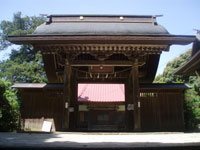
Enpuku-ji is entered from the west through a two-story tower gate, or Rōmon, and the approach continues toward a main hall on a high foundation. A road divides this central area from a rear group of temple buildings. The five-story pagoda and the Iinuma benchmark stone occupy the area behind the main Buddha image, while Chōkō Shrine is adjacent to and extends into the temple grounds.
Entrance and Central Precinct
Rōmon Gate
The western entrance is formed by a Rōmon, a two-story gate with an open passage through its lower level. Two Niō guardian figures protect the passage. The present gate replaced the earlier gate that was destroyed during the 1945 air raids, and it dates from 1972.
Main Hall
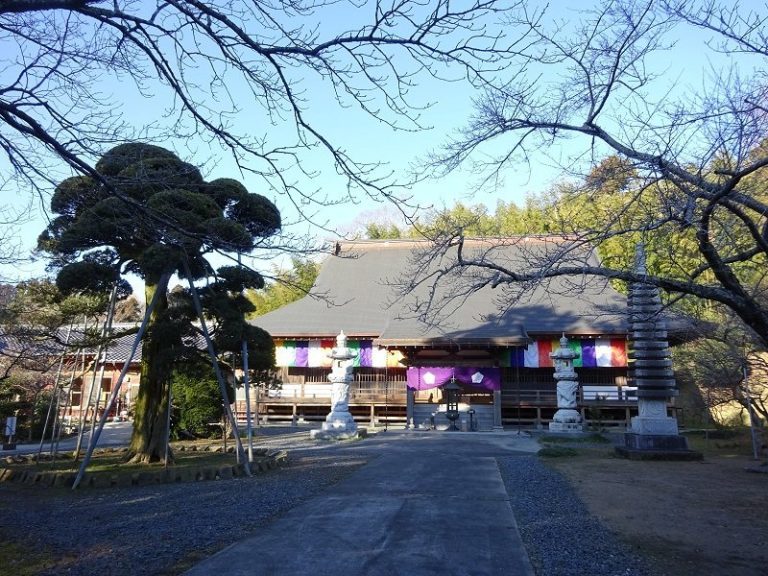
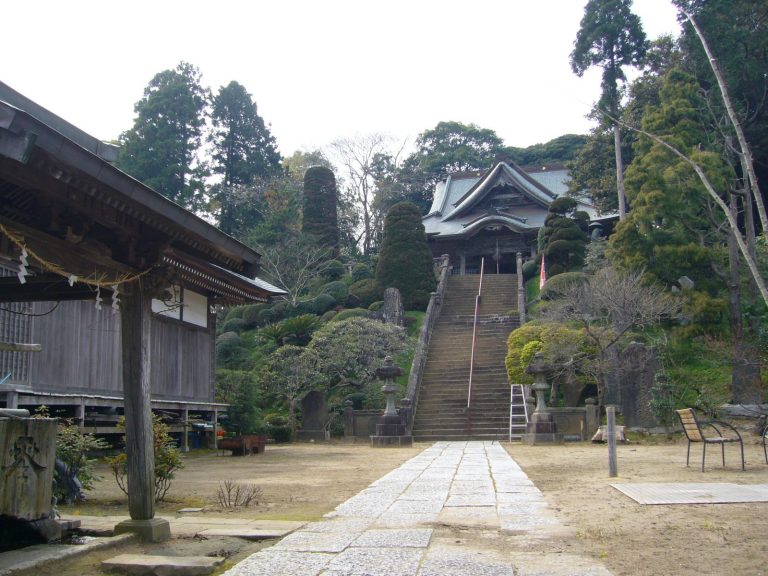
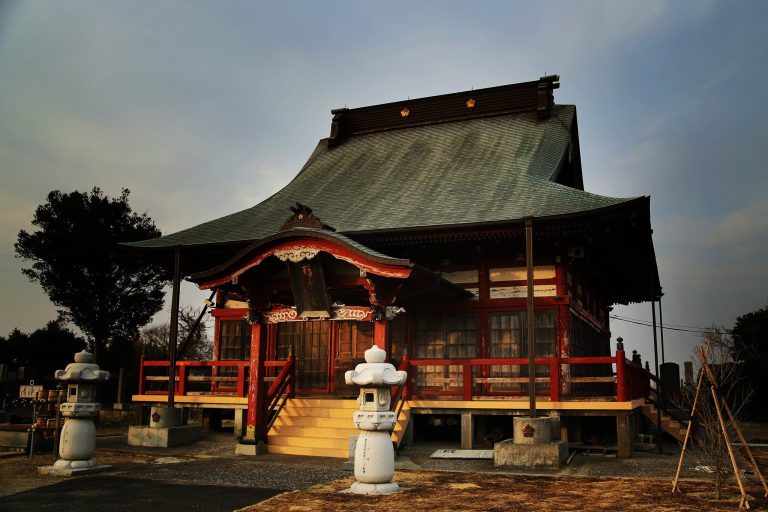
The Hondō, or main hall, stands on a high foundation reached by stairs. It is a post-1945 reconstruction. The temple’s enshrined Kannon is generally not visible to visitors, but the Eleven-Headed Kannon remains the principal image associated with the temple.
Bell Tower and Amida Buddha
A bell tower stands on the right side of the approach to the main hall. On the left is a seated bronze Amida Buddha made in 1711. The statue is approximately 5.4 meters high, and traces of the 1945 air raids remain visible on its surface.
Five-Story Pagoda
The current five-story pagoda stands behind the Great Buddha. Completed in 2009, it rises 33.55 meters above the temple grounds and forms part of the reconstructed central complex.
Surveying Marker and Rear Buildings
Iinuma Benchmark Stone
Behind the pagoda is the Iinuma benchmark stone, a fixed surveying marker used as a reference for measuring elevation. Dutch surveying engineer Isaac Lindo installed it in 1872. The stone served as a basis for height markings used in river engineering on the Tone and Edo rivers, as an origin point for river surveying in Japan, and in establishing the Japanese datum benchmark.
Daishidō and Hōmotsuden
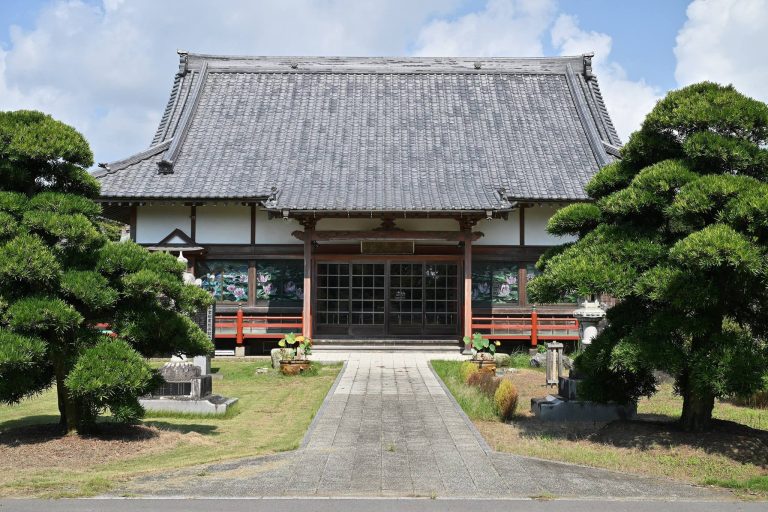
Across the road from the main hall, the rear group of temple buildings includes the Daishidō and the Hōmotsuden treasure house. The Daishidō is dedicated to Kūkai and was built in 1847. The Hōmotsuden houses temple treasures.
Chōkō Shrine and Stone Monument
Chōkō Shrine
Chōkō Shrine adjoins the temple and extends into its grounds. Its present hall is identified with the former hall dedicated to Ryūzō Daigongen, one of the buildings destroyed in the 1945 air raids.
Stone Monument
An old stone monument stands between the main hall and Chōkō Shrine. Local tradition identifies it as the grave of a layman who lived in the surrounding area during the Keichō period, the era spanning the late sixteenth and early seventeenth centuries during the transition to the Tokugawa shogunate.
Religious and Cultural Treasures
Ritual Gong
A Nyō, an early Heian-period cast-bronze gong used in Buddhist ritual, is associated with Enpuku-ji. It is currently deposited at the Nara National Museum and is designated a National Important Cultural Property.
Bell and Buddhist Scroll
The temple’s associated cultural properties include a bell bearing an era inscription corresponding to 1462. Another treasure is a three-part Buddhist scroll depicting Shaka’s death, dated to 1663 and measuring 354.6 centimeters in one stated dimension. A three-volume account of the scroll’s provenance is also preserved among the temple treasures.