Kanpuku-ji Temple: A Shingon Buddhist Temple in Katori, Japan

Site at a Glance
- Rating
- 3.9
- Popularity
- Very Low
- Country
- Japan
- Primary era
- Unclassified
- Eras represented
- Unclassified
- Civilizations
- Unclassified
- Site type
- Religious
- Remains
- Temple
On this page5 sections
History
Kanpuku-ji Temple is a Buddhist temple of the Shingon Buzan Sect in Katori, Japan, traditionally founded in 811 by the priest Enton. Shingon Buddhism is an esoteric tradition centered on ritual practice, sacred teachings, and devotional images, while the Buzan Sect is one of its branches. The temple is also known as Yamakura-sama and was formerly an auxiliary temple of nearby Yamakura Shrine.
Founding traditions
Several traditions connect Kanpuku-ji with important Buddhist figures. One associates it with Saicho, the founder of the Tendai Buddhist tradition, through the enshrinement of a Sacred Kannon image. Another states that Kukai, the ninth-century founder of Shingon Buddhism who is also known as Kobo Daishi, entered the temple and performed religious rites there in 814. A related tradition says that in 815 he enshrined the principal images of Dairoku Ten and Kosodate Kannon. Dairoku Ten, also called Takejizai-ten in the temple’s terminology, is the deity at the center of the temple’s worship, while Kannon is a Buddhist bodhisattva associated with compassion.
The temple legend places these events in a time when infectious diseases afflicted local residents. Kukai is said to have fasted and prayed to Dairoku Ten and Kosodate Kannon. After residents offered him salmon from the nearby Kuri River, they were suddenly cured. The annual festival held on 7 October preserves this tradition through the offering of a raw salmon during a Buddhist service. Kanpuku-ji is also regarded as the head temple of the Dairoku Ten tradition at sites distributed throughout Japan and is the 45th temple in the Kanto Eighty-eight-temple pilgrimage circuit associated with Kukai.
Relationship with Yamakura Shrine
Until the formal separation of Buddhism and Shinto in the early Meiji period, Kanpuku-ji served as an auxiliary temple to Yamakura Shrine under shinbutsu-shugo, the historical blending of Buddhist and Shinto practices in Japan. A separation policy enacted in 1871 required Buddhist institutions and objects to be separated from Shinto shrines. Buddhist objects were transferred from the shrine to Kanpuku-ji in a process that continued into the early twentieth century.
The principal image had remained in the inner sanctuary of the present Yamakura Shrine until 24 May 1869. Priests from the auxiliary temple traveled there to conduct prayers, after which the image was brought back to Kanpuku-ji. It was first installed in the lecture hall and later placed in the present main hall.
Kanpuku-ji received permission from the Saga Imperial court to use the imperial Chrysanthemum crest as its temple emblem. Its priests were also authorized to wear purple robes, appear at the Edo palace, and meet the lord. The front of the lecture hall is described as bearing a hollyhock crest.
Remains
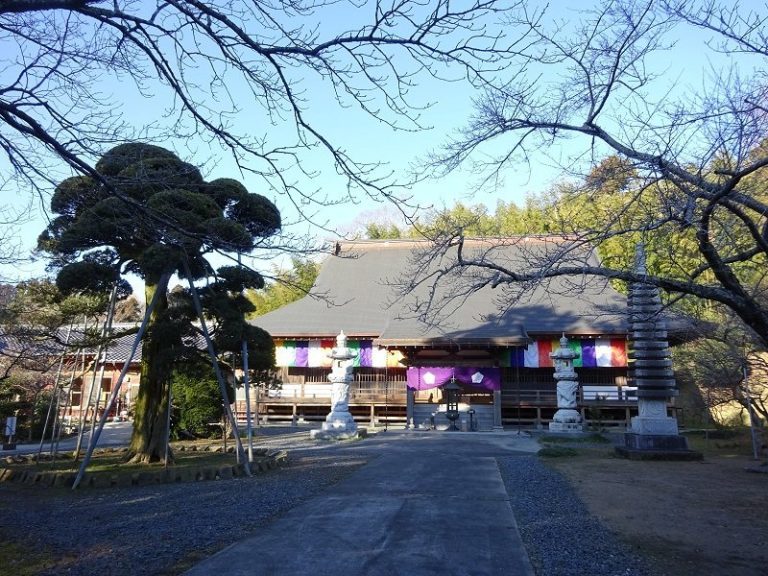
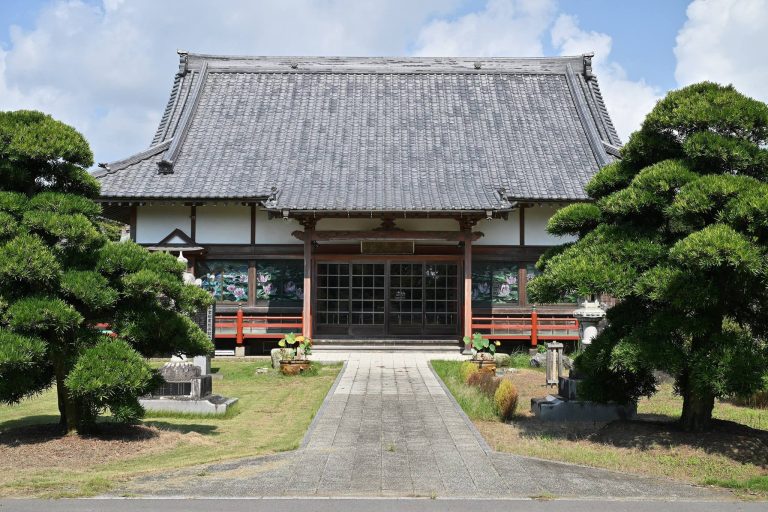
The temple precinct is organized around a group of religious and residential buildings, including the main hall, lecture hall, reception hall, and monks’ quarters. It also contains a roofed hand-washing area with a water basin and a place for offering a Buddhist sutra. The principal deity is Dairoku Ten, accompanied by Sacred Kannon and Kosodate Kannon, the latter represented by a roughly carved image. The principal image brought back from Yamakura Shrine remains enshrined in the main hall.
Approach and ritual stairways
The approach to the main hall bends first to the left and then to the right, a protective arrangement associated with averting misfortune in the eight directions. A separate stone stairway from the road has a sequence of symbolic sections. Its first part represents the age-related danger traditionally associated with thirteen, and the next five steps signify purification of the body. A further section refers to the traditional ages of misfortune for women at thirty-three and men at forty-two. Six wooden steps before the main hall represent purification of the six senses. The approach and stairways are designated for worshippers’ use.