Protestant Church Treschklingen: A 1582 Reformation-Era Church in Germany
Site at a Glance
- Rating
- 4.4
- Popularity
- Very Low
- Country
- Germany
- Primary era
- Early Modern
- External website
- Open
- Eras represented
- Early Modern, Modern
- Civilizations
- German, Holy Roman Empire
- Site type
- Religious
- Remains
- Church
On this page12 sections
History
Protestant Church Treschklingen is a church in Treschklingen, now part of Bad Rappenau in Germany, built in 1582 during the Reformation era on the site of a medieval chapel. Its history reflects disputes over patronage, tithes, parish administration, and the changing religious affiliations of the local nobility.
From filial chapel to disputed parish
The medieval chapel at Treschklingen was originally a filial church of Bonfeld, meaning that it was administered from another parish rather than operating independently. The knightly Frey von Treschklingen family held its patronage rights, the legally recognized authority connected with a church and its clergy. In 1430, Martin Frey von Treschklingen sold the Bonfeld parish, together with its patronage and tithe rights, to the Wimpfen collegiate foundation, a religious corporate institution that held ecclesiastical rights and income.
Religious and financial tensions intensified after the von Gemmingen lords introduced the Reformation in Bonfeld from 1523. Treschklingen’s Catholic lord, Sebastian von Helmstatt, ended the chapel’s parish association with Bonfeld. He demanded that the Wimpfen collegiate foundation provide a pastor without payment because it received the tithes. When the foundation rejected a legal obligation to maintain a parish, Sebastian von Helmstatt collected the tithes himself from 1528.
The 1582 church and the von Gemmingen settlement
Eberhard von Gemmingen of Bürg acquired Treschklingen in 1538 and settled the Wimpfen foundation’s claims to the tithes. His son Reinhard von Gemmingen later demolished the deteriorated medieval chapel and commissioned the present church. The new building was completed and consecrated on 28 October 1582.
A dispute over construction expenses followed. Reinhard von Gemmingen sought reimbursement from the Wimpfen collegiate foundation and again used the withholding of tithes as leverage. A settlement based largely on a 1569 agreement between Philipp von Gemmingen, lord of Bonfeld, and the foundation transferred all rights and obligations concerning the Bonfeld parish and its dependent churches at Treschklingen and Fürfeld to the von Gemmingen lords.
Treschklingen became a filial congregation of Rappenau in 1626. An independent parish was established in 1738, although its pastor also administered neighboring Babstadt for an extended period. The Treschklingen branch of the Barons von Gemmingen returned to Catholicism in 1764 under Sigmund von Gemmingen. His son, Sigmund Johann Nepomuk von Gemmingen, commissioned a family crypt chapel beside the cemetery in 1839.
Parish growth and modern changes
An additional gallery was installed in 1825 as the congregation grew. The municipality acquired the church in 1841. A renovation in 1882 removed many of the building’s older furnishings, while six historical grave slabs were later placed on an interior wall after having formerly been set into the floor.
Lightning severely damaged the tower on 30 July 1908. Water entered through the open tower and caused further damage, leading to renovation during the summer and autumn of 1911. The tower received a new steeple roof, and the church acquired a new organ. Its exterior was renovated again in 1988, when another steeple roof was installed.
The parish was not continuously staffed during the twentieth century. Gottlieb Heinrich Bender served from 1912 to 1926, Heinrich Billmann from 1931 to 1949, parish vicar Kaufmann from 1957 to 1969, and J. Makarinus-Heuß from 1987 to 1995. During intervening periods, pastors from Bad Rappenau, Ehrstädt, and Obergimpern generally administered the parish. Konrad Schomerus served in Treschklingen and Babstadt from 2001 to 2005.
Remains
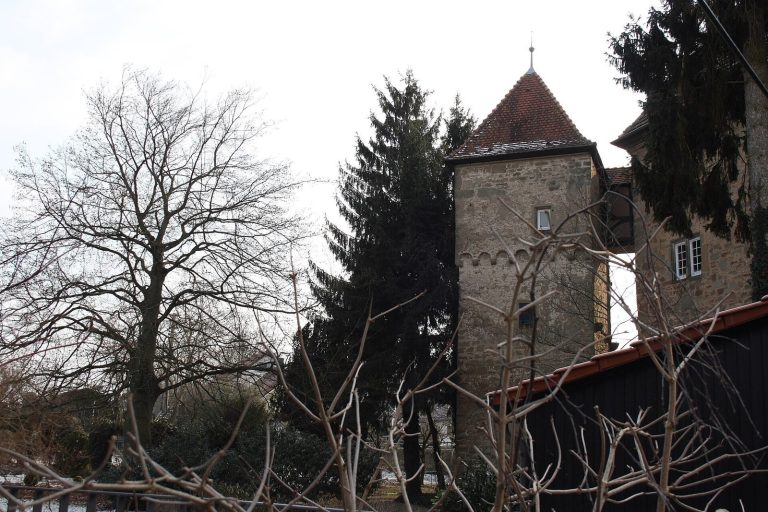
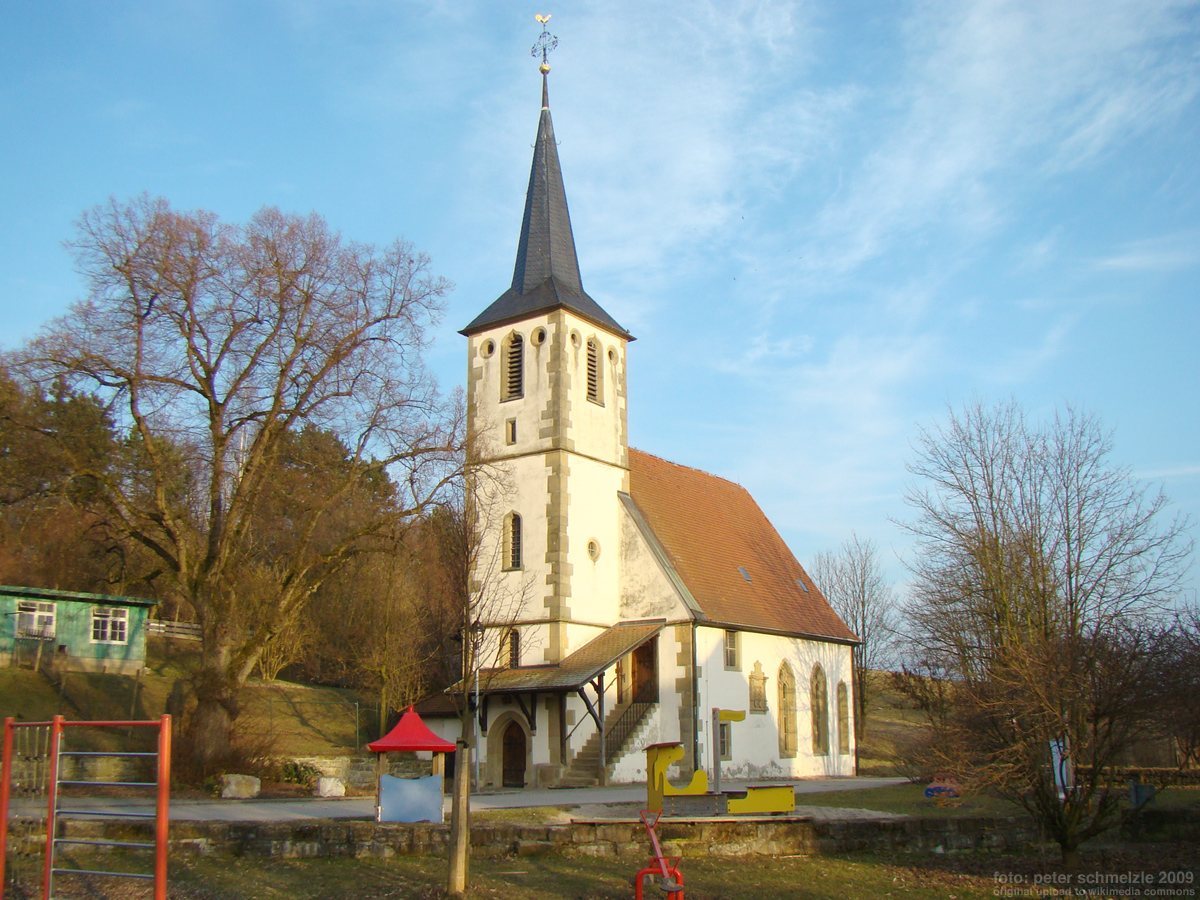
The surviving church consists of an approximately 13-by-9-metre nave, a chancel ending in several angled sides, and a tower at the front. A staircase on the tower’s south side rises beneath a wooden porch to the gallery. The building retains heraldic sculpture, grave monuments, a 1911 organ, a three-bell peal, and a precision tower clock.
Building and memorial features
Nave, tower, and heraldry
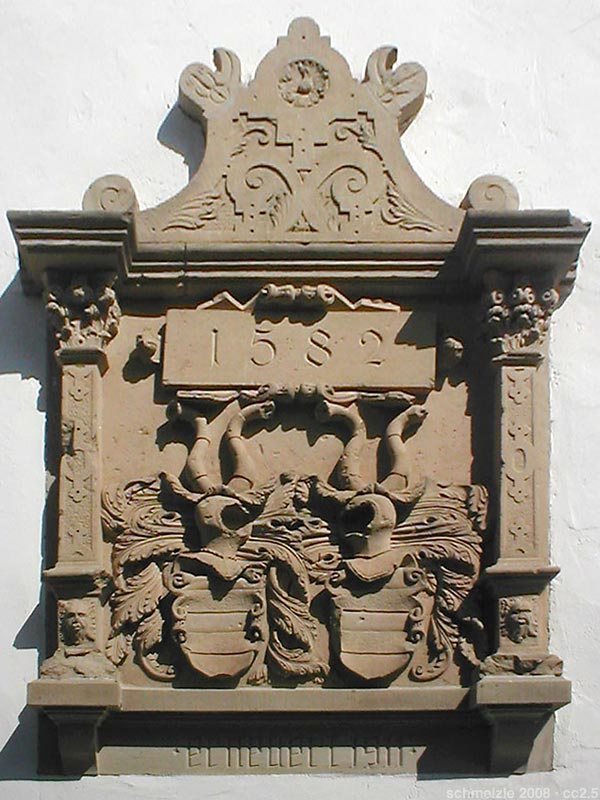
The nave forms the main rectangular body of the church, while the polygonal chancel termination gives the eastern end a faceted shape. The tower stands at the front of the building. On its south side, the gallery staircase is sheltered by a wooden porch. The southern exterior displays the combined coat of arms of Reinhard von Gemmingen and Helene von Massenbach, dated 1582. The same alliance arms, joining the heraldic emblems of two families, appear above the chancel arch inside the church.
Grave slabs
Six historical grave slabs survive inside the church. They commemorate Reinhard von Gemmingen, the builder of the church, who lived from 1532 to 1598; his wife Helene von Massenbach, who lived from 1534 to 1601; and their son Hans Wilhelm von Gemmingen, who lived from 1573 to 1615. The group also includes Hans Wilhelm’s wife, Martha Zuckmantelin von Brumat, who died in 1611; Hans Reinhard von Gemmingen, the three-year-old son of the scholar Reinhard von Gemmingen, who died in 1625; and Barbara Fussenegger, a pastor’s wife who died in 1681.
Organ, bells, and clock
Organ
A. M. Schaefer of Creglingen made the present organ in 1911. It was Schaefer’s first numbered work, produced after earlier experience limited to building harmoniums, and replaced an instrument from the second half of the eighteenth century. Thirty-five tin pipes from its visible organ facade were requisitioned during the First World War. Philipp Ziegler, an organ builder from Steinfurt, replaced them in 1922.
Bells
The church’s bells preserve several stages of its history. The oldest bell associated with Treschklingen was a small bell weighing 11 pounds. In 1709 it was accepted as payment when Johann Georg Rohr of Heilbronn cast a bronze bell weighing more than four hundredweight. Johann Daniel Rohr, Johann Georg’s son, supplied the Baptism or Lord’s Prayer Bell in 1725. It has a diameter of 60 centimetres, weighs 120 kilograms, and has the strike note e”, the musical pitch of its principal tone. Its inscription reads, “IN GOTTES NAMEN GOS MICH JOHANN DANIEL ROHR 1725 IN HEILBRONN. TRESCHKLINGEN SOLI DEO GLORIA.”
The older Rohr bell cracked in 1847 and was recast by Bachert in Dallau before being surrendered for armaments production in 1917. In 1922, two bells were cast by the Bachert foundry in Kochendorf. The 360-kilogram Memorial Bell, dedicated to Georg Stier, who had died in 1914, had the strike note a’. The 220-kilogram Peace Bell had the strike note c”. Both were surrendered during the Second World War in 1942. The small bell cast in 1725 survived both world wars.
After the Second World War, the congregation rebuilt a three-bell peal in stages. A used bell cast in 1932 was acquired from Friedrich Wilhelm Schilling in Heidelberg. Before the war it had been in the Friedenskirche in Charlottenburg. Known as the Evening, Prayer, and Death Bell, it has the strike note h’, a diameter of 75.5 centimetres, a weight of 237 kilograms, and the inscription “Danket dem Herrn, denn er ist freundlich. Psalm 106.1 1932.” Schilling cast the final bell in Heidelberg in 1953. The Eleven O’Clock Bell has the strike note d”, a diameter of 68 centimetres, a weight of 180 kilograms, and the inscription “Er ist unser Friede.” The peal has been electrically controlled since 1970.
Tower clock
The precision tower clock was made by Walz and Hielscher in Pfullingen in 1970. It replaced a clock made by Valentin Stoß of Ulm in 1837. That earlier mechanism had itself replaced an older clock last repaired in 1784.