Church of Saint Nicholas (Jince): A Baroque Parish Church in Czechia
Site at a Glance
- Rating
- 4.3
- Popularity
- Very Low
- Country
- Czechia
- Primary era
- Early Modern
- Eras represented
- Early Modern, Modern
- Civilizations
- Austria-Hungary, Habsburg, Holy Roman Empire
- Site type
- Religious
- Remains
- Church
On this page14 sections
History
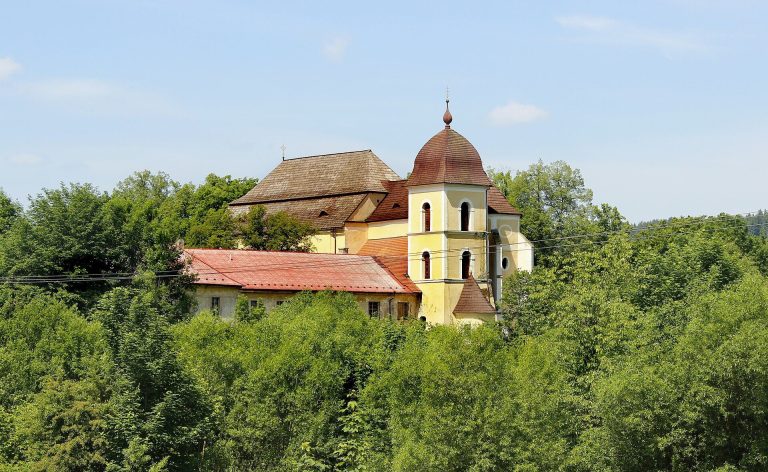
The Church of Saint Nicholas is a Baroque parish church in Jince, Czechia, built between 1728 and 1731 under Count František Karel Vratislav of Mitrovice. It replaced an earlier wooden church and was consecrated in 1731. The building became part of the religious and communal life of Jince, where successive estate owners generally lived elsewhere and took little direct part in the settlement’s local affairs.
Medieval Church and Estate Ownership
The first written evidence of a church at Jince dates from 1352, the same year as the earliest surviving written reference to the settlement. This medieval church was wooden. From the fifteenth century onward, Jince passed through the hands of several owners. They usually held the settlement without residing at its local fortified manor, leaving the church as an important continuing institution in the community.
The Vratislav Building Campaign
The Jince estate came to a branch of the Bohemian Vratislav family of Mitrovice in 1647. Count František Karel Vratislav of Mitrovice inherited it in 1727 and made Jince his permanent residence the following year. He then initiated construction of the present church, whose design was a simplified and altered version of rural church forms associated with the Bohemian architect František Ignác Prée during the 1730s. Work continued until 1731, when the new church was consecrated.
Ironworking and the Parish in the Nineteenth Century
In 1806, Count Rudolf Jan Bruntálský of Vrbno purchased the Jince estate from the Vratislavs. He also held the hereditary estate at Hořovice and specialized in ironworking technology. During his lifetime, the Komárov ironworks became a leading European producer of cast iron for artistic and industrial purposes. Jince was placed under the operation of the ironworks, and the Barbora blast furnace was established there. As the settlement became a less important residential estate, parish development slowed.
Between 1807 and 1809, the Count of Vrbno ordered a new two-storey rectory and masonry farm buildings on parish land. Further substantial renovations took place in 1818 and 1841. Parish development later improved after the estate was sold to Elector Frederick William of Hesse-Kassel, a German elector and member of the Hesse-Kassel ruling house.
Later Changes and Parish Use
In 1877, Maurice, Prince of Hanau, converted the local castle into a brewery and abolished its chapel. The Saint Joseph altar in the church later received a new painting by Josef Jelínek in 1939, using an image that had originally come from the castle chapel. In 1885, William of Hanau commissioned the restoration of all the church’s altar paintings in Vienna.
The First World War brought the requisition of all three Baroque bells for military purposes. Three replacement bells, named Maria, Wenceslas, and Nicholas, were hung in the tower on 22 October 1922. After the Second World War, only one of the original bells was returned. The church remains the parish church of the Roman Catholic Parish of Jince within the Prague Diocese, the Czech ecclesiastical province, and the Příbram Vicariate, and regular religious services continue there. The church, mortuary, enclosure wall with its gates, and adjoining land have been protected as a cultural monument since 1965.
Remains
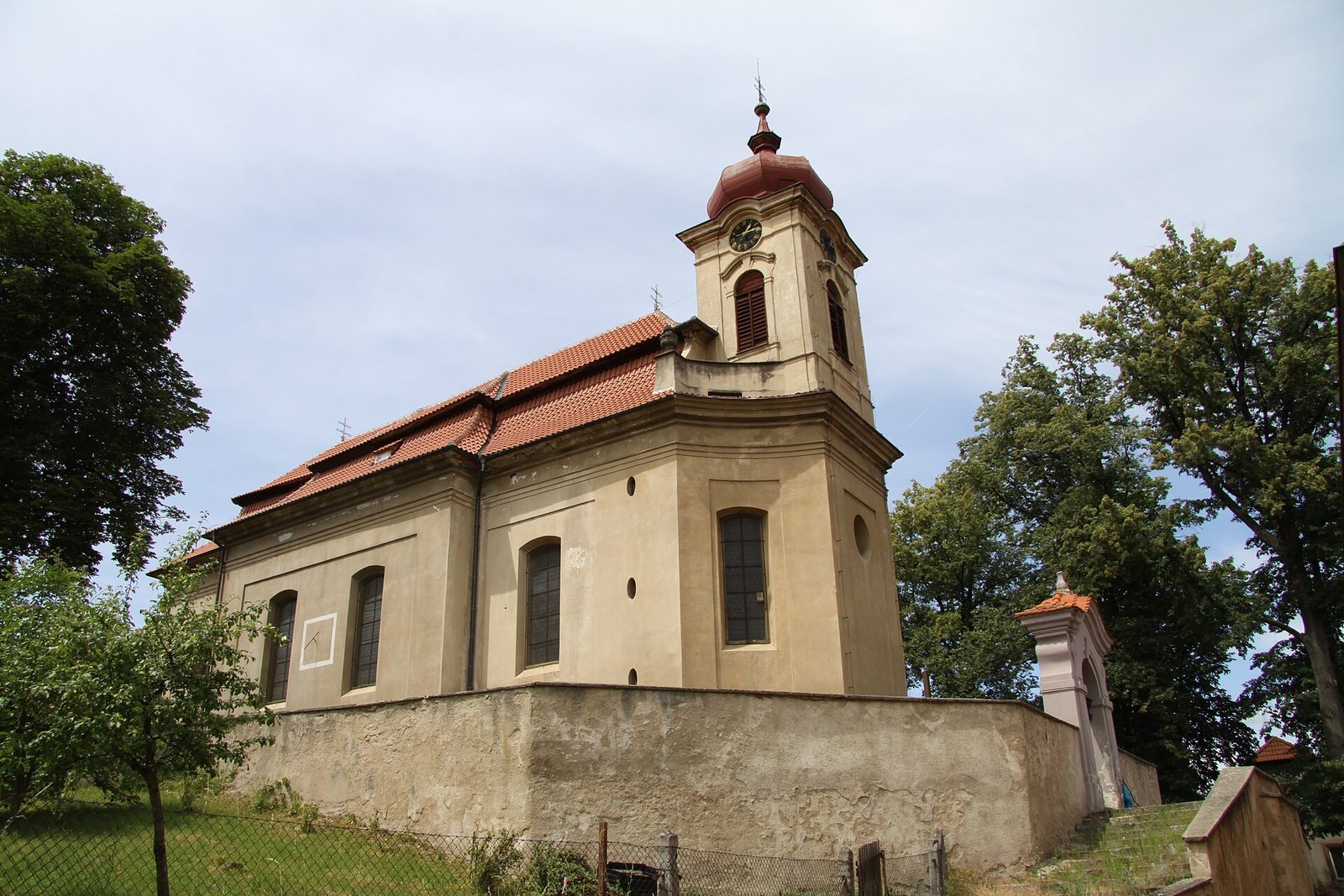
The church complex occupies a low rise in central Jince, west of the Zdice to Příbram main road. A former cemetery wall with gates encloses the complex, while the gently rising, grass-covered area is largely taken up by the church. The present building is a single-nave rectangular structure with a pronounced presbytery, the area around the main altar, an adjoining sacristy for vestments and liturgical preparation, and an oratory above the sacristy along the north wall. A mansard roof, whose lower slopes are steeper than the upper ones, is covered with traditional pantiles.
Church Exterior and Tower
The square tower rises above the end of the choir and forms the most vertical element of the building. Its exterior has corner pilasters, cornices with segmentally curved profiles, and decorative vases on the side sections of the attic. Elsewhere, the walls are arranged with flat pilaster frames and large rectangular windows topped by segmental arches. A more elaborate crowning cornice gives emphasis to the upper line of the church.
Mortuary and Ossuary
Baroque Mortuary
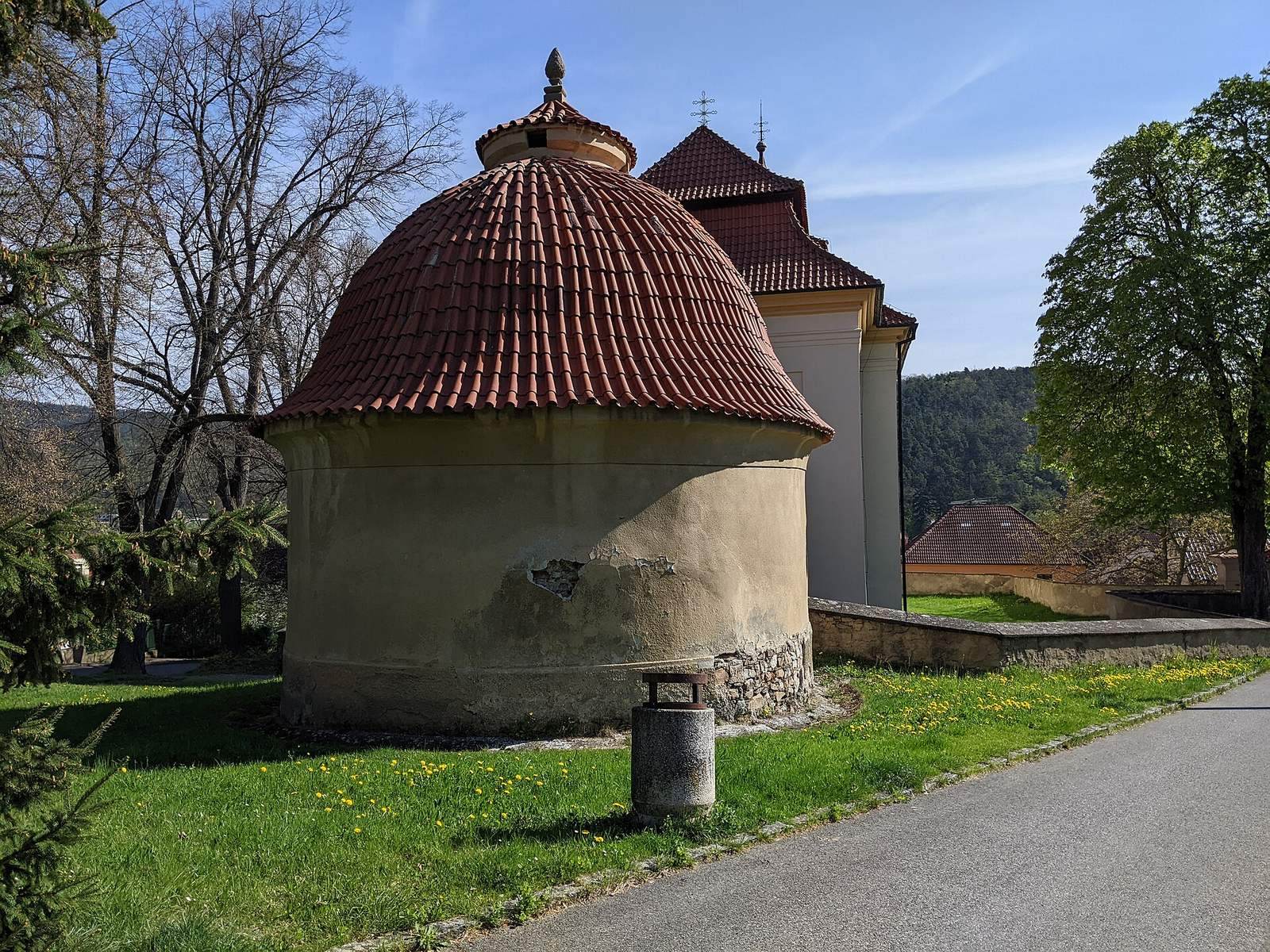
A wooden covered passage links the church facade with the neighboring Baroque mortuary, a circular building that forms part of the enclosed complex.
Ossuary and Statue
A circular former ossuary, a structure associated with the storage or commemoration of human bones, is incorporated into the church’s west facade. To its west stands a cast-iron statue of Saint John of Nepomuk, produced in 1901 at the Komárov ironworks.
Interior Furnishings
Altars and Sacred Objects
A small Gothic aumbry, a wall cupboard for sacred objects, is built into the sacristy wall. The main altar and pulpit are Baroque works dating from after 1720. Along the north side of the nave are the Baroque altar of Saint Joseph, with Josef Jelínek’s 1939 image, and a Baroque altar dedicated to Saint Wenceslas. The same wall also contains a Rococo painting of the Holy Family, made in the lighter decorative style that developed during the eighteenth century.
South Nave Altars
The south side of the nave contains the Baroque Holy Cross altar, which incorporates a sculptural group of the Crucifixion, and the altar of Saint John of Nepomuk. Both belong to the period in which the present church was founded.
Organ and Epitaph
The original Baroque organ was installed under the patronage of the Vratislavs of Mitrovice. It was replaced in 1896 by an instrument purchased from the Prague organ builder Emanuel Štěpán Petr. The church also preserves an epitaph beside the confessional commemorating the burial of the remains of the knight Hendrych Tejřovský of Einsiedl, who died at Jince in 1556. He was the son of Jošt of Einsiedl, secretary to King George of Poděbrady.
The church’s organist Antonín Slavík was a teacher as well as a musician. His son Josef Slavík became a noted violin virtuoso, giving the parish’s musical history a connection to a prominent nineteenth-century performer.