Palazzo Pretorio: Prato’s Medieval Town Hall and Civic Museum


Site at a Glance
- Rating
- 4.2
- Popularity
- Very Low
- Country
- Italy
- Primary era
- Medieval
- External website
- Open
- Eras represented
- Medieval, Early Modern
- Civilizations
- Unclassified
- Site type
- Civic
- Remains
- Town Hall
On this page16 sections
History
Palazzo Pretorio is a former town hall in Prato, Italy, founded in the twelfth century and assembled into its present form during the late thirteenth and early fourteenth centuries. Built for the city’s medieval civic institutions, it stood opposite the current Palazzo Comunale in Piazza del Comune and accommodated government, justice, the local prison, and the officials who administered them.
Medieval civic government
The palace was formed by joining three separate buildings. Its oldest component was a thirteenth-century tower-house owned by the Pipini family. In 1284, the municipality purchased it from Fresco dei Frescobaldi, who served as capitano del popolo, a municipal official representing the urban populace. The building was then used by the city government and later became the residence of the podestà, the chief magistrate responsible for civic administration and justice.
The complex also served the judiciary and included a prison. Its changing functions reflected the concentration of municipal authority in one urban building. It later housed the capitano del popolo as well, extending its role as a center for both civic administration and the representation of the town’s inhabitants.
Political memory and later alterations
Until at least 1799, a fourteenth-century statue of Robert of Anjou stood in a tabernacle, a small architectural shrine, on the facade. Robert was an Angevin ruler of the Kingdom of Naples who had once been honored as a protector of Prato. His sale of the city to Florence ended Prato’s independence, giving the statue a political meaning connected with the loss of local autonomy.
Part of the palace, including its bell tower, collapsed during the sixteenth century. Restoration after the collapse added a new bell tower and crowning crenellations, the alternating raised blocks and openings of a battlement. As the responsibilities of local government increased, the interiors were divided into many smaller rooms to accommodate its expanding administrative work.
In 1788, Grand Duke Peter Leopold of Lorraine expressed the intention to establish in Prato a “school of taste for future artists.” The initiative eventually led to the creation of an initial art collection in 1858. It was first installed in the neighboring Palazzo Comunale before moving into Palazzo Pretorio.
Earthquake, restoration, and museum use
An earthquake in the Bisenzio Valley damaged the palace on 26 June 1899. The shock reached intensity VII in Prato on the Mercalli scale, which measures an earthquake through its observed effects on people, buildings, and the landscape rather than through instrumental magnitude.
During the late nineteenth century, demolition of the building was proposed. The proposal was abandoned in 1909, when the decision was made to restore Palazzo Pretorio and return its rooms toward their earlier arrangement. Since 1912, the palace has housed the Museo di Palazzo Pretorio, also known as the Civic Museum of Prato. The building closed for restoration in March 1998 and remains owned by the Municipality of Prato and in use as a museum.
Remains
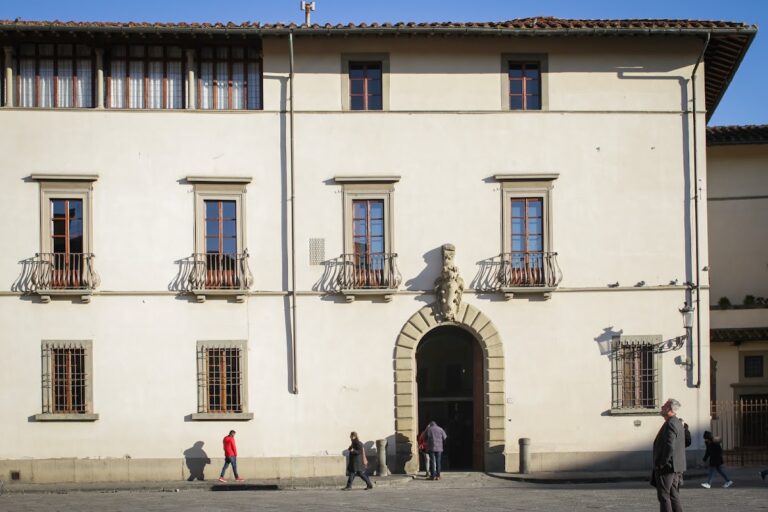
Palazzo Pretorio retains the compound character created by the joining of three earlier buildings. Differences in construction materials remain visible across the facade and reveal the outlines of the original structures. The surviving complex combines a medieval tower-house, a fourteenth-century facade, later bell structures, an external staircase, and rooms containing wall paintings and the museum collection.
Facade and civic interiors
The medieval tower-house
The oldest section stands on the right side of the building. This thirteenth-century tower-house retains a ground-floor portico supported by limestone pilasters. The portico was later blocked up, but the pilasters remain visible and preserve evidence of the earlier building’s form.
The fourteenth-century facade
The left side of the facade dates from the fourteenth century. It contains eight mullioned windows, each divided into separate lights by slender stone members, together with a tabernacle intended to hold a religious image or statue. A wide external staircase rises to the principal floor and forms the approach to the palace’s main rooms.
Bell structures and painted rooms
The sixteenth-century rebuilding produced the bell tower and a small bell gable, a wall-mounted structure with an opening for a bell. Crowning crenellations were added as part of the same restoration. The ground-floor portal opens into a series of rooms with original frescoes, wall paintings applied to wet plaster. The earliest date to 1307 and are attributed to Bettino Corsino. Later frescoes, from 1425, are attributed to Pietro di Miniato and Antonio di Miniato.
Medieval and Renaissance paintings
Works associated with the Lippi circle
The museum’s collection includes several works by Filippo Lippi. Madonna del Ceppo, from 1452–1453, is a tempera painting on panel measuring 187 by 120 centimeters. His Madonna of the Girdle, dated 1456–1460, is also tempera on panel and measures 207 by 200 centimeters. The collection further contains Adoration of the Child with Saint Vincent Ferrer, made about 1455–1466 in tempera on panel, and Annunciation with Saint Giuliano, made about 1455 in tempera on panel and attributed to Filippo Lippi and Fra Diamante. The latter measures 75 by 48 centimeters.
Filippino Lippi is represented by the Crucifixion, made about 1501 in tempera on panel and measuring 31.2 by 23.4 centimeters; Madonna and Child with Saints Stephen and John the Baptist, dated 1502–1503 and measuring 132 by 118 centimeters; and the fresco Madonna and Child with Saints Stephen, Catherine, Anthony Abbot, and Margaret, dated 1498 and measuring 239 by 141 by 71 centimeters. His Audience Altarpiece, from about 1502, is executed in oil on wood, while the Small Crucifixion dates from 1500–1504.
Other works connected with this period include Nativity with Saints George and Vincent Ferrer, a tempera painting on panel attributed to Filippo Lippi’s workshop, and Raffaellino del Garbo’s Madonna and Child with the Young Saint John the Baptist, a tempera painting on panel measuring 113.5 centimeters in diameter. The collection also includes a second listing of Madonna of the Girdle by Filippo Lippi and Fra Diamante, executed in tempera on panel and measuring 207 by 200 centimeters.
Fourteenth- and fifteenth-century altarpieces
Paolo Uccello’s Blessed Jacopone da Todi is a fresco from about 1435 measuring 181 by 59 centimeters. Francesco Botticini’s Enthroned Madonna with Child among Saints Jerome, Francis, Anthony of Padua, and Ludwig of Toulouse dates to about 1483. It is a gilded tempera painting on wood measuring 157 by 133 centimeters.
Lorenzo Monaco’s Polyptych of Saint Bartholomew, a multi-panel painted altarpiece, dates to about 1413 and is executed in tempera on gilded wood. A polyptych from his workshop, Enthroned Madonna and Child with Two Praying Angels among Saints Catherine of Alexandria, Benedict, John Gualbert, and Agatha, has a central panel measuring 111 by 69 centimeters and lateral panels measuring 139 by 63 centimeters each.
Pietro di Miniato’s Coronation of the Virgin with Saints Matthew and Matthias is dated to 1413 and painted in tempera on panel. Its central section measures 139 by 66.5 centimeters, while its upper predella, the row of smaller panels below an altarpiece, measures 35 by 118 centimeters and its lower predella measures 28 by 201 centimeters.
Scenes of the Holy Girdle
Bernardo Daddi’s collection works include Madonna and Child between Saints Francis, Bartholomew, Barnabas, and Catherine, dated 1332–1335, and Stories of the Holy Girdle, dated 1337–1338. Both are executed in tempera on panel. Giovanni da Milano is represented by Madonna and Child between Saints Catherine of Alexandria, Bernard, Bartholomew, and Barnabas, a tempera painting on panel measuring 245 by 210 centimeters, and by Stories of the Holy Girdle, whose individual tempera-on-panel scenes measure 26.5 by 22.3 centimeters.
Andrea di Giusto Manzini’s Madonna and Child with Two Angels is another tempera-on-panel work in the collection, measuring 237 by 250 centimeters. Together, these paintings present a sequence of medieval and early Renaissance devotional works in which panel painting, gilding, and narrative scenes form a major part of the museum’s holdings.
Sculpture and later paintings
Glazed terracotta and marble sculpture
The sculptural holdings include Andrea della Robbia’s Saint Anthony Abbot between Two Angels, made in glazed terracotta and measuring 103 by 186.5 centimeters. Benedetto Buglioni’s Madonna and Child, the Holy Spirit, and Two Cherubs is also in glazed terracotta and measures 82.5 by 55 centimeters.
Lorenzo Bartolini’s works include marble sculptures of Leopold II, Grand Duke of Tuscany, 59 centimeters high, and Napoleon Bonaparte, 30 centimeters high. The collection also contains his model for the funeral monument to Nicola Demidoff, made in alabaster and white marble and measuring 73.5 by 51 by 51 centimeters, together with the 93-centimeter-high plaster work Trust in God.
Paintings from the sixteenth to eighteenth centuries
The later paintings include Luca Signorelli’s Madonna and Child and Tintoretto’s Portrait of Doge Nicolò da Ponte, dated about 1580. G. D. Ferretti’s Annunciation, from 1726, is painted in oil on canvas, while G. B. Salvi, known as Sassoferrato, is represented by Praying Madonna, dated about 1700.
Other works include B. Caracciolo’s Noli me tangere, painted in oil on canvas between 1618 and 1620; Zanobi Poggini’s Saint Ursula and the Virgins, from about 1549; and Jan van Kessel’s Still Life with Vegetables, painted in oil on canvas in the 1660s. The museum’s works on canvas, wood, marble, alabaster, plaster, and glazed terracotta extend the collection from medieval religious art into the early modern and nineteenth-century periods.
Nearby sites