Castello dell’Imperatore: Medieval Swabian Fortress in Prato



Site at a Glance
- Rating
- 4.4
- Popularity
- Medium
- Country
- Italy
- Primary era
- Medieval
- External website
- Open
- Eras represented
- Medieval
- Civilizations
- Holy Roman Empire, Knights Hospitaller
- Site type
- Military
- Remains
- Castle
On this page10 sections
History
Castello dell’Imperatore is a medieval fortress in Prato, Italy, commissioned by Frederick II, Holy Roman Emperor and King of Sicily, in the Swabian, or Frederickian, architectural tradition between 1237 and 1247. Probably begun around 1240, it was intended as an imperial garrison and as a visible expression of Frederick’s authority in his northern possessions during the prolonged struggle between the Empire and the papacy for control of Tuscany.
Before Frederick II’s Fortress
The site already held an important settlement before the present castle was built. Documents from 1035 mention a palatium, or palace, which formed the nucleus of the Castrum Prati. This earlier settlement also included the parish church of Santa Maria in Castello, which no longer survives.
An Alberti family fortification occupied the site in the early twelfth century. Troops commanded by Matilda of Canossa, a powerful noblewoman who supported the papacy and controlled extensive territories in central and northern Italy, almost completely destroyed it during the siege of 1107. A replacement palace known as Palazzolo was later constructed to accommodate the envoys of the emperors Henry VI and Otto IV.
Imperial Construction and Florentine Control
Frederick II entrusted the new fortress to Riccardo da Lentini, a thirteenth-century architect and military engineer associated with imperial building projects. Construction continued during the period from 1237 to 1247 and probably started around 1240. Work was interrupted around 1250 after Frederick’s premature death, leaving the interior unfinished. The incomplete structure was subsequently adapted for various purposes.
During the fourteenth century, when Prato was under Florentine rule, the castle was linked to the city’s third circuit of walls by the Corridore del Cassero, a covered military passage. This protected connection enabled Florentine troops to enter the city from outside its walls. Houses were later built inside and around the fortress, changing the relationship between the castle and the surrounding urban fabric.
Demolition, War, and Restoration
During the 1930s, under the Fascist government, the dwellings within and around the castle were demolished. These clearances produced the configuration seen today, which is dominated by the surviving outer walls. The opening of Viale Piave also caused the demolition of most of the Cassero, leaving two sections of the passage.
The castle acquired a grim place in Prato’s wartime history. In 1944, Fascist forces imprisoned hundreds of people from Prato there after their arrests during the March strike. Between 6 and 7 September, following the partisan occupation of the city, Fascists and people accused of being Fascists were taken to the castle during a citywide roundup and shot. This event is remembered as the massacre of Castello dell’Imperatore.
Restoration during the 1970s led to the castle’s opening to the public. Further reconstruction work began later and remains ongoing, continuing the effort to preserve and interpret the surviving fortress.
Remains
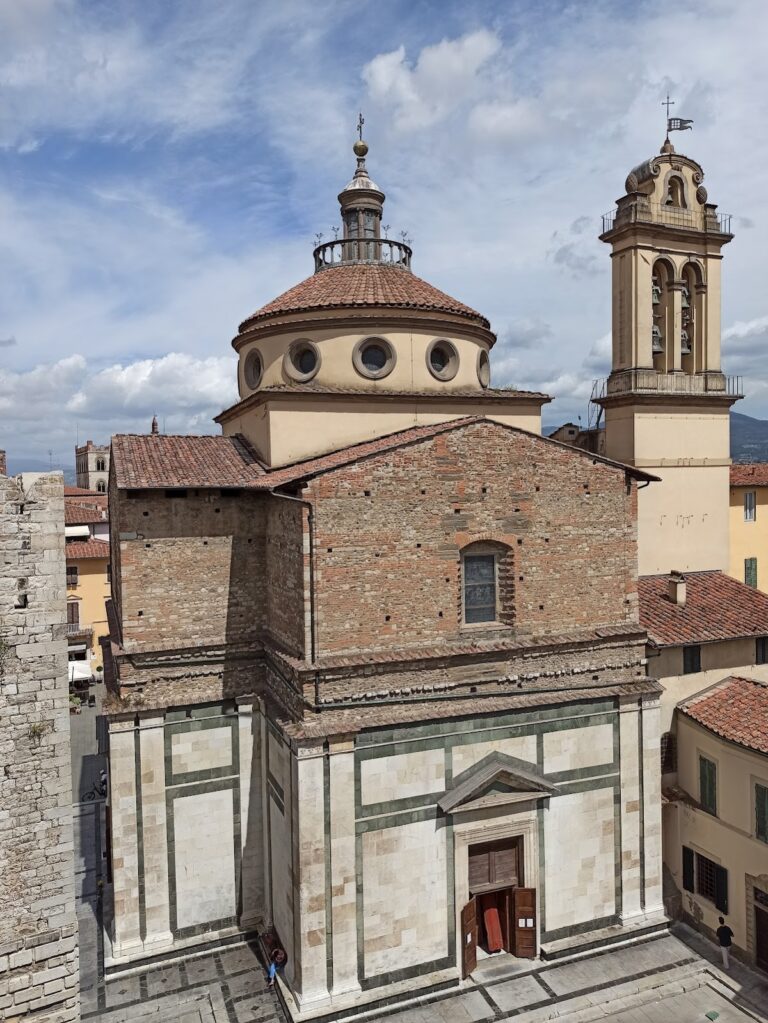
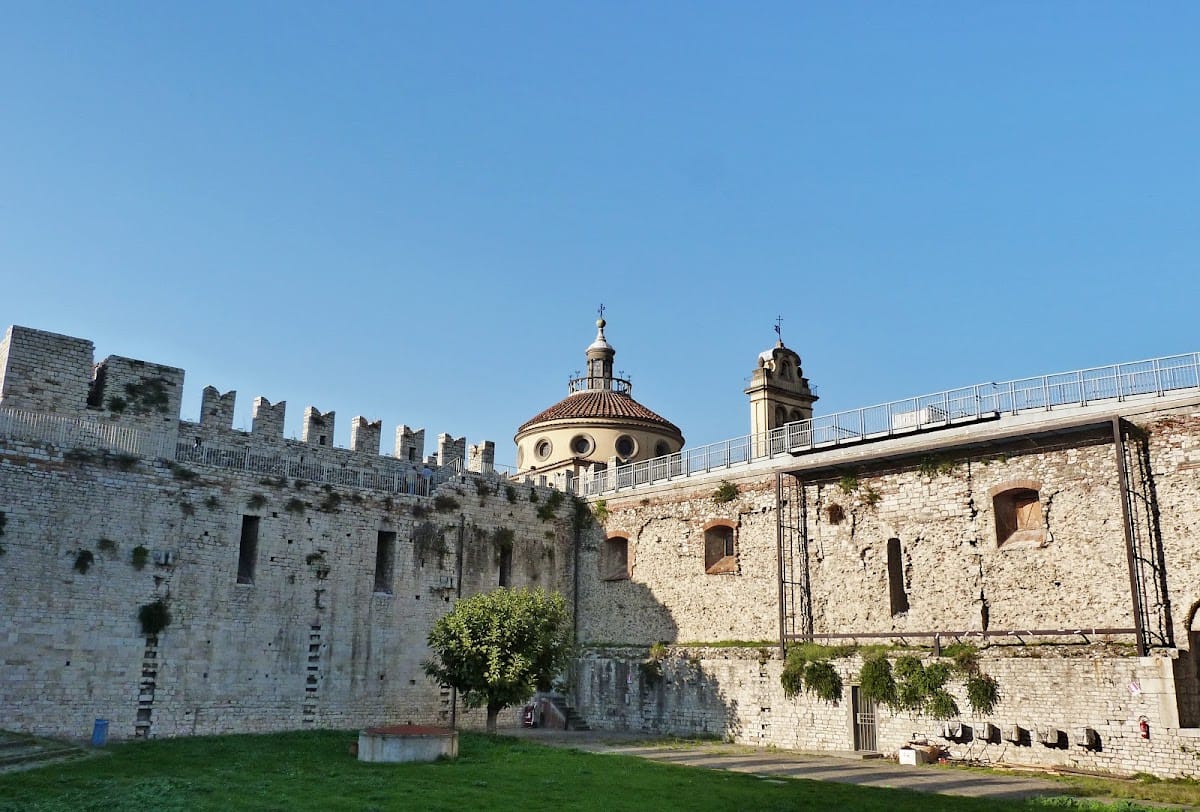
Castello dell’Imperatore stands in Piazza delle Carceri beside the church and sanctuary of Santa Maria delle Carceri. The fortress was originally tangent to Prato’s twelfth-century second circuit of walls and was partly enclosed by a moat. Built from local stone, it has crenellated perimeter walls and eight towers. The design of its structure and portal includes symbolic elements comparable to those associated with Castel del Monte.
Fortress Walls and Towers
Perimeter Walls
The surviving complex is largely defined by its external walls, since the interior was never completed and the houses that had occupied the castle and its immediate surroundings were demolished in the twentieth century. The crenellated circuit and its towers retain the basic defensive form of the imperial fortress. Ancient spiral staircases within the corner towers lead to the wall-walk.
Palazzolo Towers
Two towers incorporated from the earlier Palazzolo complex remain within the fortress. Unlike the perimeter towers, they lack crenellations. Until 1767 to 1768, they stood at approximately twice their present height, after which their surviving form was reduced.
Cassero Passage
Two sections of the former Corridore del Cassero survive beside the castle. The covered passage once connected the fortress with Prato’s fortifications, providing a protected route for military movement. Most of it disappeared when Viale Piave was opened in the 1930s.
Hospital and Church Behind the Castle
Behind the fortress are the remains of a hospital and its associated church of San Giovanni Gerosolimitano, also known as the church of the Knights of Malta. Built outside the walls, or extra moenia, in the mid-twelfth century, the now-disused complex preserves small anthropomorphic terracotta elements from the Romanesque period. These rare surviving features form part of the archaeological and architectural remains connected with the castle’s setting.