Palazzo Pallavicino: A Gothic Palace and Historic Theater in Italy


Site at a Glance
- Rating
- 4.5
- Popularity
- Very Low
- Country
- Italy
- Primary era
- Early Modern
- Eras represented
- Medieval, Early Modern, Modern
- Civilizations
- Unclassified
- Site type
- Civic
- Remains
- Palace
On this page7 sections
History
Palazzo Pallavicino, also known as Palazzo Vecchio, is a Gothic palace in Zibello, Italy, in the municipality of Polesine Zibello. Its construction began in the second half of the fifteenth century under Gianfrancesco I Pallavicino, the first hereditary ruler of the Zibello marquisate, and continued into the early sixteenth century. The palace served the administration of the small state and later became the setting for the Teatro Pallavicino.
The Pallavicino marquisate
The smaller northeastern section was built during the second half of the fifteenth century. Gianfrancesco I Pallavicino established it as the residence of the podesta, a civic official responsible for governmental and judicial administration. Several years later, in the early sixteenth century, the southwestern section was added during the regency of Clarice Malaspina, widow of Federico Pallavicino, the second marquis of Zibello. Although joined to the earlier structure, this extension introduced more Renaissance-style features.
The Teatro Pallavicino
In the final years of the eighteenth century, Antonio Francesco Pallavicino, the last lord of Zibello, commissioned a theater within the palace. The Teatro Pallavicino was completed and opened in 1804. Its first arrangement included a stage and an auditorium with about twenty benches, whose places were assigned according to rank among the marquis, the clergy, Dominican friars, actors’ families, and the general public. The Dominican friars belonged to the Order of Preachers, a Catholic religious order founded in the thirteenth century.
Lorenzo Boni directed a major restoration in 1827. Twelve theater boxes were installed, including a central box for the Pallavicino marquises, while Pietro Piazza and Giovanni Azzi decorated the auditorium. Azzi also produced the curtain that survives today. A second level of boxes was added in 1872. In 1905, the Municipality of Zibello purchased the theater and atrium from Countess Simonetta Pallavicino.
Further restoration began in 1910 according to a design by Lino Bocchi. The work, which ended in 1913, added a wooden upper gallery, altered and enlarged the entrance under Virginio Michiara, installed an electrical system, and replaced the seating without changing the auditorium’s original arrangement. The theater reopened on 12 June 1914 with a performance of Lucia di Lammermoor.
The theater became a cinema in 1930, although comedies, tragedies, concerts, and lyric opera continued there until 1955. The cinema closed in 1963, after which the premises deteriorated. In 1978, the municipality intervened to prevent the theater’s collapse. Restoration proceeded in stages, addressing the roof, corridor, boxes, and seating area while reconstructing the technical systems. The work was completed in 2003, and the theater subsequently hosted occasional performances and concerts.
Recent conservation and continuing uses
In the early twenty-first century, the palace’s oldest section underwent restoration, including scientific conservation and consolidation of its facade. Several badly deteriorated rooms on the ground floor were recovered, and earlier decorative traces were rediscovered. Architect Marco Pellegri directed the work, which was financed by Fondazione Cariparma.
The ground-floor rooms opening onto the long portico have contained shops for centuries and continue to house commercial premises, including a restaurant. The upper floors have long accommodated the headquarters of various associations, while the building continues to contain the Teatro Pallavicino.
Remains
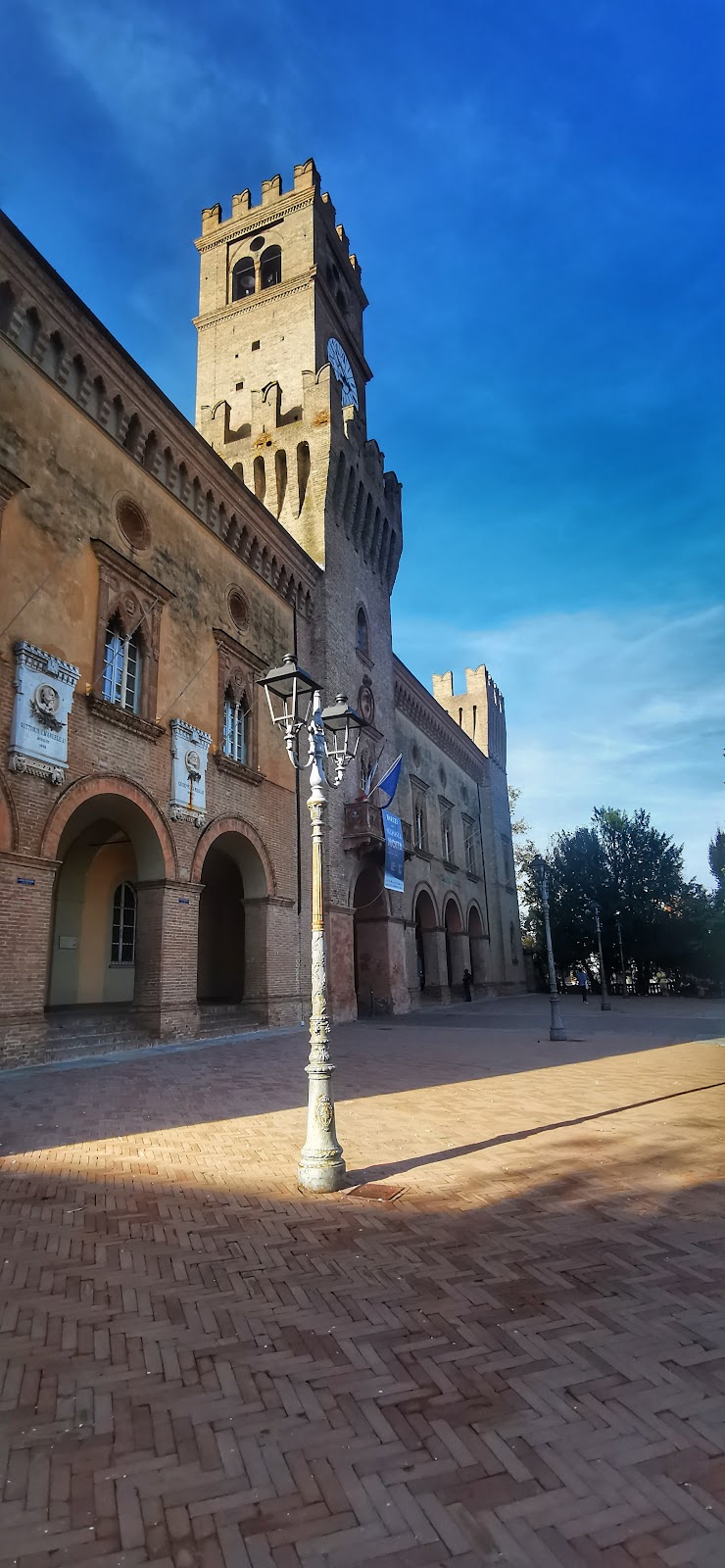
Palazzo Pallavicino occupies the entire southeastern side of Piazza Guareschi, at the corner with Piazza Garibaldi, and includes a small courtyard at the rear. Its long facade is divided into two sections that correspond to the palace’s two construction phases. Both sections rise above a portico with pointed arches, but their materials, proportions, and ornament distinguish the older northeastern wing from the later southwestern addition.
Facade and portico
The northeastern wing is smaller and occupies the first two bays of the portico. Its broad pointed arches are built in red brick, and a projecting reinforced corner protects the building at ground level. Above a terracotta string course, the plastered upper story has windows set within pointed arches. Their richly ornamented terracotta frames were produced by the workshop of Rinaldo de Stavoli in a floral Gothic style, a late Gothic manner known for elaborate plant-like decoration.
The southwestern wing presents a more classical appearance. Its facade is entirely faced with red brick and rests on a portico whose pointed arches are considerably narrower than those of the older section. The upper-story windows are spaced more widely and framed by simpler pointed brick arches. In both wings, octagonal red-brick pillars support the portico and end in chamfered, cube-shaped capitals. Numerous graffiti carved into these capitals commemorate major events that affected the village over the centuries.
Teatro Pallavicino
The Teatro Pallavicino occupies the upper floor of the palace’s southwestern section. Its original plan combined a stage with an auditorium of approximately twenty benches arranged according to social rank. The 1827 remodeling inserted twelve elevated boxes and brought new decoration to the auditorium. A second box tier followed in 1872, and a wooden upper gallery was added during the restoration of the early twentieth century. The auditorium’s overall original layout was retained through these changes.
The theater’s surviving furnishings and decoration include the curtain made by Giovanni Azzi. Restored parts of the complex include the roof, corridor, boxes, seating area, and technical systems, preserving the physical evidence of its transformation from an early nineteenth-century theater through its later theatrical and cinematic uses.
Nearby sites