San Bartolomeo: A Gothic Collegiate Church in Busseto, Italy


Site at a Glance
- Rating
- 4.4
- Popularity
- Very Low
- Country
- Italy
- Primary era
- Medieval
- External website
- Open
- Eras represented
- Medieval, Early Modern, Modern
- Civilizations
- Holy Roman Empire, Italian
- Site type
- Religious
- Remains
- Church
On this page17 sections
History
San Bartolomeo is a Roman Catholic parish church in Busseto, Italy, dedicated to Saint Bartholomew the Apostle. Standing at the northeastern corner of Piazza Giuseppe Verdi, it is part of the Diocese of Fidenza and the Bassa Parmense vicariate. The present building is a monumental Gothic church begun in 1437 and completed around 1440.
Medieval Foundation
A small medieval church dedicated to Saint Nicholas occupied the site before Busseto became the capital of the Pallavicino state, a territorial lordship ruled by the Pallavicino family in northern Italy. Marquis Oberto III Pallavicino commissioned a larger church dedicated to Saint Bartholomew. The building was completed and solemnly consecrated in 1340.
In 1432, Marquis Rolando the Magnificent sought to secure prepositural status for the church. This status placed its governance under a provost and prepared the way for a more powerful collegiate institution. A papal bull issued by Pope Eugene IV in 1436 elevated San Bartolomeo to a collegiate church, meaning that it was served by a chapter of clergy and held jurisdiction over numerous surrounding places of worship.
The Gothic Rebuilding
Rolando’s initiative led to the construction of the present church in 1437. It was approximately twice the size of its predecessor and was completed about three years later. The rebuilding gave Busseto a large Gothic church suited to its position within the Pallavicino state and to the elevated ecclesiastical status granted the previous year.
After the Diocese of Fidenza was created in 1601, the collegiate church remained the seat of a vicariate and retained precedence over some nearby churches. It nevertheless lost many of the jurisdictional rights that it had acquired earlier.
Later Alterations and Commemorations
The interior was extensively remodelled in the Rococo style around the middle of the eighteenth century. Fortunato Rusca and Carlo Bossi carried out elaborate stucco work in 1753 and 1754. In 1876, an attempt to lower the floor level and lengthen the pillars was halted when the work threatened the stability of the building.
A marble plaque dated 1584 on the right-hand buttress commemorates a meeting held at Busseto in 1543 between Charles V of Habsburg, the Holy Roman Emperor whose reign shaped much of sixteenth-century European politics, and Pope Paul III, who led the Catholic Church from 1534 to 1549.
The chapel dedicated today to the victims of the First World War preserves a memorial created after the conflict. Its earlier dedication was to Saint Anthony of Padua and Saint Bernardino of Siena. The church’s campanile received five bells in 1955. Cast by the Regolo Capanni foundry in Fidenza, they are tuned to the scale of C major.
Collections and the Organ
The church treasury contains liturgical vestments, silverware, illuminated books, and other precious objects, including pieces transferred from other churches in Busseto. The sacristy holds the principal part of the collection. The organ also changed position over time. It was once installed in one of two galleries beside the presbytery, while the choir used the other. Both galleries were dismantled during the twentieth century. The organ was moved behind the altar and, after enlargement, was installed in a side chapel in 1979.
Remains
Exterior and Plan
San Bartolomeo has a three-aisled plan with ten side chapels, a western entrance, and an eastern presbytery. Its exterior retains a primarily Gothic character, while the interior combines the medieval structure with extensive Rococo remodelling and a smaller number of Renaissance elements.
Facade
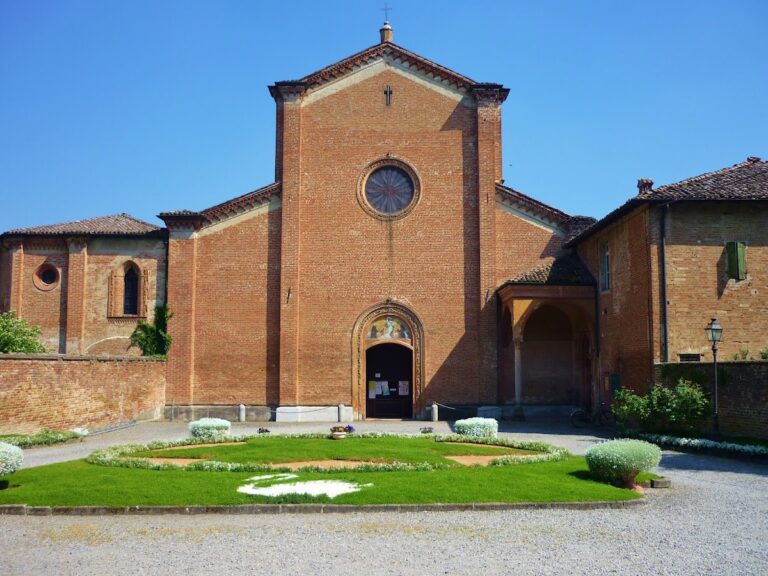
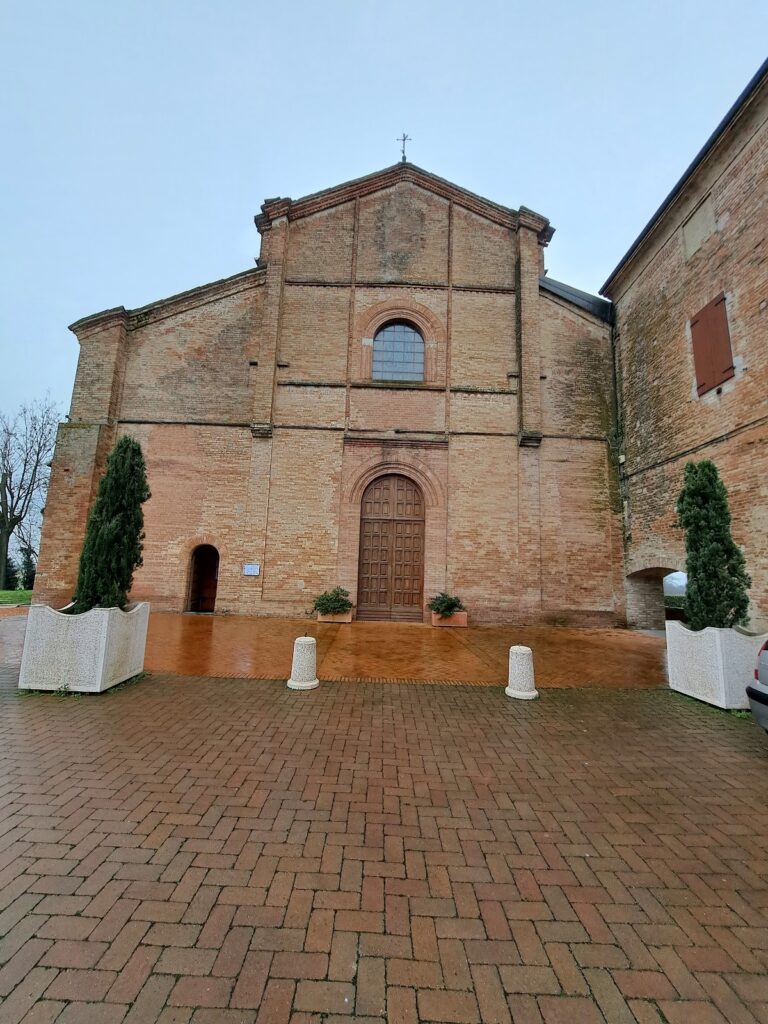
The brick gabled facade is divided into three sections by buttresses. A large segmental-arched central portal is framed by two bands of terracotta moulding, probably made by the workshop of Jacopo de Stavolis toward the end of the fifteenth century. The inner frame contains reliefs of putti, leaves, and vine tendrils and surrounds a round arch with traces of an old fresco of Saint Bartholomew. The outer frame consists of two tall fluted pilasters with small composite capitals supporting an elaborate entablature.
A large rose window, a circular window with radiating tracery, is set above the portal within terracotta moulded panels. Interlaced blind arches crown the facade, together with three tall pinnacles bearing elaborate terracotta reliefs. The cornice of interlaced arches continues along the side walls and the apsidal zone. Two secondary entrances open symmetrically beside the main doorway, each beneath a window.
Apse
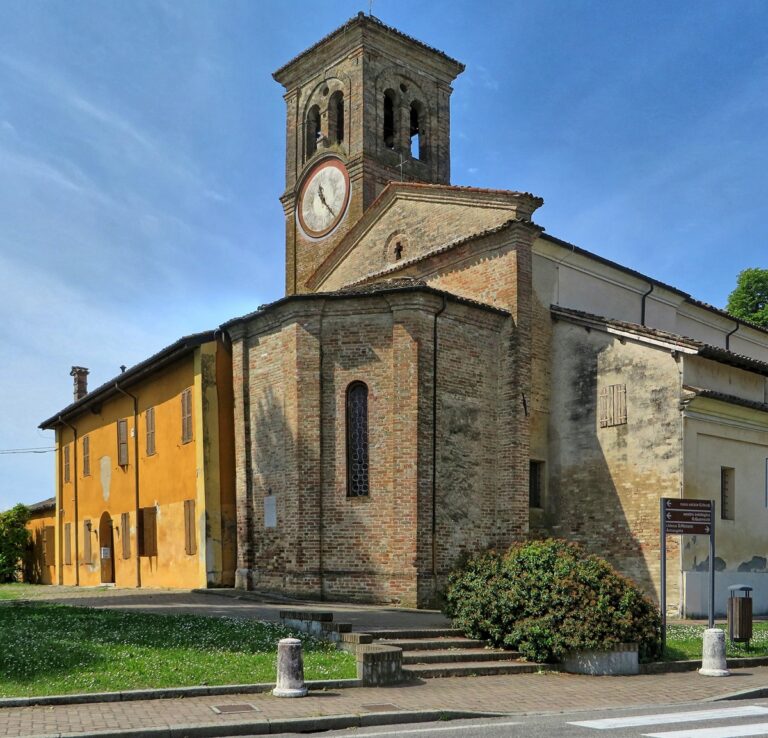
The polygonal apse is strengthened by buttresses. Its exterior includes a small central rose window and two tall lateral lancets, which are narrow pointed-arch windows. The terracotta frames of these openings form part of the decorative system that also surrounds the main rose window.
Nave, Presbytery, and Main Furnishings
Round arches decorated with stucco separate the three aisles, resting on massive clustered pillars. The same pillars carry pointed arches that divide the sail vaults of the central nave. Subdued colours and elaborate Rococo stucco cover the interior surfaces. Each pillar has a Rococo candle sconce cast around 1767, possibly by Antonio Pallavicini, while six confessionals made by Giacomo Rossi in 1795 stand in the side aisles.
Medieval Paintings and Eastern End
A fifteenth-century fresco of the Madonna and Child remains on the first pillar on the left. The corresponding pillar on the right preserves an older painting of Christ the Redeemer. The presbytery and apse retain largely intact fifteenth-century Gothic features, including groin and umbrella vaults with brick ribs.
Frescoes of the Passion of Christ cover the walls and ceilings of the presbytery and apse. Giuseppe Moroni painted them in 1942 and also designed the stained glass for the small apsidal rose window and the two lancets. The apse wall contains a painting of Saint Bartholomew by Francesco Boccaccini.
Choir and High Altar
The choir stalls were enlarged in the seventeenth century and carved in the Neoclassical style by Francesco Galli around 1805. The Rococo wooden high altar was richly decorated in the eighteenth century by Giovanni Battista Febbrari with figures and carvings imitating gilded bronze.
Side Chapels
Left Chapels from the Entrance
The first chapel on the left is dedicated to the Assumption of Mary and was formerly dedicated to Saint Anthony the Abbot. Its nineteenth-century marble altar carries a 1704 altarpiece of the Assumption by Giovanni Evangelista Draghi, moved here from the fourth chapel on the same side. Camillo Procaccini’s painting of the Madonna and Child with Saints Francis and Clare, made around 1611, hangs on one wall. Another painting, by Clemente Ruta between 1734 and 1741, shows the Christ Child with Saints Bernardino of Siena, Anthony of Padua, and Francis of Paola.
The second chapel is dedicated to Saint Joseph and was formerly dedicated to Saints Cosmas and Damian. Its Rococo stucco altar contains a statue of Saint Joseph with the Child. The walls hold a painting of the Madonna and Child with Saints Peter and Hyacinth, probably by Ermenegildo Lodi and dated 1598, and Francesco Superti’s 1599 Madonna and Child with Saints Geminianus and Francis.
The third chapel is dedicated to Our Lady of Lourdes and was originally dedicated to Saint Bernard. A reproduction of the Lourdes grotto occupies its apse. It was made at the beginning of the twentieth century during the remodelling of the church’s marble pavement. Stucco decoration from 1760 and oval frescoes of Saint James the Less and Saint Bernard, probably painted by Pietro Balestra toward the end of the eighteenth century, cover the walls.
The fourth chapel is dedicated to the Blessed Virgin of the Rosary. Its octagonal-based dome is entirely covered with Giovanni Evangelista Draghi’s fresco of the Coronation of the Virgin, painted in 1704. Draghi also painted saints on the walls, which were later covered by further frescoes by Giovanni Motta before 1819. A marble altar supports a large Neoclassical stucco altarpiece with statues, probably made by Antonio Rusca around 1819. Fifteen roundels showing the Mysteries of the Rosary, probably executed by Vincenzo Campi between 1576 and 1581, decorate its sides. The altarpiece includes a statue of Our Lady of the Rosary by Angelo Gabriello Piò from the beginning of the eighteenth century, and the chapel also contains a nineteenth-century painting of Saint Isidore the Farmer by Giorgio Scherer.
Right Chapels from the Entrance
The first chapel on the right is dedicated to the Crucifix. It dates from 1642 and was restored in 1846. Its gilded and carved Baroque wooden altar was donated by the Pallavicino marquises and has a scagliola antependium, a polished imitation-stone altar frontal, probably made by Lodovico Leoni. A fifteenth-century wooden crucifix stands above it. Nearby is Andrea Mainardi’s 1589 painting of the Immaculate Conception with Saints Paul, Peter, Francis, and Clare.
The second chapel is now dedicated to Saint Maria Goretti. It was first dedicated to the Blessed Virgin of the Assumption and later to Saint Anthony of Padua. An old painting of the Madonna del Pilastro has been kept there since 1630.
The third chapel commemorates the victims of the First World War and was formerly dedicated to Saints Anthony of Padua and Bernardino of Siena. Giuseppe Moroni’s Neogothic frescoes of 1926 cover the chapel. They include Saint George and Saint Sebastian on the side walls, as well as groups of angels and figures on the polygonal rear walls. Moroni also designed the stained glass in the two lateral lancets, depicting Saint Vigilius and Saint Justus. The central altar holds a Carrara-marble monument from the 1920s showing Jesus beside a fallen soldier.
The fourth chapel is dedicated to the Blessed Virgin of the Immaculate Conception and was originally dedicated to Saint Jerome. Michelangelo Anselmi painted its frescoes of seven Fathers and Doctors of the Church in 1538 and 1539. The figures are Saint Anselm, Saint Cyril, Saint Ambrose, Saint Jerome, Saint Augustine, Saint Hilary, and an unidentified saint. The paintings were cut when the chapel was partly demolished and rebuilt in the eighteenth century.
In 1865, Giovanni Gaibazzi decorated the upper walls and the octagonal-based dome, with painted frames by Giovanni Bavisi. The programme includes an allegory of the Church, the virtues of Faith, Hope, Charity, Justice, Temperance, and Fortitude, and the biblical heroines Deborah, Esther, Judith, and Jael. The altar has a large painted scagliola altarpiece containing a wooden statue of the Virgin made by Angelo Gabriello Piò at the beginning of the eighteenth century.
Chapels beside the Presbytery
The fifth chapel on the right of the presbytery is dedicated to the Sacred Heart and was formerly dedicated to the Blessed Sacrament. Its eighteenth-century carved altar includes an altarpiece and a scagliola antependium, probably made by the workshop of Lodovico Leoni, along with statues of Faith and Hope. A marble balustrade decorated with wrought iron and gilded bronze closes the chapel.
The fifth chapel on the left of the presbytery was originally dedicated to Saint Domninus and later to the Holy Relics. Its monumental Baroque reliquary is now kept in the adjacent Oratory of the Holy Trinity. The chapel contains the large organ made by the Serassi brothers in 1838. The instrument was enlarged before it was moved into the chapel in 1979.
Sacristy and Treasury
The sacristy has a ceiling decorated with pairs of Baroque stucco corbels from the end of the seventeenth century. An altar from the same period supports a carved ciborium, an architectural canopy associated with the Eucharist, and Luca Giordano’s painting of Saint Peter of Alcantara Hearing the Confession of Saint Teresa. Baroque furnishings include several storage cabinets and a wall cupboard.
Other paintings in the sacristy include Francesco Lucchi’s 1614 Holy Family with Saint Christopher, an old copy of Antonio Campi’s Supper at Emmaus, the Procession of Saint Roch by an unknown Cremonese-school painter from the first half of the seventeenth century, and Pietro Antonio Balestra’s Saint Margaret of Cortona and Annunciation from toward the end of the seventeenth century.
The treasury includes an ivory and inlaid-wood pax, a small devotional object presented for veneration during the liturgy, probably made by the Embriachi workshop at the beginning of the fifteenth century. Its triptych panels show Jesus Christ, the Madonna, and Saint John, while the outer faces of the shutters show Saint Paul and Saint Bartholomew.
A silver processional cross made by Jacopo Filippo and Damiano Da Gonzate in 1524 is more than one metre high and decorated with gilding, enamels, and cast figures. Its imagery includes Christ among putti and arabesques, the Madonna and Saint John, the Evangelists, Saint Anthony the Abbot, Saint Mary Magdalene, Saint Francis, other saints, the Apostles, and Saint Bartholomew on the reverse.
Other important pieces include a silver processional cross with applied relief figures from the end of the fifteenth century, a silver and gilded-copper arm-shaped reliquary of Saint Blaise made by Altobello de’ Cambi in 1540, and a repoussé, chased, and gilded silver parade dish made by Johann Mittnacht between 1675 and 1677. The collection also contains silver pieces made by the Froni brothers in 1783, Angelo Filiberti in 1785, and Luca Finelli in 1794.
Eight illuminated choir books made by Zeno Pegorari in the sixteenth century belong to the treasury. Objects kept in storage include several display thrones from the second half of the eighteenth century, a painted Rococo antependium, and a wooden statue of Saint Roch made by Giovanbattista Perfetti during the same period.