Convento di Santa Maria degli Angeli (Busseto): Franciscan Church and Convent in Italy


Site at a Glance
- Rating
- 4.6
- Popularity
- Very Low
- Country
- Italy
- Primary era
- Medieval
- External website
- Open
- Eras represented
- Medieval, Early Modern, Modern
- Civilizations
- Holy Roman Empire
- Site type
- Religious
- Remains
- Monastery
On this page14 sections
History
Convento di Santa Maria degli Angeli (Busseto) is a Roman Catholic church and Franciscan convent in Italy, built in the late fifteenth century in a Gothic manner. Located in the Diocese of Fidenza, the church is a subsidiary of the parish church of San Bartolomeo Apostolo and belongs to the Bassa Parmense vicariate. Its foundation was financed by the brothers Gian Lodovico and Pallavicino Pallavicini in fulfilment of provisions made in the will of their father, Rolando Pallavicino, who died in 1457 and was known as Rolando the Magnificent.
Foundation and Franciscan use
Work on the church began in 1470. Construction of the Franciscan convent followed in 1472 and was completed in 1474. The friars entered the complex in 1475, and in 1480 it hosted a provincial chapter of the Franciscan Order, the Catholic religious order founded on the teachings and example of Saint Francis of Assisi, with an emphasis on poverty, simplicity, preaching, and service.
Although the complex was founded during the Renaissance, its architecture followed the sober Gothic principles associated with Franciscan convents of the period. The convent was enlarged and decorated through successive campaigns that continued until the nineteenth century. The church’s chapels were likewise added in stages, reflecting the continuing development of the complex after its initial construction.
Later religious and cultural history
The convent was suppressed in 1810 during the religious policies of Napoleon Bonaparte, whose rule brought the closure of many religious orders in territories under his control. The friars returned after the convent reopened in 1816. The church also retained a strong connection with the musical life of Busseto. Giuseppe Verdi, the nineteenth-century Italian opera composer from the Busseto area, attended it from childhood and performed successfully there in an organ concert on 6 January 1836.
The complex’s historic library was founded at the time of its construction and grew over the following centuries through donations from the Pallavicino family. Father Ireneo Affò, an eighteenth-century Franciscan scholar, literary figure, and historian, reorganized its holdings in 1766. Since 2001, the former eighteenth-century carpenter’s workshop has housed the Giovannino Guareschi Library, preserving objects and posters that belonged to the writer and were donated by his children.
Restoration and associated spaces
The church underwent several important interventions in the modern period. The presbytery was raised and the high altar was made in 1926, followed by the solemn consecration of the presbytery by the bishop of Fidenza in 1927. Major conservation and restoration work on the church interiors continued from the final years of the twentieth century until completion in 2010.
The complex also includes enclosed green spaces and the Casa del Pellegrino, a former lodging house for travellers. In a deteriorated condition, the building was restored from 1995 by Sergio Fulcini and Father Angelo, the convent’s superior. It was inaugurated in 1999 as a place for gathering and rest and contains a permanent nativity display. The park beside the church is dedicated to Emanuele Bonilauri, a young worker from Busseto who died in Switzerland in 1999.
Remains
Church exterior and interior
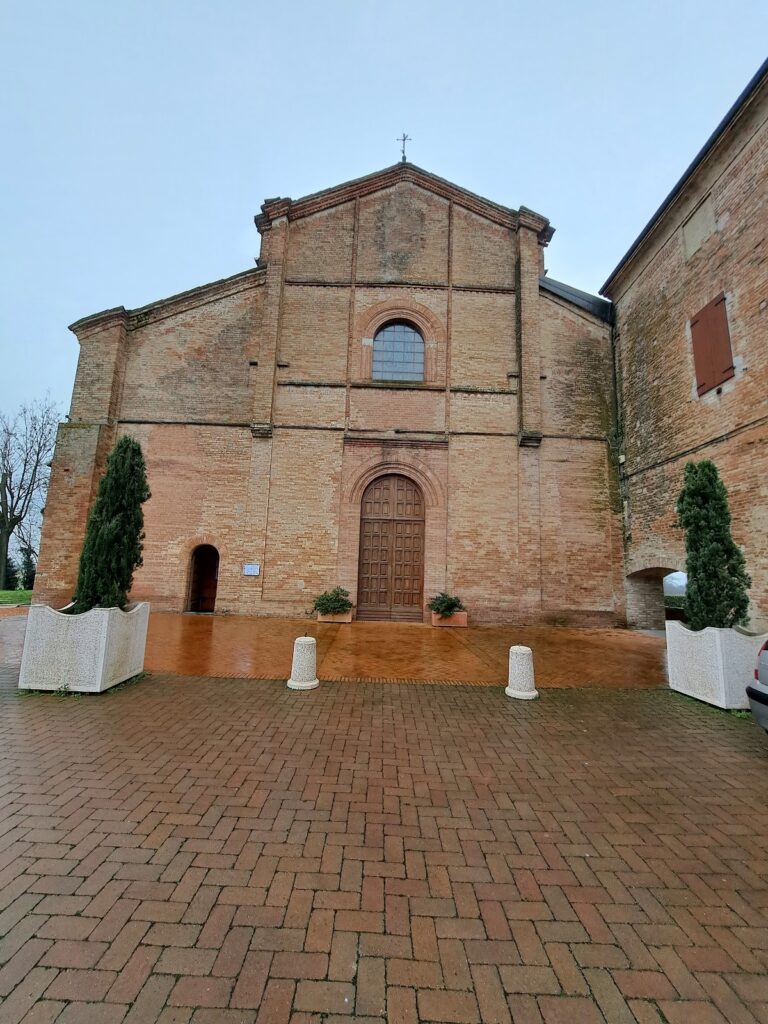
The church is a late-Gothic brick building with three aisles. Its central nave is substantially wider than the side aisles, and five chapels survive within the building. The stepped facade is entirely faced in red brick and divided into three sections by tall pilasters. An ornamental brick pattern enriches the upper part, while the centre is dominated by a large segmental-arched entrance. The portal is framed by a slightly splayed round-arched surround decorated with fifteenth-century terracotta panels probably made by the workshop of Jacopo de Stavolis.
The terracotta panels show leaves, interlaced cords, and putti among vine shoots and clusters of grapes. Above the entrance, the lunette contains a 1952 fresco of the Assumption of the Virgin, and a rose window, a large circular window with radiating tracery, is framed in terracotta. A small porch with a sail vault projects from the right side of the facade and shelters the entrance to the convent.
On the north side, projecting lateral chapels display details related to those of the facade. Tall single-lancet windows, narrow openings topped by one arch, have pointed arches and brick surrounds, while smaller circular windows provide additional openings. Similar elements appear in the polygonal apse, whose exterior is reinforced by buttresses. The right aisle once ended in a chapel dedicated to Saint Peter of Alcantara, which was demolished in 1846 after severe deterioration.
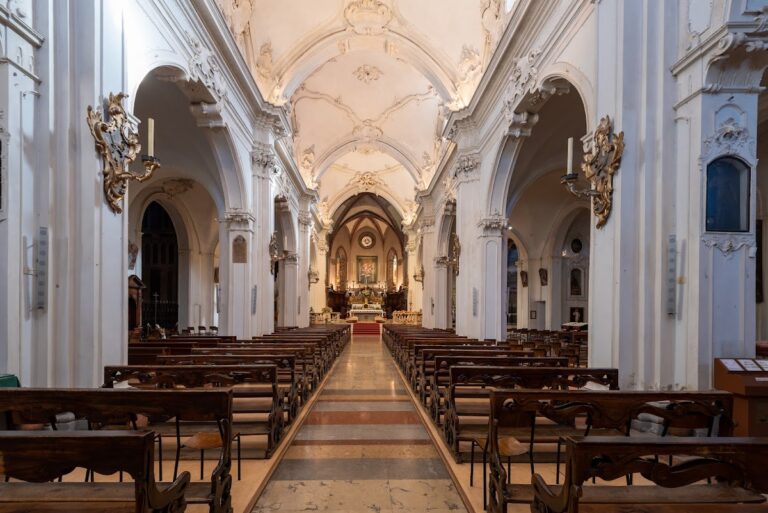
Inside, pointed arches rest on tall brick piers with chamfered cube capitals. Ribbed groin vaults, vaulted ceilings strengthened by intersecting ribs, cover the nave and aisles beneath white plastered surfaces. Four interconnected chapels open from the left side and extend the interior space. Above the pointed arch of the high altar, a large stucco emblem of the Franciscan Order is supported by two angels. The wooden choir dates from 1923, the high altar and presbytery from 1926, and the marble balustrade from 1940.
Chapels and artworks
Chapel of Saint Anthony of Padua
The chapel nearest the entrance is dedicated to Saint Anthony of Padua and was originally dedicated to Saint Mary of Grace. Built after 1484 at the request of Giovan Manfredo Pallavicino, son of Rolando the Magnificent, it served as a burial chapel for the family. Its altar was replaced in 1958. A fifteenth-century fresco of the Madonna del Canale was installed in the chapel’s left wall in 1905 after being detached from the Madonna del Canale oratory beside the church forecourt. The oratory was demolished in 1906 because of its poor condition. The fresco was probably painted by a pupil of Francesco Squarcione.
Chapel of Saint Rita of Cascia
The second chapel is dedicated to Saint Rita of Cascia and was originally dedicated to Saint Anthony of Padua. Though built after 1484, it received its current appearance in 1907. At that time, the floor was rebuilt, a Neo-Gothic altar of red cement and grit was installed with a wooden niche, and stained-glass windows were added. Camillo Uccelli designed the altar.
Chapels of the Immaculate Virgin and Saint Francis
The third chapel, dedicated to the Immaculate Virgin, was built in 1478. It contains a marble altar from 1952 and an eighteenth-century statue of the Madonna. The fourth chapel, dedicated to Saint Francis of Assisi, was also built in 1478. Its marble altar was made in 1922 to a design by Camillo Uccelli.
Chapel of the Blessed Sacrament and Chapel of Saint Catherine
The chapel at the end of the left aisle is dedicated to the Blessed Sacrament. Built with the church, it was modified repeatedly and received its final form in 1902. A marble plaque installed on its left wall in 1797 supports a bust of Ireneo Affò, who is buried beneath the church’s presbytery. Beside the sacristy, the smaller internal Chapel of Saint Catherine has a Baroque interior with stucco decoration and frescoes of saints and Franciscan figures by the eighteenth-century artist Pietro Rubini. It is used for weekday Masses.
A detached fresco fragment on the right-aisle wall depicts Christ fallen with the Cross and Veronica. It was probably painted by Nicolò dell’Abate in 1543 or 1544. The church also preserves Clemente Ruta’s large 1732 painting of the Madonna and Child with Saint Paschal Baylon. In the adjoining sacristy is The Holy Family with the Young Saint John, Saint Anthony of Padua, and Another Franciscan Saint, painted by Antonio Campi around 1580.
Compianto sul Cristo morto
Beside the Chapel of Saint Francis, a false grotto houses Compianto sul Cristo morto, a life-sized group of eight painted terracotta statues made by Guido Mazzoni in 1476 or 1477 for the Marziani family of Busseto. Mazzoni was an Italian Renaissance sculptor known for realistic and emotionally expressive terracotta groups of sacred subjects. The scene shows Christ taken down from the Cross, surrounded by Joseph of Arimathea, John the Evangelist, Mary Salome, Mary, Mary of Cleopas, Mary Magdalene, and Nicodemus. A plaster coat of arms of the patrons, held by two grieving angels, is placed above the grotto.
The group was removed in 1810 and transferred to the parish church of San Rocco in a Busseto hamlet. The bishop of Fidenza ordered its return to Santa Maria degli Angeli in 1845 and began a restoration that was not entirely satisfactory. A further intervention at the end of the twentieth century restored the terracotta figures to their former splendour.
Convent and library buildings
The convent is entered through the doorway beside the church facade and is arranged around a large rectangular cloister with a portico on all four sides. Numerous expansions continued until the nineteenth century. The complex is faced almost entirely in red brick, while the arcades vary in width and form from one side to another.
The north front, adjoining the church, has a first-floor loggia with elegant round arches resting on slender columns. Camillo Uccelli restored the loggia between 1928 and 1930. Two complementary sections of an old sundial are embedded in adjoining sides of the first level and were restored around 2000. Broad, simple corridors on the first floor open onto numerous friars’ cells. At the end of one corridor, a large clock is set within an extensive trompe-l’oeil fresco, a painted illusion intended to make a flat surface appear architectural or three-dimensional.
The refectory has a lunette-vaulted barrel vault, a curved ceiling interrupted by smaller arched openings, decorated with large Pallavicino coats of arms. Its arched end wall is covered by a large Last Supper attributed to Michelangelo Anselmi and painted between 1538 and 1540. The painting originally stood in the former refectory. When moved to its present position, part of its lower centre was cut away to make room for the entrance door, while a new section was added above so that the work would fill the lunette.
Other paintings in the convent include Saint Felix of Cantalice Receiving the Child from the Virgin, attributed to Fra Semplice da Verona and dating from the first half of the seventeenth century; Ignazio Stern’s Immaculate Madonna of 1722; Carlo Angelo Dal Verme’s Blessed Giovanni Buralli Celebrating Mass of 1779; and The Unnamed Sinner, painted by an unidentified Flemish artist in the sixteenth century.
Park and Oratory of the Red Madonna
A large enclosed park extends behind and beside the complex. At its south-eastern corner stands the small Oratory of the Red Madonna. Its name comes from the colour of the fifteenth-century terracotta bas-relief of the Virgin preserved inside. The oratory was built in an earlier period, enlarged and remodelled in the Neoclassical style in 1806, and altered internally by restorations in 1913 and 1938.
The oratory retains a symmetrical nineteenth-century facade. Pilasters and capitals support an entablature with triglyphs, which is crowned by a large pediment. Within the adjoining park beside the church, the restored Casa del Pellegrino occupies the former travellers’ lodging house and contains a permanent exhibition of nativity scenes.
Nearby sites