Masnago Castle: A Medieval Fortification and Art Museum in Varese


Site at a Glance
- Rating
- 4.4
- Popularity
- Very Low
- Country
- Italy
- Primary era
- Medieval
- External website
- Open
- Eras represented
- Medieval, Early Modern
- Civilizations
- Duchy of Milan, Habsburg, Holy Roman Empire, Spanish
- Site type
- Military
- Remains
- Castle
On this page15 sections
History
Masnago Castle is a medieval fortification in Varese, Italy, whose earliest core was a watchtower of uncertain date. It formed part of the defensive system associated with the Tower of Velate before becoming a residential estate, a pleasure villa, and eventually a public museum. Its frescoes are regarded as among the most important examples of secular courtly Gothic painting in Italy.
From watchtower to residence
The castle first belonged to the Marliani family. The Castiglioni family later took possession and built a residential villa around the earlier tower, changing the character of the site from a defensive position into an aristocratic dwelling. Further alterations followed during the sixteenth and seventeenth centuries.
In the eighteenth century, Marquis Giuseppe Castiglioni and his wife, Paola Litta, transformed the property into a pleasure villa. They added the west wing and laid out an Italian-style garden, a formal garden based on geometric organization, ordered planting, architectural elements, and sculpture.
Rediscovery and public use
The Castiglioni Stampa family sold the castle to Angelo Mantegazza in 1934. Renovation work in 1937 brought its important fresco cycles to light. Their painter remains unknown. Comparisons have been made with frescoes associated with the fifteenth-century painter Jacquerio at Fénis Castle and with the work of the unidentified Master of the Borromeo Games at the Borromeo Palace in Milan. Bonifacio Bembo has also been proposed as the artist.
The fresco cycle has been linked intellectually with L’Acerba, a didactic encyclopedic poem by the fourteenth-century Italian scholar, physician, and poet Cecco d’Ascoli. It has also been associated with the Aristotelian-derived ideal of virtue as the mean between extremes.
The Municipality of Varese acquired the castle in 1981. Since 1995, the building has housed the Civic Museum of Modern and Contemporary Art. Its collection contains painting, sculpture, and graphic art from the sixteenth to the twentieth centuries, principally from Lombardy. Donations, including the collection of Luigi De Grandi and Amelia Bolchini, helped form the holdings, while acquisitions were supported by the art critic Giovanni Testori. The castle remains owned by the Municipality of Varese and functions as a public art museum.
Remains
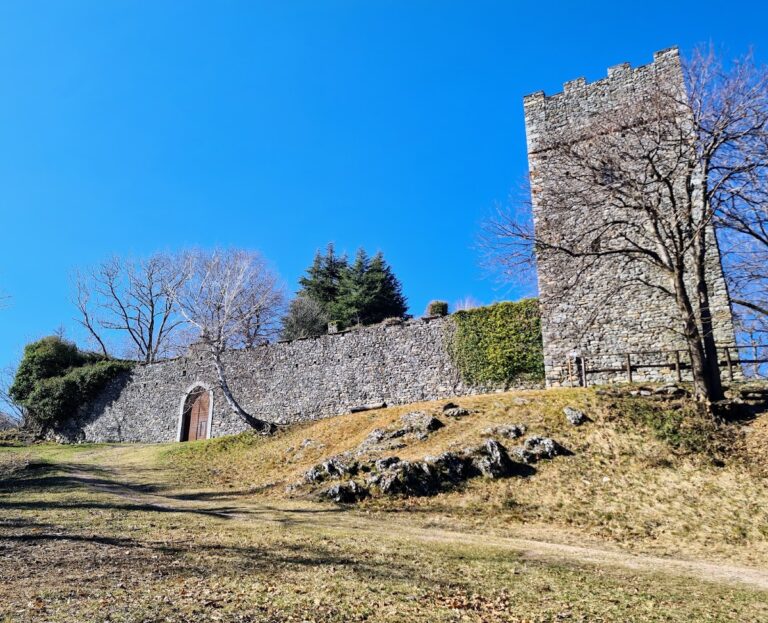
Masnago Castle stands on elevated ground within Mantegazza Park. Its surviving complex combines a late-medieval wing, attached service buildings, and a seventeenth-century building with an L-shaped plan. Together, these structures form a quadrangular courtyard that remains open at the northwestern end. The oldest tower is crenellated and has been extensively rebuilt, yet it remains an identifiable part of the castle.
Castle buildings
Medieval tower and courtyard
The crenellated tower is the oldest recognizable element of the complex. Rebuilding over several centuries has altered its fabric, while its continued presence preserves the connection between the castle and its earlier defensive role. The tower is incorporated into the larger arrangement of wings and service buildings around the courtyard.
Seventeenth-century wing
The seventeenth-century building has an L-shaped plan and forms part of the quadrangular enclosure. It belongs to the later architectural development of the residence, alongside the late-medieval wing and attached service structures.
Frescoed rooms and chapel
Sala degli Svaghi
On the ground floor, the Sala degli Svaghi contains a fresco cycle probably painted around the middle of the fifteenth century, when Maria Lampugnani, the widow of Giovanni Castiglioni, lived at the castle. The scenes present courtly medieval life through a falcon hunt, three ladies boating and exchanging flowers, gentlemen taking breakfast on the grass, ladies playing tarot on a small boat, and a woman playing an organ beneath a richly decorated tent. The tent bears the coats of arms of the Castiglioni and Lampugnani families.
Sala dei Vizi e delle Virtù
The upper-floor Sala dei Vizi e delle Virtù is divided by painted pilasters into architectural compartments. Each compartment contains groups of three allegorical figures, personifications of moral qualities and their opposites. Liberality appears between Avarice and Prodigality, while Chastity is shown with Lust and Vanity. Other groups include Wrath; Humility with Pride and Arrogance; Charity between Hypocrisy and Envy; Diligence between Sloth and Acedia; and Temperance between Gluttony and Slander. Faith holds a chalice, and Hope carries an anchor.
Private chapel
The private chapel has geometric decoration and contains a small fresco of the Crucifixion with saints. Its painted furnishings form a separate religious element within the predominantly residential complex.
Museum collection
The Civic Museum’s works occupy the castle alongside its historic interiors. Among the paintings are Giacomo Balla’s Girl with Flowers (1902), Renato Guttuso’s Tower of Velate, Tranquillo Cremona’s Portrait of Carlo Villa and Among the Flowers, Portraits of Children (both 1871), Francesco Hayez’s Tamar of Judah (1847), and Pietro Antonio Magatti’s The Virgin Brings the Viaticum to a Devotee of the Blessed Sacrament.
The holdings also include Giovanni Migliara’s Architectural Capriccio (1815–1825), Pier Francesco Mazzucchelli’s, known as Morazzone, Lamentation over the Dead Christ, Carlo Francesco Nuvolone’s Massacre of the Innocents, Eleuterio Pagliano’s The Prayer Book (1857–1858), Giulio Cesare Procaccini’s Resurrection of Christ, and Girolamo Romanino’s Tapestry of the Judgment of Solomon. The collection further contains portraits by Daniele Ranzoni of Luigi Villa and Margherita Villa as children (1872–1873), Vincenzo Vela’s marble bust of Girolamo Ghirlanda (1851), and sculptures from the Sacro Monte of Varese attributed to Martino Retti. The Sacro Monte is a Catholic pilgrimage complex of chapels and religious artworks on a nearby mountain slope.
Mantegazza Park
Park landscape
Mantegazza Park surrounds the castle and covers nearly three hectares. It is arranged as an English-style park, with a more naturalistic layout than the formal eighteenth-century garden. Its lower section consists largely of lawns and broad-leaved trees. The upper section contains beeches, horse chestnuts, oaks, hornbeams, and cedars, while the park as a whole includes more than one hundred varieties of trees and shrubs.
Garden remnants and botanical area
Only limited traces of the former eighteenth-century garden remain. Two stone lions, symbols of the Castiglioni family, survive on top of the entrance pillars. A small botanical garden contains plants associated with Mediterranean vegetation, including holm oak and strawberry tree.