San Michele Arcangelo: A Historic Parish Church in Roncole Verdi, Italy


Site at a Glance
- Rating
- 4.5
- Popularity
- Very Low
- Country
- Italy
- Primary era
- Early Modern
- Eras represented
- Medieval, Early Modern
- Civilizations
- Duchy of Parma and Piacenza, Holy Roman Empire
- Site type
- Religious
- Remains
- Church
On this page16 sections
History
Medieval foundation and later rebuilding
San Michele Arcangelo is a Catholic parish church in Roncole Verdi, Italy, founded by the medieval Italian marquis Adalberto Pallavicino of Massa. The original church was built in 1004 and consecrated on 8 May 1094, when it was known as San Michele dei Ronchi and belonged to the Diocese of Parma. Dedicated to Saint Michael the Archangel, the Christian figure traditionally associated with heavenly protection and the defeat of evil, it developed as a religious centre for the surrounding community.
The building was altered repeatedly, and no visible trace of the original structure survives. Its apse was completely rebuilt in 1509. In 1601, the creation of the Diocese of Fidenza transferred the church into that new diocese, where it became the seat of a forane vicariate, an area administered by a local church official, for about three centuries. It remains a Catholic parish church of the Roman rite within the Bassa Parmense vicariate of the Diocese of Fidenza.
Baroque transformation
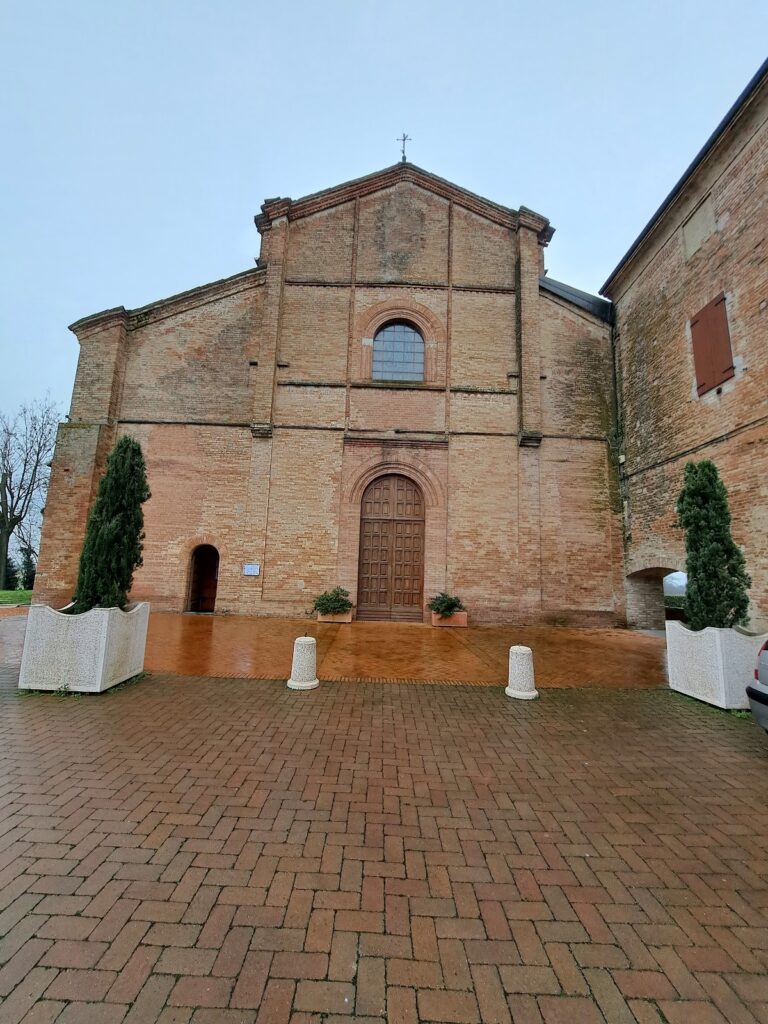
The facade was reconstructed in the Baroque style in 1610. Baroque architecture is associated with dynamic forms and elaborate visual effects, although the rebuilt front of San Michele Arcangelo is architecturally restrained. The interior was modified on several later occasions, reflecting the continuing use of the church as a parish and liturgical building.
Giuseppe Verdi and the parish church
The church has a direct connection with the early life of Giuseppe Verdi, the nineteenth-century Italian composer especially associated with opera. He was baptized here on 11 October 1813 and confirmed on 25 July 1819 by Bishop Luigi Sanvitale. In spring 1814, after the defeat of the Napoleonic army, Verdi’s mother, Luigia Uttini, sheltered with him in her arms at the top of the bell tower during raids by Russian and Austrian troops. A commemorative plaque at the tower’s base recalls the episode.
Verdi also practiced as a child on the parish organ. The instrument was completely restored in 1900 by Filippo Tronci under Verdi’s supervision, linking its later history with the composer’s earliest musical training.
Restoration and continued use
The baptistery was completely restored in 1963 for the 150th anniversary of Verdi’s birth, and a commemorative plaque was placed there. Further interior restoration in 1964 brought some of the earlier frescoes back to light. The former wooden high altar was removed in 1932, restored, and returned to the presbytery in 2006. In the same year, the neoclassical marble altar formerly in the presbytery was moved to the chapel of the Blessed Sacrament.
The organ underwent repairs or alterations in 1821, 1839, 1849, 1871, 1924, 1955, 1964, and 2000. These interventions preserved an instrument that had served the parish for more than two centuries and had been part of Verdi’s childhood musical environment.
Remains
Plan and exterior fabric
San Michele Arcangelo has a three-aisled plan, with the principal entrance to the west and the presbytery to the east. The building combines plastered later elements with older brick construction. The apse and bell tower are built entirely of brick and are the oldest surviving parts of the church.
Facade
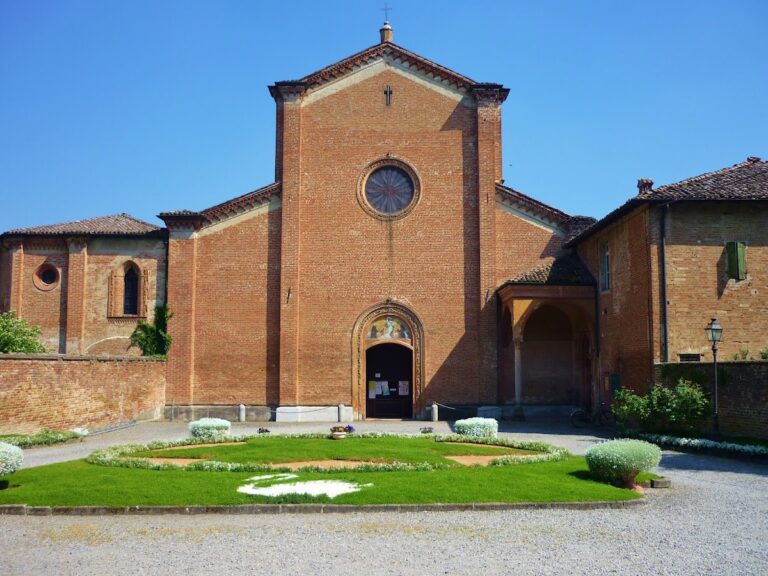
The stepped facade is fully plastered and simple in design. Its broad central portal has a projecting frame and upper cornice, above which is a three-light window with a central round-arched opening. Two secondary entrances flank the portal, each topped by a small rectangular window. A triangular pediment crowns the facade and contains a small rose window.
Apse and bell tower
The polygonal apse dates from the sixteenth century and has buttresses and a tall single-lancet window on the side opposite the rectory. The bell tower is 27 metres high and was probably built a few years before 1000 in the Romanesque style. Romanesque buildings commonly use round arches and massive masonry. The belfry has two round-arched openings on each of its four faces, while a large old clock is set into the rear side. Its present hipped roof replaced an original circular pinnacle that was struck by lightning in the eighteenth century.
Nave and paintings
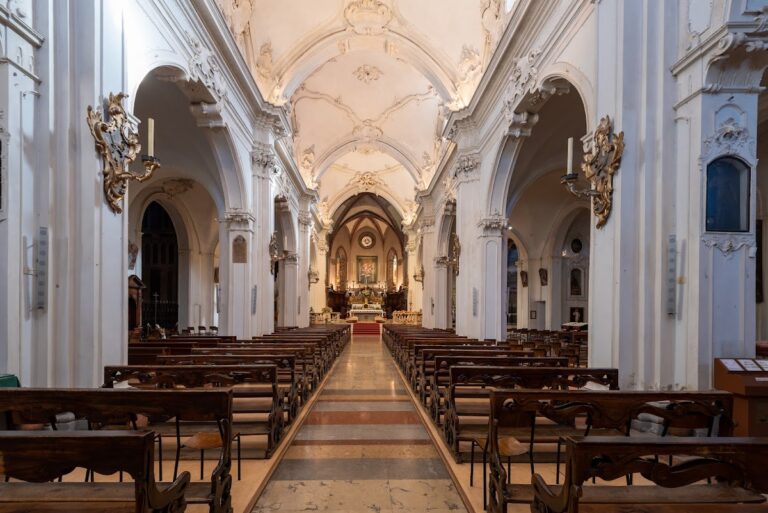
The central nave is covered by a barrel vault, a continuous semicircular ceiling formed by extending an arch along an axis. Round arches separate it from the side aisles, resting on large square-section piers. Two large oil paintings hang on the inner facade. One is a seventeenth-century image of Saint Peregrine Laziosi, transferred from the former Servite religious house at Soragna. The other, painted by Pietro Balestra in 1787, shows the Immaculate Virgin with Saints Sebastian, Roch, Anthony of Padua, and Margaret of Cortona, with San Michele Arcangelo represented in the background.
Frescoes in the right aisle
The right aisle preserves traces of sixteenth-century frescoes revealed during twentieth-century restoration. Near the baptistery is a damaged Ecce Homo. Farther along are a Pietà, an Adoration of the Magi, Saint John the Baptist, the Madonna and Child enthroned, and the Madonna and Child with Saints Francis of Assisi and Anthony of Padua. The Pietà had already been rediscovered and restored in 1800. Two opposing frescoes from the beginning of the sixteenth century remain on the right-hand pier between the second and third arches, depicting the Virgin and Child and Saint Lawrence, a deacon and martyr.
Presbytery and chapels
Presbytery artworks
The presbytery contains the restored painted wooden high altar returned there in 2006. At the centre of the apse behind it is an altarpiece of Saint Michael the Archangel, painted by Pietro Balestra in the second half of the eighteenth century. On Good Friday, a large nineteenth-century canvas of Calvary by Girolamo Magnani is raised behind the altar, spanning the entire arch of the apse.
The right presbytery wall contains several mainly sixteenth-century frescoes recovered during twentieth-century restoration. The lower register shows several figures, including a bishop and a nobleman, and is earlier than the adjoining paintings. Nearby, Saints Sebastian and Roch appear within a festooned arch, with the image repeated in another badly damaged fresco below. Higher up is an almost intact Crucifixion with Saint John the Apostle and the Virgin Mary, together with the Madonna Queen and Mother, shown with the Child and surrounding angels within another festooned arch. A pier on the opposite side retains traces of the Virgin Mother nursing the Christ Child.
Organ and choir loft
A wooden choir loft with a curving parapet dominates the left presbytery wall. A choir loft is a raised platform for singers or instrumentalists, and this one houses the large pipe organ built by Francesco Bossi in 1797 to replace the original instrument, which was unusable. The organ has 736 pipes and retains its original structure. In 1821, Giovanni and Stefano Cavalletti added the Fagotto bassi and Oboe soprani stops, the only alteration to Bossi’s original tonal design. The mechanically operated instrument has a 50-note keyboard, a 13-note pedalboard, and 21 stops.
Chapel of the Blessed Sacrament
The chapel of the Blessed Sacrament opens at the end of the left aisle. Since 2006, it has contained the former neoclassical altar from the presbytery. The altar is made of red Verona marble, with white Carrara-marble profiles and panels of polychrome marble. A statue of the Sacred Heart stands above it.
Right-hand chapel and baptistery
A small chapel at the end of the right aisle is completely covered with sixteenth-century frescoes rediscovered during twentieth-century restoration. Above its altar, within a Renaissance structure with a horizontal beam, the Virgin Mother appears with Saints Donninus, Sebastian, Roch, and Michael, while the Dove of the Holy Spirit is shown above them. The slightly incomplete restored fresco is considered one of the oldest images of Saint Donninus. A contemporary Nativity occupies an arch on the right and is damaged in its central section.
The baptistery stands at the beginning of the right aisle in a chapel built around the middle of the eighteenth century. Before that chapel was constructed, the baptismal font stood in the small chapel at the end of the aisle. The baptistery’s restoration in 1963 commemorated the 150th anniversary of Verdi’s birth and remains part of the church’s material connection with his early life.