Palazzo Mattei di Giove: A Roman Palace of the Mattei Family
Site at a Glance
- Country
- Italy
- Primary era
- Early Modern
- Eras represented
- Classical, Early Modern, Modern
- Civilizations
- Italian, Papal States, Roman
- Site type
- Domestic
- Remains
- Elite Residence
On this page13 sections
History
Palazzo Mattei di Giove, also known as Palazzo Mattei, is a palace in Rome, Italy, commissioned by the Roman nobleman Asdrubale Mattei after his 1595 marriage to Costanza Gonzaga. Designed by Carlo Maderno, it was built from 1598 to 1618 and became a setting for the Mattei family’s artistic patronage and its presentation of ties to the Habsburg dynasty.
Construction and family connections
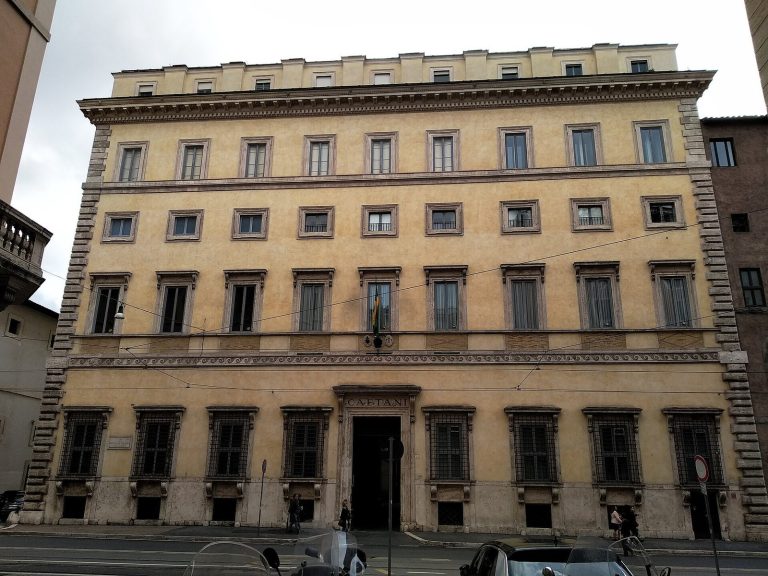
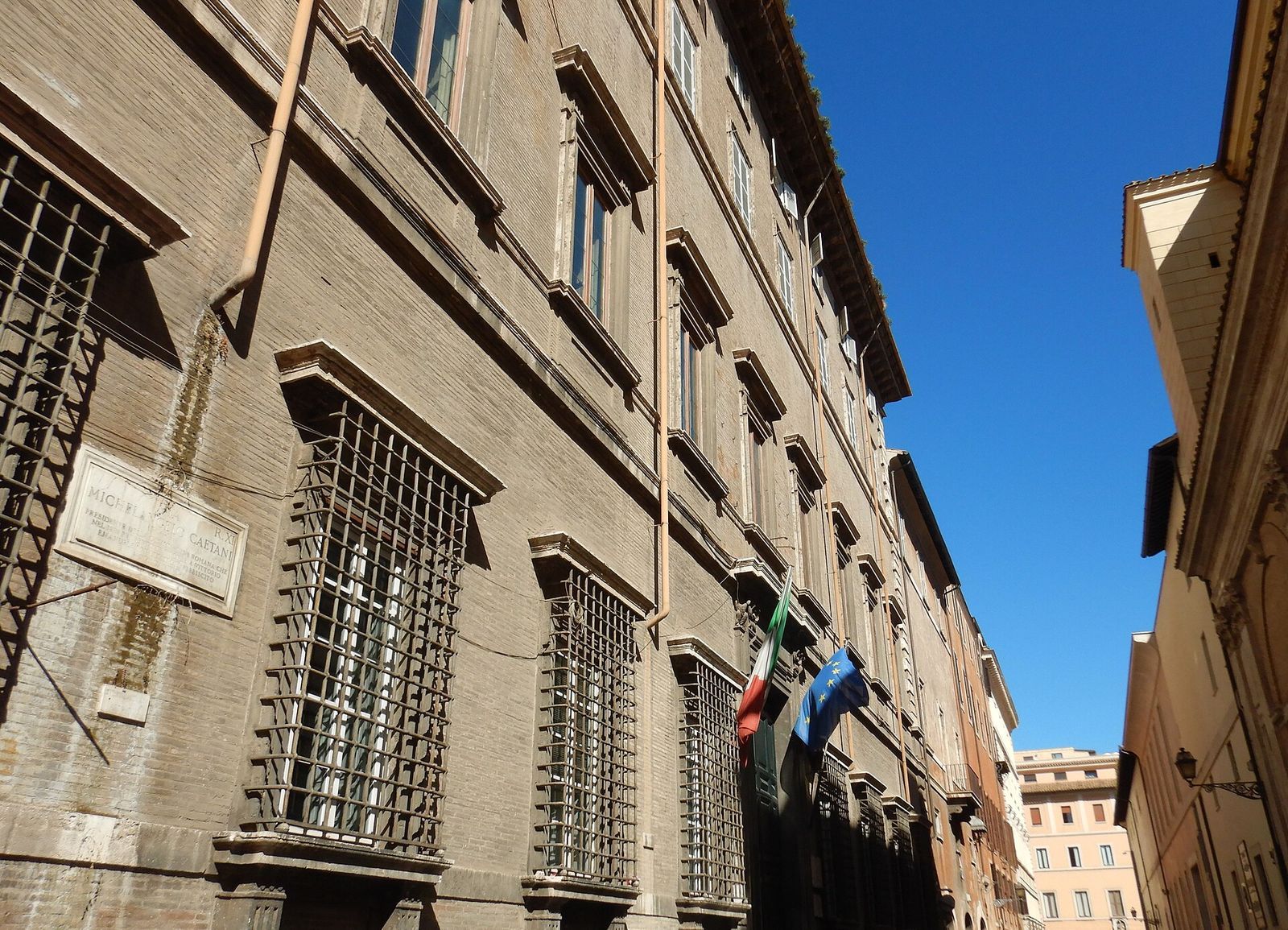
Construction began on property already owned by the Mattei, with financial support from Asdrubale’s elder brother, Ciriaco. In 1613, work started on a wing intended to join the palace to the nearby residence of Asdrubale’s father, Alessandro. That adjoining building later passed to the Caetani family and became known as Palazzo Caetani.
The Mattei family’s connections to the Gonzaga and Habsburg dynasties shaped the palace’s decoration. In 1622, Ferdinand II of Habsburg, Holy Roman Emperor, married a member of the Gonzaga family, linking the families by marriage. The palace courtyard was then arranged to evoke a connection between ancient Roman emperors and the contemporary Habsburg rulers.
Art, collections, and occupants
Asdrubale supported the arts, and the painter Caravaggio is recorded as living in the palace in 1601. The family also assembled one of Rome’s richest private collections of ancient marble works. Giuseppe Mattei sold part of it to Pope Clement XIII in 1766; some sculptures displayed at Ciriaco Mattei’s Villa Celimontana were outside that sale. Much of the collection is now in the Vatican Museums, while other works were dispersed among museums and private collections in Italy and beyond. A group of paintings from the palace was bought by the Scottish collector William Hamilton Nisbet and taken to Scotland in the early nineteenth century.
At the beginning of the nineteenth century, the male line of the Mattei di Giove ended. The palace passed to the Antici family through the marriage of Marianna Mattei, daughter of Giuseppe, to Carlo Teodoro Antici di Recanati. Carlo Teodoro was the maternal uncle of the poet Giacomo Leopardi, who stayed at the palace from November 1822 to April 1823 and used a room on its third floor.
Later history
The palace was the final residence of Costantino Corvisieri, a historian and the first president of the Roman Society of Homeland History. The Italian state acquired the building in 1938. It now houses the Central Institute for Sound and Audiovisual Heritage, formerly the State Sound Archive; the Library of Modern and Contemporary History; the Center for American Studies; and the Historical Institute for the Modern and Contemporary Period. Two of these institutions belong to the Ministry of Cultural Heritage and Activities.
On 9 May 1978, the body of Aldo Moro, an Italian statesman and former prime minister, was found in a car on Via Caetani.
Remains
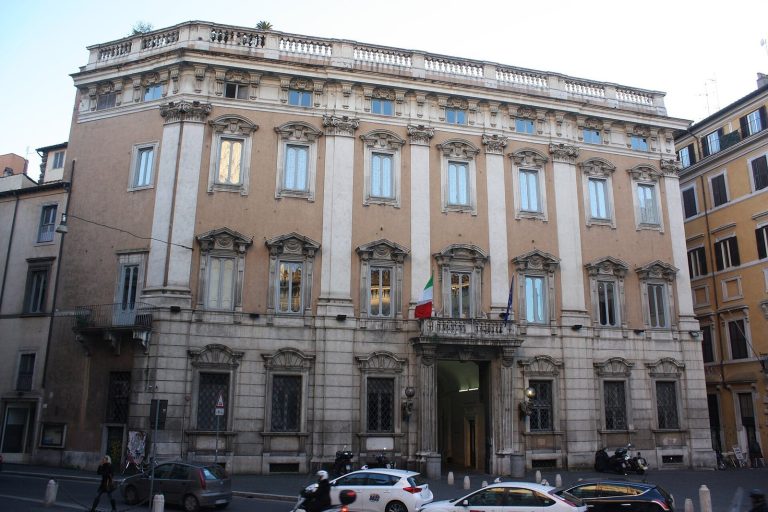
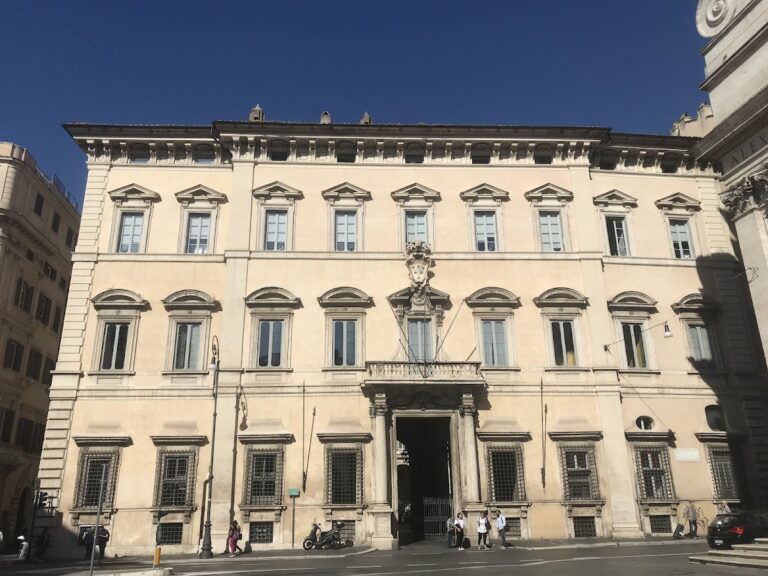
The three-storey palace stands at the corner of Via Michelangelo Caetani and Via dei Funari, within the block known as Isola Mattei. The block is bounded by Via delle Botteghe Oscure, Via dei Funari, and Via Paganica, and includes several Mattei family palaces, among them Palazzo di Giacomo Mattei and Palazzo Mattei Paganica. Built of brick and travertine, Palazzo Mattei has an entrance on each of its two street-facing sides.
Exterior
The façades have rough-faced masonry at the corners. On the ground and principal floors, the windows are framed by prominent mouldings and horizontal architectural bands; the upper-storey windows have simpler surrounds, with a further row of attic windows above. Nine windows face Via Michelangelo Caetani and eleven face Via dei Funari on the principal floor. Two horizontal cornices divide the upper levels. A projecting cornice at the top carries the Mattei chequerboard and Gonzaga eagle, above which rises a rooftop lookout with an open-sided gallery. The last-built section facing Via Michelangelo Caetani has three arched doorways with framed decorative panels, opening onto three recesses.
Courtyards
First courtyard
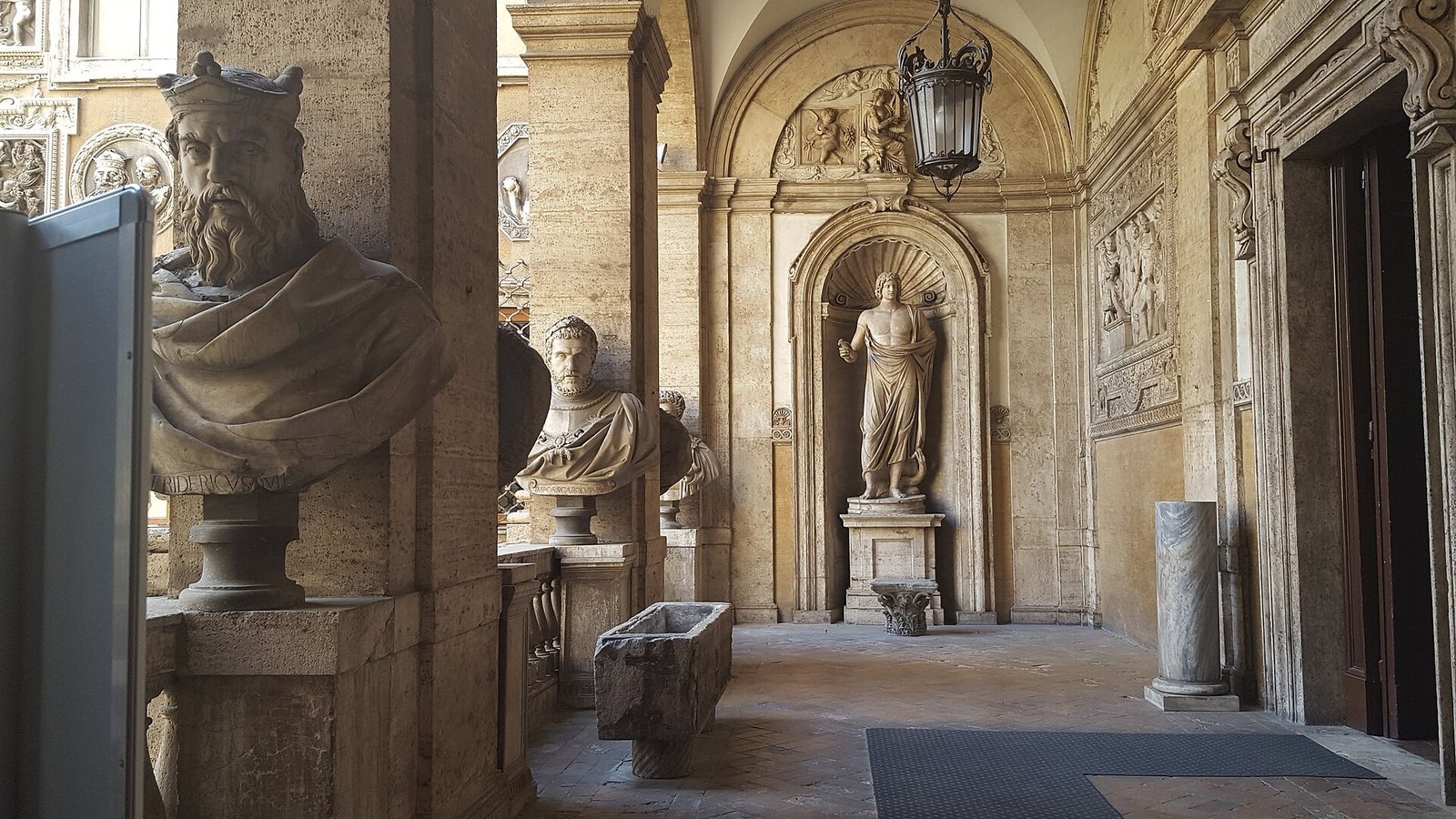
Maderno designed the first courtyard around a two-storey open-sided gallery. On its south side, three-arched arcades extend across both levels, with two tiers of pilasters. The courtyard walls display ancient marble fronts of sarcophagi, reliefs, inscriptions, and other carved fragments, set within elaborate plaster frames. Medallions and busts occupy niches. An imperial series includes eight modern busts of ancient Roman emperors on the walls, eight busts of Habsburg emperors on the upper gallery’s balustrade, and eight medallions bearing modern reliefs of Byzantine emperors.
Second courtyard and garden
A wall of three arches closes the north side of the first courtyard. Its two side arches are blind, and a balustrade runs above; the wall leads to a second courtyard-garden. Against the garden’s rear wall, a fountain pours water from a grotesque mask into a sarcophagus decorated with curved grooves and symmetrical lion heads. The sarcophagus rests on two steps and two travertine supports. Roman statues of male figures stand on pedestals in the courtyard.
Staircase and principal-floor decoration
Staircase and upper gallery
The four-flight staircase incorporates ancient sculptures within plaster frames. Donato Mazzi’s plaster decoration dates to 1606–1611. Roman sarcophagi are also built into the staircase, including the fronts of the Sarcophagus of Mars and Rhea Silvia, named for the Roman war god and the legendary mother of Romulus and Remus, and the Mattei I Sarcophagus. The stairs lead to a gallery overlooking the first courtyard, decorated with Roman fragments and large busts of ancient and contemporary emperors made in the sixteenth and seventeenth centuries.
Frescoes and paintings
Rooms on the principal floor contain frescoes with subjects from the Bible. Works include Francesco Albani’s Jacob’s Dream, Domenichino’s Jacob and Rachel at the Well, Pomarancio’s Stories of Joseph, and Giovanni Lanfranco’s Joseph and Potiphar’s Wife, painted in 1615. The gallery features scenes of Solomon and the Queen of Sheba associated with Pietro Paolo Bonzi, Pietro da Cortona, and Paul Bril. Cortona’s ceiling compositions date to about 1622–1623. Other artists represented include Antonio Carracci, Gaspare Celio, Cristoforo Greppi, Francesco Nappi, Giacomo Triga, and Grappelli.
Street-side painting and memorial plaque
An oval seventeenth-century Baroque oil painting known as Madonna della Tenerezza is set into the Via Michelangelo Caetani façade. It depicts the Virgin and Child in an affectionate pose. Lorenzo Mattei placed it there in gratitude for surviving an epidemic. Stars decorate its plaster frame, with a crown of roses and vegetal garlands above; a triangular canopy shelters the painting, which is lit by a wrought-iron lantern. A plaque on the palace marks the place associated with the discovery of Aldo Moro’s body.