Fort Pulaski National Monument: A Coastal Defense Fort on the Savannah River
Site at a Glance
- Country
- United States
- Primary era
- Modern
- Eras represented
- Modern
- Civilizations
- Unclassified
- Site type
- Military
- Remains
- Fort
On this page11 sections
History
Fort Pulaski National Monument preserves Fort Pulaski, a United States coastal-defense fort on Cockspur Island at the mouth of the Savannah River. Built between 1829 and 1847 as part of the Third System, the national coastal-fortification program begun after the War of 1812, the fort guarded the approach to Savannah. Its 1862 siege showed how rifled cannon, whose grooved barrels spin projectiles for greater range and accuracy, could threaten brick defenses.
Construction and purpose
After the War of 1812, President James Madison ordered new coastal defenses to protect the country from attack. Construction at the Savannah River began in 1829 under Major Samuel Babcock, then continued under Second Lieutenant Robert E. Lee, a recent West Point graduate. Military engineer Simon Bernard designed the fort. Both free workers and enslaved people labored on the project. It was named in 1833 for Casimir Pulaski, a Polish military commander who served under George Washington during the American Revolution. The fort was completed in 1847, after 18 years of work and at a cost of nearly $1 million.
After completion, two caretakers looked after the fort rather than a regular military garrison. When South Carolina seceded in 1860, Georgia Governor Joseph E. Brown ordered its seizure. A force of 110 men sailed from Savannah and took control. After Georgia seceded in February 1861 and joined the Confederacy, the government of the seceding Southern states, Confederate troops occupied the fort.
The Civil War siege
In December 1861, Confederate forces left Tybee Island, which was isolated and poorly prepared for conflict. Union troops, representing the United States and the states that remained in it, then established a foothold on the island under Quincy A. Gillmore and built artillery batteries along its beaches.
On April 10, 1862, Union forces called on Confederate commander Colonel Charles H. Olmstead to surrender and avoid further loss of life. He refused. The Union bombardment brought 36 guns to bear, including James rifled cannon and Parrott rifles. After about 30 hours, shells threatened the fort’s main powder magazine, and Olmstead surrendered. One Union soldier and one Confederate soldier were killed.
The siege was the first widespread use of rifled cannon in military history. It demonstrated that such weapons could strike brick fortifications with greater range and accuracy than smoothbore guns, helping to make defenses of this kind obsolete. Gillmore was promoted to brigadier general. The Union capture also halted shipping to and from Savannah, seriously damaging the Confederate war effort.
On April 16, 1862, Union General David Hunter issued an order freeing enslaved people at the fort and on Cockspur Island. The island also became part of the Underground Railroad, a network of routes and assistance used by enslaved people seeking freedom. Enslaved people arriving from the surrounding area were freed there.
Prison and postwar use
The Union garrison initially numbered about 600 soldiers, then fell to approximately 250 as the likelihood of a Confederate attempt to retake the fort diminished. In October 1864, the fort became a prison for captured Confederate soldiers, most of them officers. This group became known as the Immortal Six Hundred. Poor food and limited water contributed to starvation, dehydration, dysentery, and scurvy. Thirteen prisoners died and were buried outside the fort walls.
For a short time after the Civil War, the fort continued in use as a military and political prison. Its prisoners included the Confederacy’s secretaries of state, the treasury, and war, as well as its assistant secretary of war. Three state governors, a senator, and officers who had commanded the fort under Confederate control were also held there.
Preservation and twentieth-century service
After falling into disrepair, Fort Pulaski was declared a National Monument by presidential proclamation on October 15, 1924. The War Department transferred it to the National Park Service in 1933, and the Civilian Conservation Corps, a government work program for conservation and public works, carried out rehabilitation completed by 1938.
During World War II, the fort closed to the public while Cockspur Island served as a U.S. Navy section base. The National Park Service resumed control of the fort in 1945. In 1966, its 260-acre historic district was added to the National Register of Historic Places, the federal list of properties recognized for historical importance.
Remains
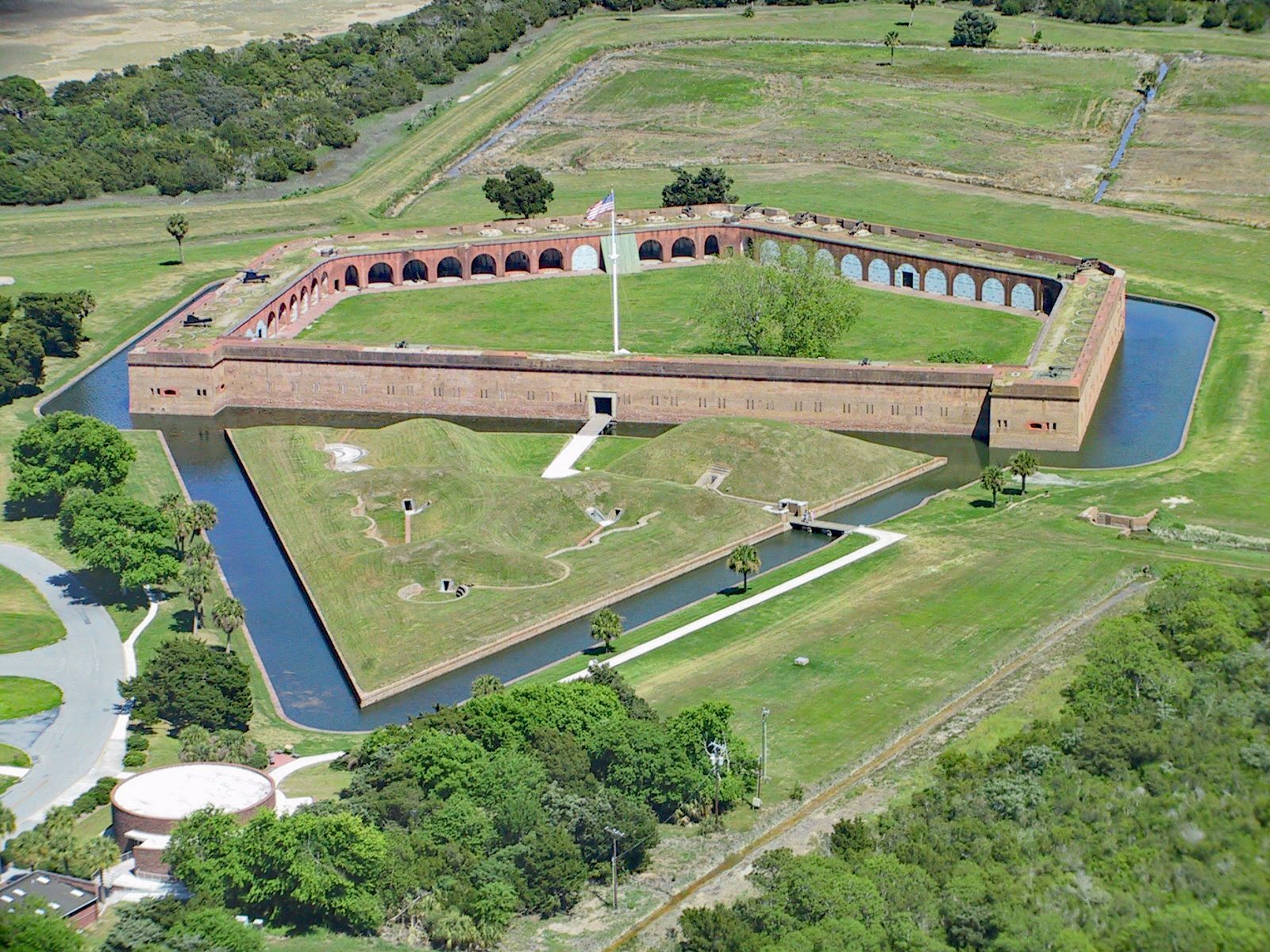
The fort is arranged around a pentagonal core whose point faces east, downstream. A water-filled moat surrounds the main enclosure, while additional defenses occupy the rear. The monument includes most of Cockspur Island and all of adjacent McQueens Island.
Enclosure and foundations
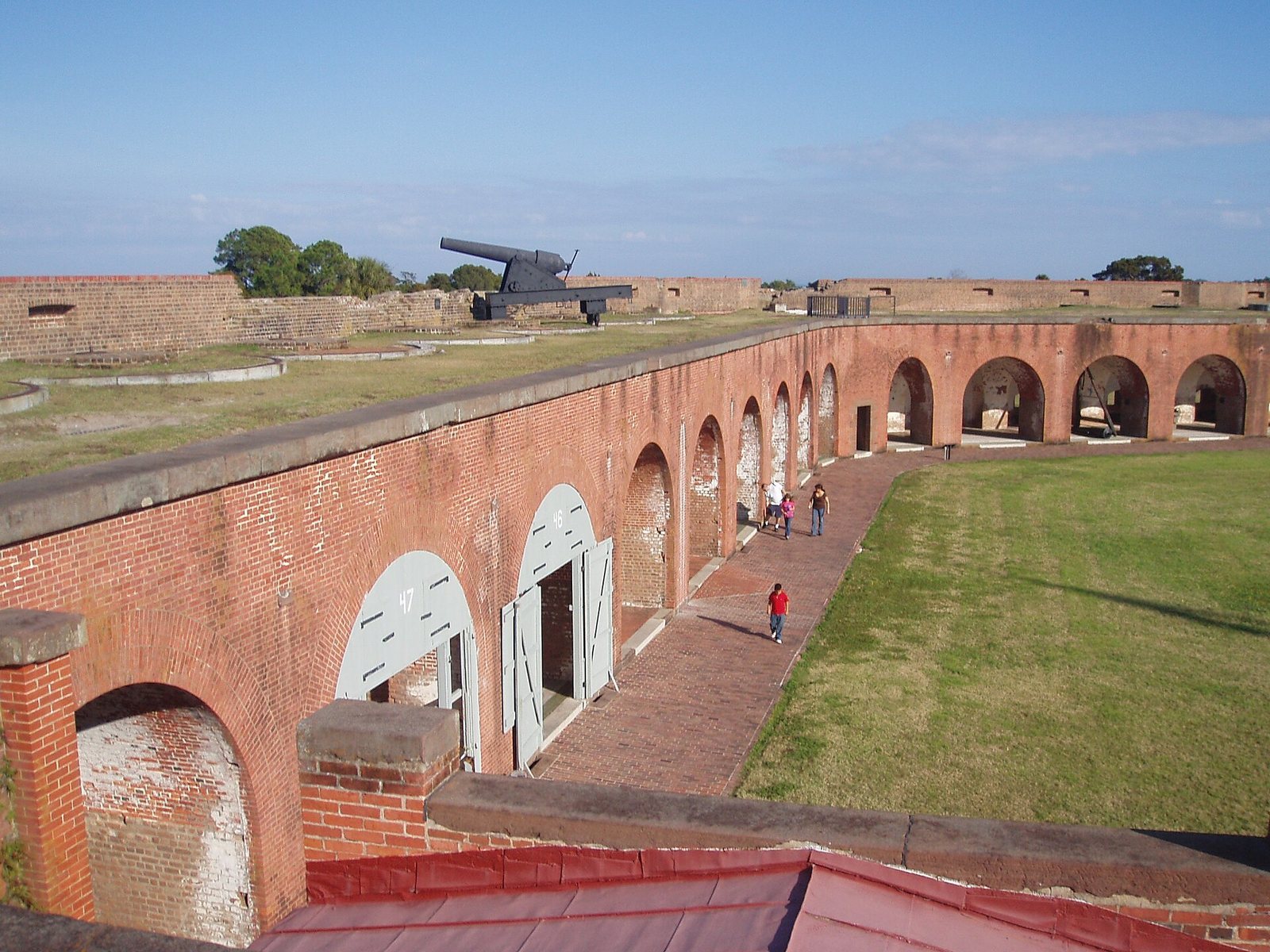
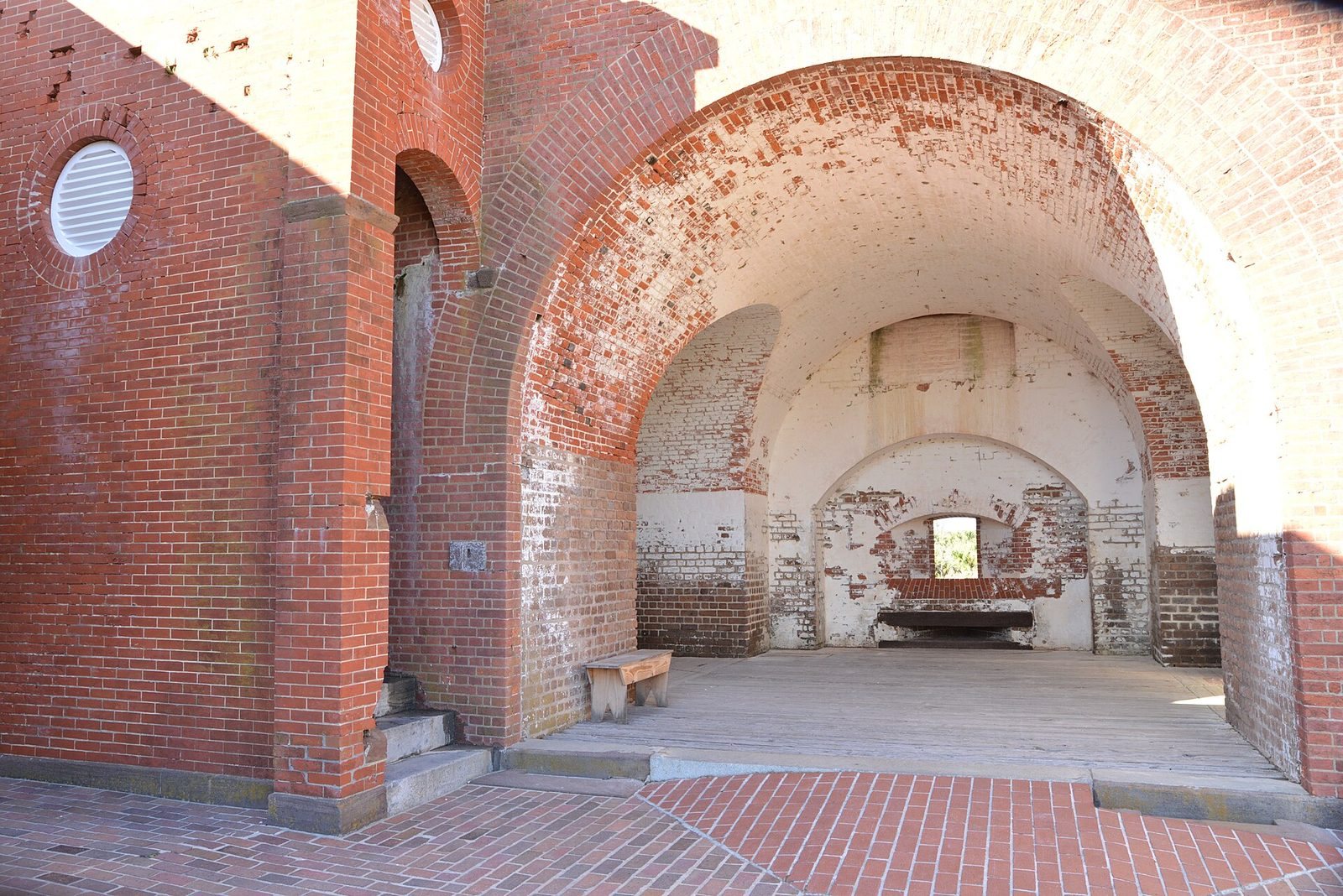
The walls extend about 526 metres in total and are approximately 3.7 metres thick. They rise about 7 metres on the inner side and 10 metres on the outer side. The site is seasonally flooded, with mud beneath the fort. Builders drove oak foundation piles as deep as about 21 metres; the logs reached lengths of up to 23 metres. Construction consumed approximately 25 million bricks.
Moat and entrance
The moat is about 16 metres wide and 2 to 3 metres deep around the main fort. The entrance consists of a gate and a bridge across the water. Where the moat was extended around the later rear defenses, it is about 10 metres wide.
Rear defenses and siege evidence
Rear defenses
Between 1869 and 1872, the fort’s rear defenses were altered to hold powder magazines and larger gun positions for heavier artillery. The gun platforms have tracks that allowed cannon to be moved.
Siege damage and graves
Bombardment during the 1862 siege breached the southwestern corner of the fort. Union forces repaired the damaged structure within six weeks. Graves outside the walls mark the burial place of the Confederate prisoners who died during their imprisonment.