Ockenfels Castle: A Historic Fortress in Germany


Visitor Information
Google Rating: 4.3
Popularity: Low
Country: Germany
Civilization: Medieval European, Modern
Site type: Military
Remains: Castle
History
Ockenfels Castle stands within the municipality of Ockenfels in modern Germany. It was originally constructed in the early 13th century by the noble family known as the Herren zur Leyen, who served as vassals under the Electorate of Cologne.
Early records from 1239 mention the Herren zur Leyen holding a fief estate at nearby Oberwillscheid. By 1341, ownership of the castle itself was attributed to Johann von der Leyen. The male lineage of this family ended in 1420, and ownership transferred to Rolman von Dattenberg. Following the marriage of his daughter Anna von Dattenberg in 1439, the property passed into the hands of Dittrich von Monreal and remained with his descendants for nearly two centuries.
In 1475, during the Cologne ecclesiastical conflict known as the Kölner Stiftsfehde, forces under Charles the Bold destroyed the castle. Despite this damage, by the start of the 17th century the fortress was reported as strong and well maintained under Johann Adam von Hoheneck. In 1615, Elector Ferdinand of Cologne officially recognized Eberhard Heinrich von Hoheneck’s sole control over the Monreal estates, including Ockenfels Castle.
The castle changed hands again in 1623 when Eberhard Heinrich sold it to Georg von Gerolt, a councilor and financial controller within the Electorate of Cologne. Von Gerolt took residence in nearby Linz am Rhein and was formally enfeoffed with the estate in 1624. The Gerolt family retained ownership until the male line ended with Friedrich von Gerolt’s death in 1887, after which the Rheinisches Heim housing cooperative acquired the property.
In the early 20th century, Linz incorporated the area containing the castle in 1912 and purchased the site in 1918. Vice-Consul Franz Delden bought the ruined structure in 1924 and commissioned architect Heinrich Reinhardt to rebuild it over several years. This restoration from 1924 to 1927 incorporated surviving medieval walls and used basalt rubble stones, reflecting a romanticized medieval aesthetic.
Following reconstruction, the castle served various roles beginning in 1936 as a nursing home operated by the Cellitinnen sisters from Cologne. By 1960, it transitioned into a hotel focused on rest and wellness. After several ownership changes and a period of disuse, the site was acquired in 1998 by Kundenzentrum Burg Ockenfels GmbH, which repurposed it as offices for the Betula shoe brand and Birko Orthopädie under the Birkenstock company.
Remains
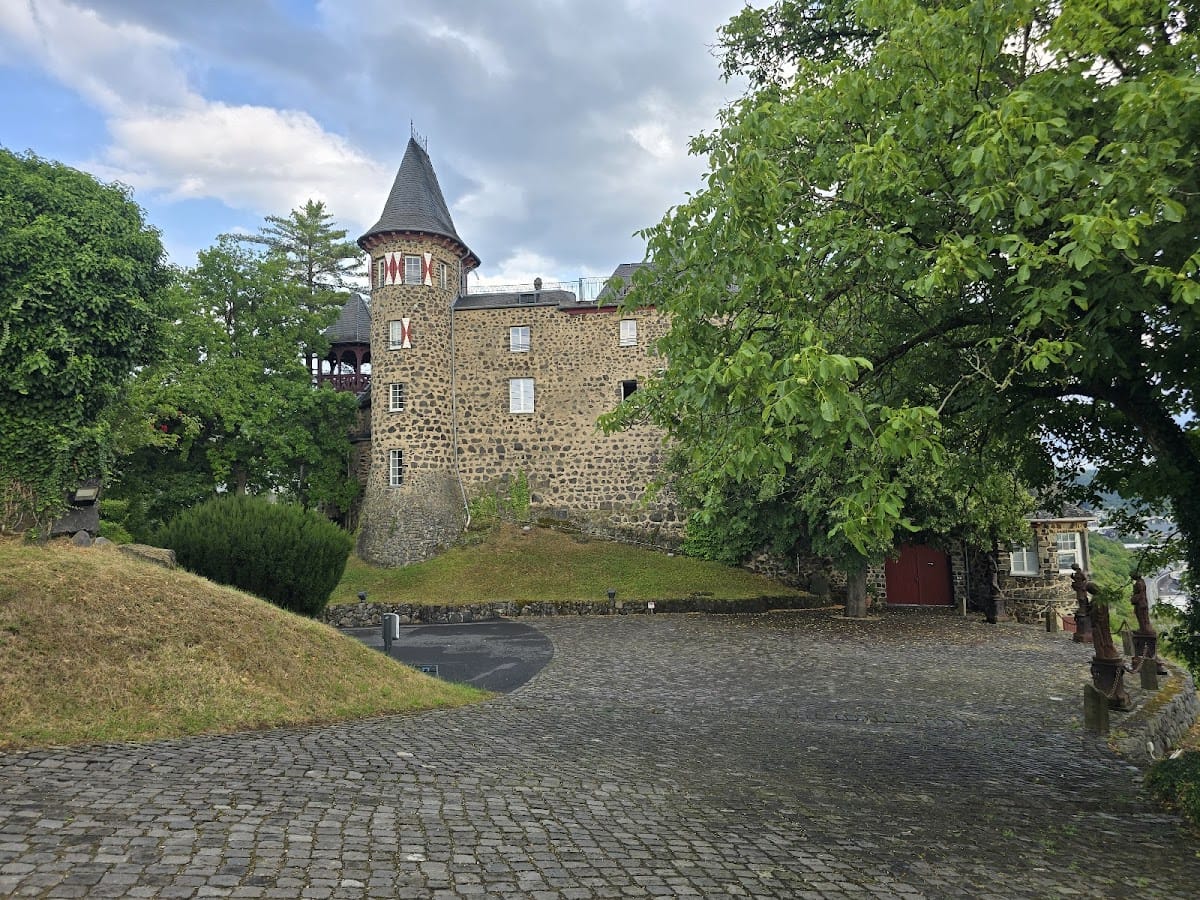
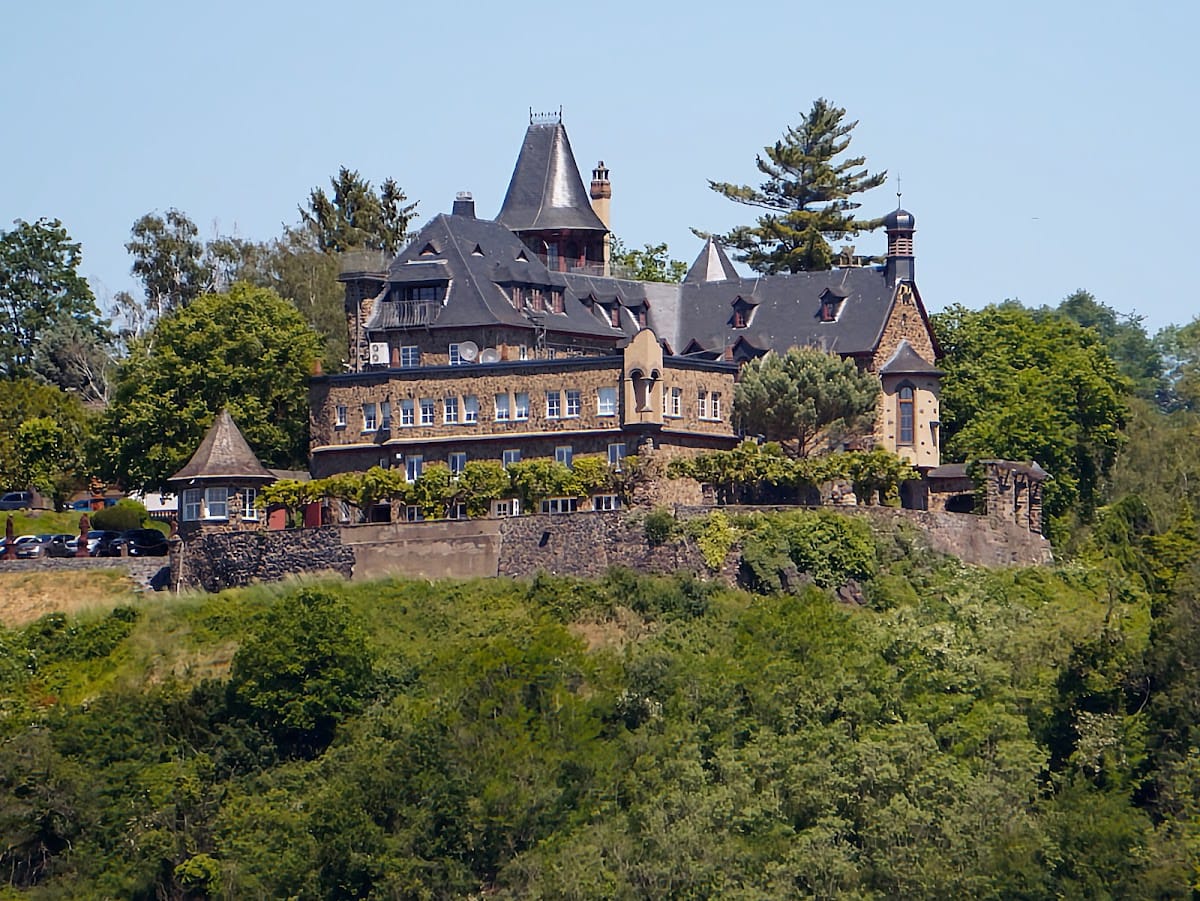
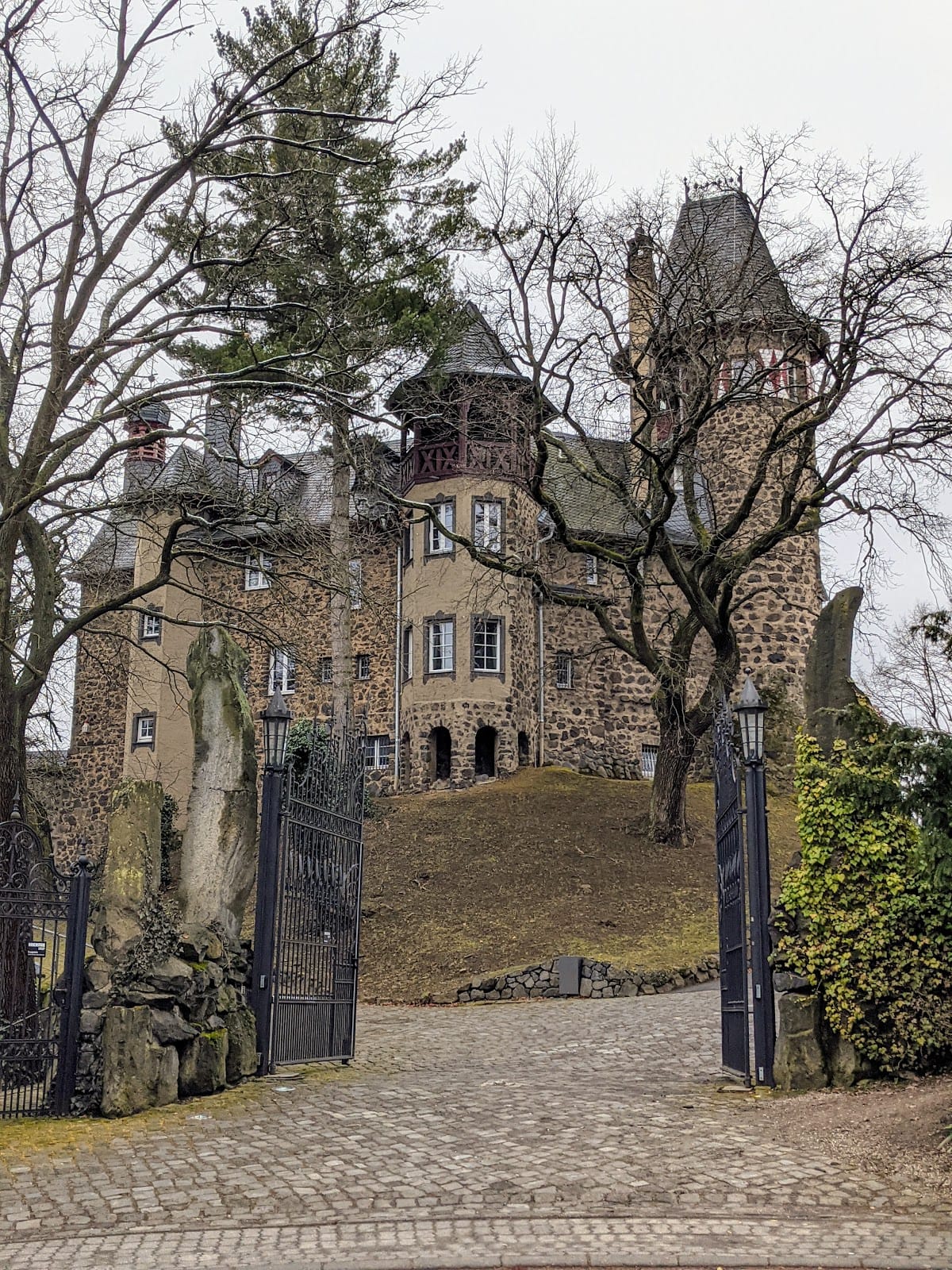
Ockenfels Castle occupies a hilltop on a gently sloping spur roughly 60 meters above the Rhine River, with the Rheinsteig hiking trail passing close by. The present three-winged building complex centers around a main tower known as the Burgfried, flanked by two semi-circular towers. These structures enclose a courtyard open toward the valley below.
The current castle owes much to the 20th-century reconstruction, which incorporated portions of the medieval fortress that had survived centuries of decay, including some foundation walls and a fragmentary section of the defensive ring wall. One tower segment also remains from the original fabric. This heritage presented a skeleton on which architect Heinrich Reinhardt based the romantic-style restoration, utilizing basalt rubble stones to match the historic masonry where feasible.
The integration of surviving medieval elements with new construction gave rise to the castle’s distinctive layout, blending authentic ruins with carefully crafted additions. The materials and structural techniques echo the fortress’s historical origins, preserving visual continuity while ensuring the building’s stability. These confirmed archaeological features convey both the castle’s defensive purpose and its enduring presence atop the Rhine valley.
Nearby sites