Ōhi Shrine: A Historic Shinto Shrine in Funabashi, Japan


Site at a Glance
- Rating
- 4.2
- Popularity
- Medium
- Country
- Japan
- Primary era
- Modern
- External website
- Open
- Eras represented
- Early Modern, Modern
- Civilizations
- Japanese, Tokugawa
- Site type
- Religious
- Remains
- Sanctuary
On this page11 sections
History
Ōhi Shrine, also known as Funabashi Daijingū, is a Shinto shrine in Funabashi, Japan, dedicated today to Amaterasu, the Shinto sun kami traditionally regarded as the imperial ancestral deity and the central deity of Ise Grand Shrine. The shrine is identified with the minor shrine of Ōhi in the Engishiki register and formerly held the status of a prefectural shrine. Its earliest historical record dates to 863, although shrine tradition places its foundation much earlier.
Foundation traditions and early records
The foundation legend connects Ōhi Shrine with the fortieth year of Emperor Keiko’s reign. Emperor Keiko is a traditionally dated early Japanese ruler whose reign is used in foundation stories, but the dates and events attributed to it are not historically secure. According to the shrine tradition, the legendary prince Yamato Takeru was campaigning in eastern Japan when a drought struck. He prayed to Amaterasu for rain and for the pacification of the eastern region. Rain then fell, and a drifting vessel carrying a sacred mirror was said to have arrived. The mirror became the shrine’s sacred object.
The first historical reference appears in the Nihon Sandai Jitsuroku for 863, when the deity Ōhi was promoted from Junior Fifth Rank, Lower Grade, to Senior Fifth Rank, Lower Grade. Further promotions followed in 871, to Senior Fifth Rank, Upper Grade, and in 874, to Junior Fourth Rank, Lower Grade.
Ōhi Shrine was originally located in Kaijin village. Flooding reportedly made the approach possible only by a floating bridge, prompting relocation to the present site. The name Funabashi, meaning “ship bridge,” is traditionally linked with this story. The former shrine site is now occupied by Irihi Shrine. The present precinct stands on a plateau formerly called Dainichi-yama. Over time, the shrine was associated with Shimosa Province, Katsushika District, Funabashi Itsukaichi village, Funabashi town, and finally Funabashi city.
Religious identity and medieval development
The meaning of Ōhi and the shrine’s original religious identity remain subjects of debate. Interpretations include “great fire” or “great cooking,” which would suggest a food deity, and “sunset,” possibly because the site faces the setting sun. Other explanations connect Ōhi with the deity of the ancient Ō clan or with “great sun,” a local solar deity or Dainichi. The shrine’s association with solar worship supports the last interpretation, while linguistic arguments have been made against the food-deity and sunset explanations.
The shrine’s later identity was shaped by its relationship with an Ise-related Shinmei Shrine at Natsumi Mikuriya. A mikuriya was an estate or agricultural domain supporting a major shrine, especially Ise Grand Shrine. The Natsumi estate was established in 1138, north of Ōhi Shrine. After it declined, its Shinmei Shrine was merged with Ōhi Shrine, and devotion to Amaterasu became dominant. From the medieval period, the institution was increasingly called Funabashi Shinmei or Funabashi Daijingū, while the historical name Ōhi Shrine was officially restored in the modern period.
During the Tengi era, approximately 1053 to 1058, Minamoto no Yoriyoshi and his son Minamoto no Yoshiie are said to have rebuilt the shrine. Another record states that the shrine buildings were constructed or rebuilt more than thirty times between 1055 and 1747. In 1151, Minamoto no Yoshitomo, the father of Minamoto no Yoritomo, reportedly endowed the shrine with revenues from six villages in the Funabashi area on behalf of the retired Emperor Toba. Minamoto no Yoritomo later confiscated the endowment, which was reportedly restored in 1219 by Chiba Mitsutane. The authenticity of Mitsutane’s endowment document has been questioned.
During the Kamakura period, Nichiren is said to have offered a mandala and a sword at the shrine. He also reportedly performed a ritual fast there while praying for the prosperity of Nichiren Buddhism. Until the Sengoku period, the Tomi family, a local lineage connected with the Chiba clan, served as shrine priests. The Ishigami, Chiba, Miyano, and Konakai families also belonged to the shrine’s priestly lineages.
Tokugawa patronage and early-modern changes
In 1591, Tokugawa Ieyasu endowed the shrine with fifty koku of land under a vermilion-seal grant. The koku was a historical unit used to measure agricultural yield. Ieyasu’s patronage also became associated with the shrine’s annual sumo tradition. Around 1590 or 1591, he is said to have watched local fishermen’s children wrestle in Funabashi and ordered a performance to be dedicated to the shrine. Adult sumo is now held during the annual festival, while children’s sumo takes place on the preceding weekend.
In 1608, with Ina Tadatsugu serving as commissioner, the shrine buildings were reconstructed, reportedly in imitation of Ise Grand Shrine. Ieyasu is also said to have presented a wooden statue of Yamato Takeru. In 1622, his successor Tokugawa Hidetada installed the statue and enshrined Ieyasu’s deified spirit in Tokiwa Shrine. Tokugawa Iemitsu later enshrined Hidetada there.
The Edo shogunate authorized a lottery at Kojimachi Tenjin in 1781, using its proceeds to repair Gongen Shrine and auxiliary shrines. In 1833, the main and auxiliary shrines were severely damaged, and permission was granted to solicit contributions in Mutsu, Dewa, and the shogunal capital. In 1843, chief priest Tomi Daizen was prosecuted for distributing amulets and other materials bearing the title of the Inner Shrine of Ise, allegedly violating restrictions on independently invoking deities.
Destruction, rebuilding, and modern status
During the Battle of Funabashi in 1868, part of the Boshin War, the conflict that brought the Tokugawa shogunate to an end, shogunal forces used the shrine as a base. Imperial forces shelled the precinct, and fire destroyed the buildings and many medieval documents.
The shrine was classified as a prefectural shrine in 1872. Its main sanctuary was rebuilt in 1873, followed by the worship hall in 1889. Further shrine buildings were reconstructed in 1923, 1963, 1975, and 1985. In 1906, Ōhi Shrine was designated a shrine authorized to receive offerings of food and cloth.
The surviving historical materials include a letter attributed to Chiba Mitsutane and other documents, including an 1847 copy of a 1311 record concerning rice-field assessments in the six villages of Funabashi Mikuriya. Some materials are preserved elsewhere. The shrine also holds or is associated with cultural properties including the shrine lighthouse designated by Chiba Prefecture, Tokugawa-related documents and seals, a Tōshō Daigongen image, an associated box bearing the Aoi crest, and the shrine’s kagura, designated by Funabashi city.
The annual festival takes place on 20 October. Kagura, a Shinto performance of music and dance offered to the kami, is presented at the New Year festival, New Year prayer festival, Setsubun festival, Water Festival, annual festival, and second rooster festival. The Water Festival is held at Funabashi Fishing Port, while the other performances take place in the kagura hall. Nine dances survive from a repertoire once thought to have contained twelve.
The former Shinmei Shrine site at Natsumi was later occupied by an unranked Shinmei Shrine, which merged with Hie Shrine in 1908. Ōhi Shrine also has branch shrines in Yonegakicho and Higashicho. Historical estimates describe a precinct that attracted worshippers from a broad area, with approximately 2,126 to 3,000 parish households and about 10,000 worshippers, although other registers give different totals.
Remains
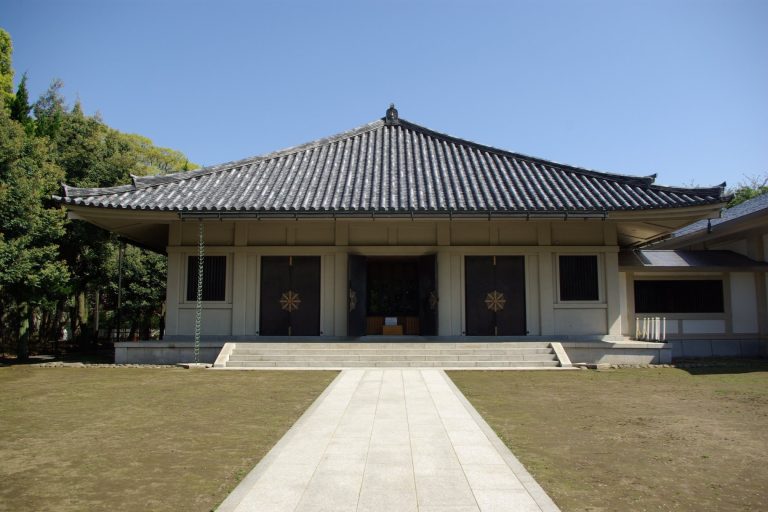
Ōhi Shrine occupies a precinct described in different records as approximately 14,000 to 15,900 square metres, or about 15,000 square metres in broad terms. Its principal sanctuary follows Shinmei-zukuri, an ancient shrine style associated especially with Ise Grand Shrine and characterized by a simple elevated timber building with a restrained gabled form. The precinct combines the main shrine buildings with auxiliary shrines, ritual facilities, a historic lighthouse, school architecture, memorials, and surviving religious objects.
Main shrine buildings
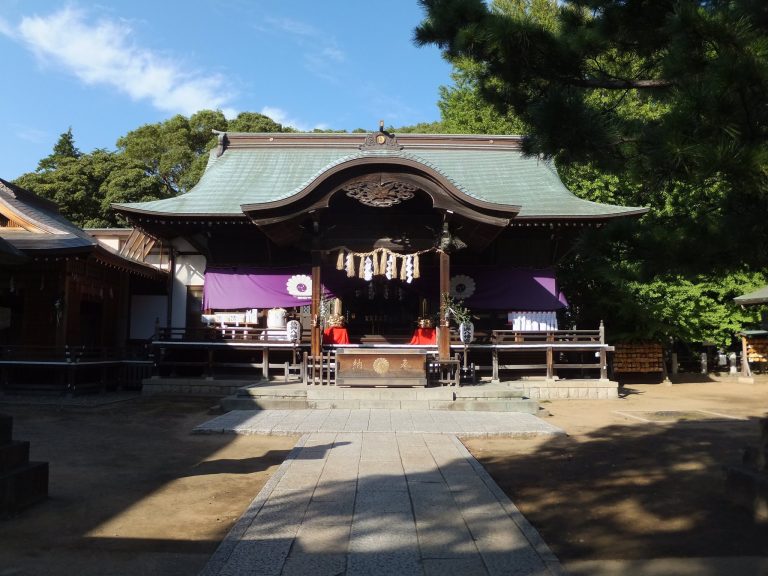
The honden, or main sanctuary, has a Shinmei-zukuri form, and its roof was completely re-covered in 2014. The heiden, a building used for offerings, is an Irimoya-zukuri structure with a copper-sheet roof and an area of approximately 39.67 square metres. The haiden, or worship hall, is also built in Shinmei-zukuri and has a copper-sheet roof covering approximately 79.34 square metres.
Toyoukehime Shrine, also called Geku, was completed in 2015. Its structure originally served as a storehouse at the Inner Shrine of Ise. Tokiwa Shrine was completed in the same year by Obayashi Corporation. Its main building measures approximately 5.45 metres in width, 3.64 metres in length, and 7.58 metres in height. Its karamon, a gate with a curved gable, measures approximately 2.73 metres wide and 5.15 metres high. The complex received an excellence award in the Chiba Prefecture Architectural Culture Awards in 2017.
The Tokiwa Shrine complex houses a wooden statue of Tokugawa Ieyasu and a relic identified as one of his teeth. The precinct also preserves a votive plaque depicting Dainichi Nyorai. The plaque is associated with practices before the modern separation of Buddhism and Shinto and helps explain the shrine’s former solar cult.
Auxiliary shrines and ritual spaces
Auxiliary shrines within the precinct include Toyoukehime, Yakumo, Otori, Ame-no-Mihashira, Yatsurugi, Yasaka, Kotohira, and Funatama shrines. Other recorded auxiliary shrines include Awashima, Ne, Kinenkokoku, Iwanaga-hime, Afuri, Oyamazumi, Kotoshironushi, Okuninushi, Suijin, Musubi, Iwajima, Sumiyoshi, Harae, Kasuga, Katori, Kashima, Tamasaki, Awa, Tenmangu, Tenjin, Hachiman, Kamado, Ryujin, Dosojin, Guest, and Taga shrines.
The Yasaka and Yatsurugi buildings also function as storage buildings for the mikoshi, portable shrines, of the corresponding neighborhood shrines of Honcho and Minatocho. Because the sacred deities remain in the mikoshi, these buildings are treated as shrines as well. Ame-no-Mihashira Shrine underwent completed repairs in 2022, and the boundary fence of Funatama Shrine was replaced in 2023.
The precinct contains a kagura hall, a sumo ring, a well, a building for distributing amulets and other religious items, and additional service and ritual structures. The surviving kagura repertoire includes Miko-mai, Saruta-mai, Okina-mai, a rice-field deity dance, Hiruko-mai, Tenko-mai, Ebisu-Daikoku-mai, and Yamagami-mai. Ebisu-Daikoku-mai is performed only during Setsubun. Three musicians accompany the dancers with a tsuridaiko, a shime-daiko, and flutes.
Historic lighthouse
A lighthouse stands on a small hill in the eastern part of the precinct. The hill was formerly called Fukumiya-zuka and may have been a burial mound. It previously held Asama Shrine and was once known as the Asamayama lighthouse. A medieval land-grant document describes the area as bounded to the east by Fukumiya-zuka and to the south by the sea, indicating its use by fishermen as a navigation landmark. Fires were reportedly lit there before the lighthouse was built.
Local fishermen involved in clam gathering and seaweed cultivation built the lighthouse in 1880. It was abandoned in 1895, dismantled and reconstructed in 1965, and partly repaired on the exterior in 1988 and 1989. The structure is a three-storey wooden building with a tiled roof and a pseudo-Western design. It has a floor area of 68.2 square metres and stands 12 metres high.
The first and second storeys are square, and each contains a Japanese-style room of approximately 12.96 square metres. These rooms served as the keeper’s lodging and lighting space. The third storey is hexagonal and once contained three oil lamps and three tin reflectors, whose light could be seen for up to six nautical miles. Windows occupy its three seaward sides.
Guest hall and later buildings
The guest hall began as the building of Mana Elementary School, the predecessor of Miyamoto Elementary School. Constructed in 1884 and completed in 1885, it is a tiled, hipped-roof building measuring approximately 336.6 square metres. Its plan is sixteen bays wide and five bays long. After the school moved in 1908, the building became the predecessor school of Funabashi High School from 1920 to 1924. It was later used as a wedding venue and is now used for naorai gatherings, ritual communal meals or concluding observances after Shinto ceremonies. Rebuilding was completed in 2019.
The shrine office completed in March 2025 replaced a Meiji-period office damaged by the Great East Japan Earthquake and typhoons. The new building emphasizes earthquake-resistant construction and contains fusuma paintings by the local artist Haruna Watabiki.
Memorials and surviving objects
A memorial tower erected on 28 November 1961 commemorates approximately 2,000 local war dead from the First Sino-Japanese War, the Russo-Japanese War, and the Greater East Asia War. The precinct also contains a China campaign memorial erected in January 1898 with an inscription by Michitomi Higashikuze, a Russo-Japanese War memorial erected in April 1906 with an inscription by Iwao Oyama, and a Chukonhi, a monument dedicated to the spirits of people who died in service or war, erected in June 1926 with an inscription by Hyōe Ichinohe.
The fire of 1868 destroyed many of the shrine’s medieval records, but several materials survive. Among them are the letter attributed to Chiba Mitsutane and the later copy of the 1311 rice-field assessment record. These documents, together with the Tokugawa objects, the Tōshō Daigongen image, the Aoi-crested box, the Ieyasu statue, and the Dainichi Nyorai plaque, preserve parts of the shrine’s political, religious, and local history.