Katsushika Hachimangū: Guardian Shrine of Shimosa Province


Site at a Glance
- Rating
- 4.3
- Popularity
- Medium
- Country
- Japan
- Primary era
- Unclassified
- External website
- Open
- Eras represented
- Unclassified
- Civilizations
- Unclassified
- Site type
- Religious
- Remains
- Sanctuary
On this page10 sections
History
Katsushika Hachimangū is a Shinto shrine in Ichikawa, Japan, traditionally established during the Kanpyō era (889–898) by imperial command of Emperor Uda through the transfer and enshrinement of worship from Iwashimizu Hachimangū in Kyoto. Dedicated to Hachiman, a Japanese deity associated with protection and martial power, it was revered as the principal guardian shrine of Shimosa Province.
Foundation and warrior devotion
The shrine’s martial character attracted the devotion of regional military leaders and ruling houses. Its associated figures include Taira no Masakado, Minamoto no Yoritomo, Ōta Dōkan, Tokugawa Ieyasu, and the Chiba, Kazusa, and Satomi clans. The Chiba and Kazusa were regional warrior lineages, while the Satomi ruled in Awa Province. The place-name Hachiman derives from the shrine, and the nearby woodland called Yawata Shiranazu, meaning the “unknown forest of Hachiman,” is also linked with it.
Katsushika Hachimangū was historically classified as a former prefectural shrine. Its cultural associations extended beyond military and political circles to writers and poets, including Nagai Kafū, Fumiko Kōda, Rohan Kōda, Sachio Itō, Sō Sakon, and Makoto Ōoka.
Buddhist administration and later traditions
Before the separation of Shinto and Buddhism, the Tendai Buddhist temple Hachiman-zan Hōzenji administered Katsushika Hachimangū as its affiliated temple. Hōzenji was also responsible for the shrine’s bell tower, and the Zuishinmon had served as the temple’s Nio gate, an entrance guarded by fierce Buddhist figures.
The annual festival takes place on September 15. For six days from that date, the Boroichi agricultural-implements market is held before the shrine, with stalls offering farm tools, do-it-yourself tools, and other goods. A Thirty-Third-Anniversary Grand Festival is held every 33 years. The latest took place from March 31 to April 3, 2017, and the next is scheduled for 2050.
Precinct improvements in 2016 altered the arrangement of the subsidiary shrines and other religious monuments. The Senbon Ginkgo is designated nationally as a Natural Monument, while the Zuishinmon is an Ichikawa City tangible cultural property and the bronze bell is a Chiba Prefecture tangible cultural property. Graffiti discovered on the shrine office in September 2023 and on the Zuishinmon in January 2024 led to police investigations as building-damage cases.
Remains
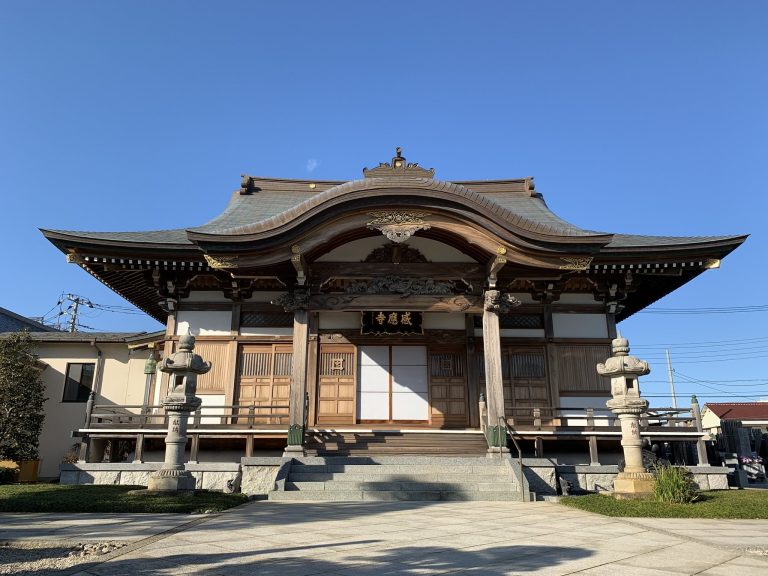
The precinct includes the worship hall, the ancient Senbon Ginkgo, subsidiary shrines, religious monuments, a bell tower, the Zuishinmon, and a bronze bell. These features preserve both the shrine’s Hachiman tradition and physical traces of the period when Hachiman-zan Hōzenji administered the site as a Buddhist temple.
Main shrine precinct
Worship hall and Senbon Ginkgo
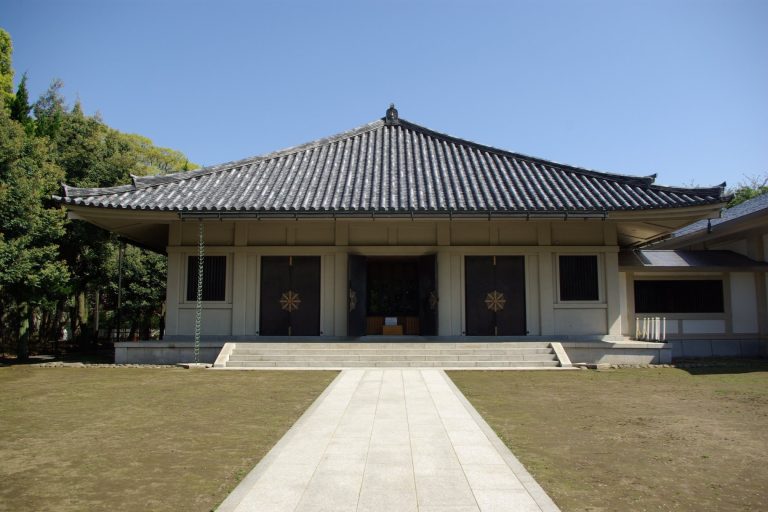
The worship hall forms part of the principal shrine precinct, where the main deities are Homudawake no Mikoto, identified with Emperor Ojin, Okinaga Tarashihime no Mikoto, identified with Empress Jingu, and Tamayoribime no Mikoto. The Senbon Ginkgo stands within the precinct. Estimated to be about 1,200 years old, it reaches 22 meters in height, with a root circumference of 10.2 meters and a trunk circumference at breast height of 10.8 meters. Its trunk circumference at breast height is greater than its circumference at the roots.
Subsidiary shrines and monuments
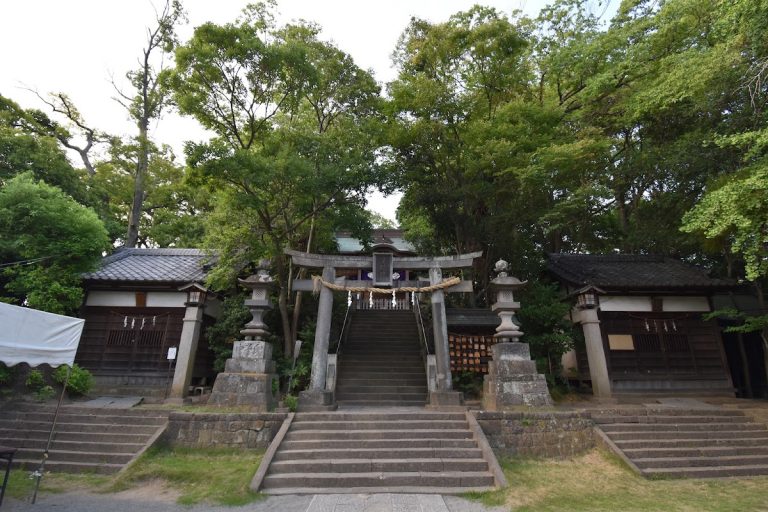
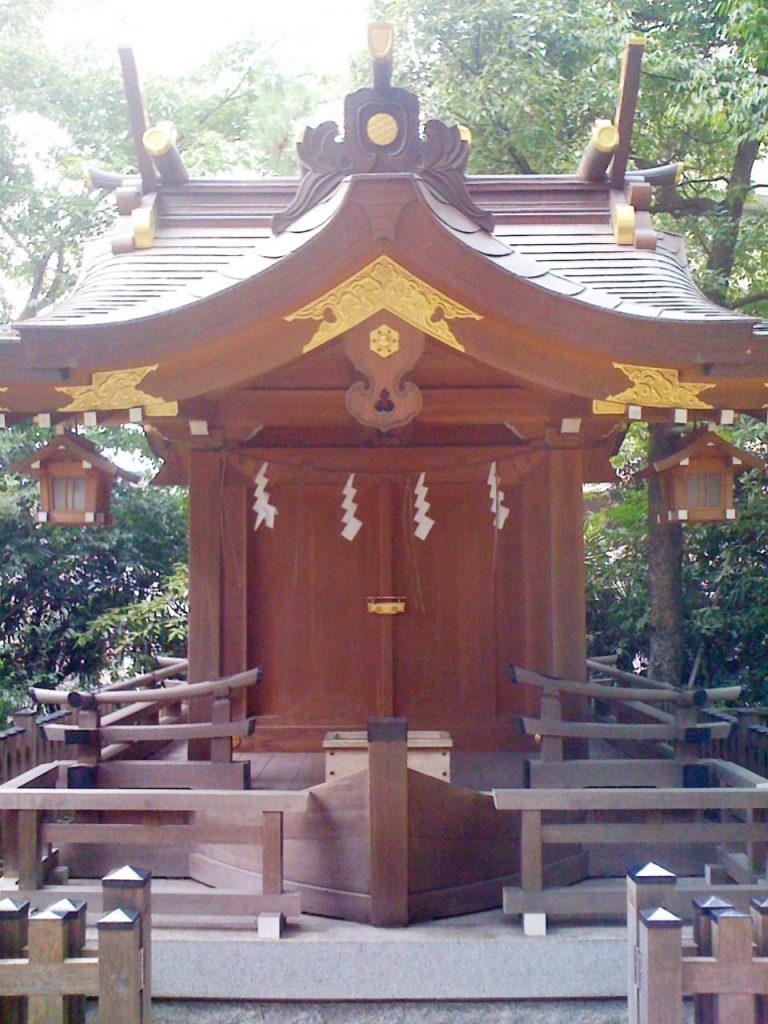
A subsidiary shrine is dedicated to Tagitsuhime no Mikoto, Tagiribime no Mikoto, and Ichikishimahime no Mikoto. Other religious features include two Dosojin shrines, whose deities protect boundaries and roads, a Shōmen Kongō monument associated with Kōshin observances, and Matsuo Daimyōjin.
Features associated with Hōzenji
Bell tower
The bell tower survives as a physical feature associated with the shrine’s former Buddhist administration under Hachiman-zan Hōzenji. Its presence preserves part of the earlier relationship between the Shinto shrine and the Tendai temple.
Zuishinmon and bronze bell
The Zuishinmon was formerly the Nio gate of Hachiman-zan Hōzenji. The bronze bell was cast in 1321. A severe windstorm toppled it in 1793, after which it was excavated beside the roots of a zelkova tree west of the shrine buildings.