Museo Poldi Pezzoli: Milan’s Nineteenth-Century House Museum


Site at a Glance
- Rating
- 4.7
- Popularity
- Medium
- Country
- Italy
- Primary era
- Modern
- External website
- Open
- Eras represented
- Early Modern, Modern
- Civilizations
- Habsburg
- Site type
- Domestic
- Remains
- Elite Residence
On this page16 sections
History
Museo Poldi Pezzoli is a nineteenth-century private house museum in Milan, Italy, created from the collection of Count Gian Giacomo Poldi Pezzoli. Located in the former Palazzo Moriggia Della Porta on Via Manzoni, it preserves both works of art and the domestic settings designed to contain them. The museum forms part of the Case Museo di Milano network of historic house museums and is included among Italy’s national heritage.
Gian Giacomo Poldi Pezzoli and the collection
The Poldi Pezzoli family acquired the palace from the Marquises Moriggia in 1800. Gian Giacomo inherited the family residence and collection when he was 24, in 1846, under the Austrian law then in force. He subsequently expanded the holdings through purchases of paintings, arms and armor, textiles, tapestries, glass, ceramics, jewelry, and other applied arts.
Poldi Pezzoli also supported the Milanese revolutionary movement of 1848, an uprising against Austrian rule. After the Austrian restoration, he was fined and forced into exile. He spent more than a year travelling through Europe, meeting collectors and visiting exhibitions, experiences that helped shape his approach to collecting.
From 1846, he created an independent apartment within the family palace, separate from the rooms of his mother, Rosa Trivulzio. The interiors combined Baroque, early Renaissance, and fourteenth-century forms in an eclectic nineteenth-century design. The rooms were planned to hold paintings, furniture, and other works of art, establishing the character of the collection as a house museum rather than an ordinary picture gallery.
Opening and institutional development
By testamentary provisions, Poldi Pezzoli assigned his apartment and collections to permanent public use and established the Poldi-Pezzoli Artistic Foundation. The museum opened officially on 25 April 1881, two years after his death. The foundation received formal recognition as an Ente Morale, a historical Italian legal status for an institution with a public or charitable purpose, by royal decree in 1887.
Giuseppe Bertini, Poldi Pezzoli’s friend, artistic adviser, and director of the Brera Picture Gallery, became the museum’s first director and held the position from 1881 to 1897. He used the founder’s bequest to make substantial acquisitions, especially of paintings and textiles. Bertini also prepared the first general catalogue in 1881, followed by a second edition in 1886.
After Bertini’s death, the museum’s direction passed to the president of the Brera Academy of Fine Arts. The architect Camillo Boito held the position in 1898. A later advisory commission included artists, patrons, and Milanese notables, among them Boito and Gustavo Frizzoni. The museum became known for bringing together Lombard, Florentine, and Venetian painting with arms, goldsmiths’ work, ceramics, glass, and other decorative arts. The art historian Bernard Berenson later praised its Italian masters as incomparable.
War damage and reconstruction
Bombing during the Second World War, particularly in August 1943, severely damaged the palace. Much of the interior decoration was destroyed, along with the museum’s first topographical inventory. The artworks had been moved to safety before the raids, but the loss of records made the provenance of some older paintings difficult or impossible to establish.
Following closure and reconstruction, the museum reopened in 1951. The interiors were recreated to preserve the original character and atmosphere of the house museum, allowing the institution to resume its role as a cultural center. It is now a nonprofit organization governed by a board that includes the Director of Milan’s Artistic Heritage, delegates of the Ministry of Culture, the Lombardy Region, and the Municipality of Milan, together with an heir of the Poldi Pezzoli family. The armory was rearranged in 2000 in a project by the sculptor Arnaldo Pomodoro.
Remains
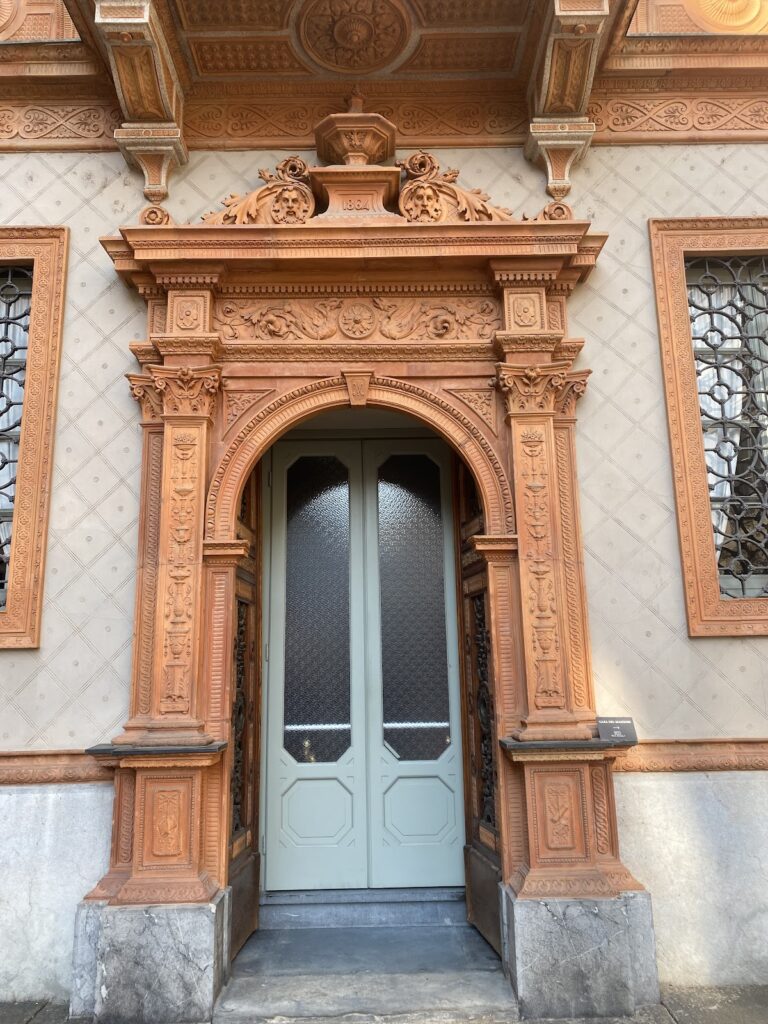
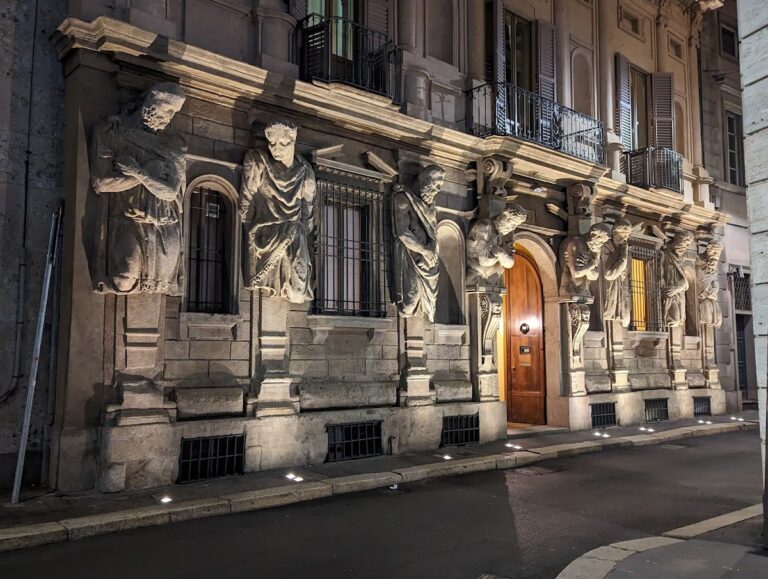
The museum occupies Palazzo Moriggia Della Porta, later called Palazzo Poldi-Pezzoli, a substantial urban palace near Teatro alla Scala. Its façade retains a late-Neoclassical character developed around the turn of the eighteenth and nineteenth centuries. The palace’s small park was redesigned as a landscape garden by the architect Simone Cantoni. Inside, the rooms form an interrelated setting in which architecture, decoration, furnishings, and collections are displayed together.
Historic rooms and interior decoration
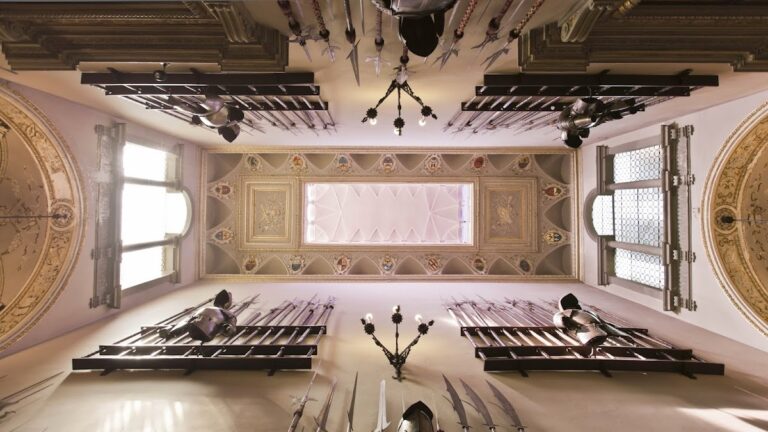
The armory
The first-floor armory was adapted under the direction of the architect Giuseppe Balzaretto and the stage designer Filippo Peroni. Completed in 1850, it was decorated in a Neo-Gothic style, reviving medieval Gothic forms for a nineteenth-century interior. Its arrangement was later revised in 2000 according to a project by Arnaldo Pomodoro.
The bedroom and Studiolo Dantesco
The bedroom was arranged in a Lombard Mannerist style, a regional form of the sixteenth-century Mannerist tradition. The Studiolo Dantesco, created between 1853 and 1856, provided the starting point for the decoration and arrangement of further rooms. Together with the other apartment interiors, these spaces were conceived for the display of art as well as for domestic use.
The decorated rooms and staircase
Giuseppe Bertini, Giuseppe Speluzzi, and Luigi Scrosati worked on the decoration and furnishing of rooms including the Sala Gialla, the Sala Nera, and the monumental staircase. Completed in 1857, the staircase was later enhanced with a Baroque-style fountain. The interiors combine historical decorative languages and contain furniture alongside paintings and applied arts.
Paintings and sculpture
Italian paintings
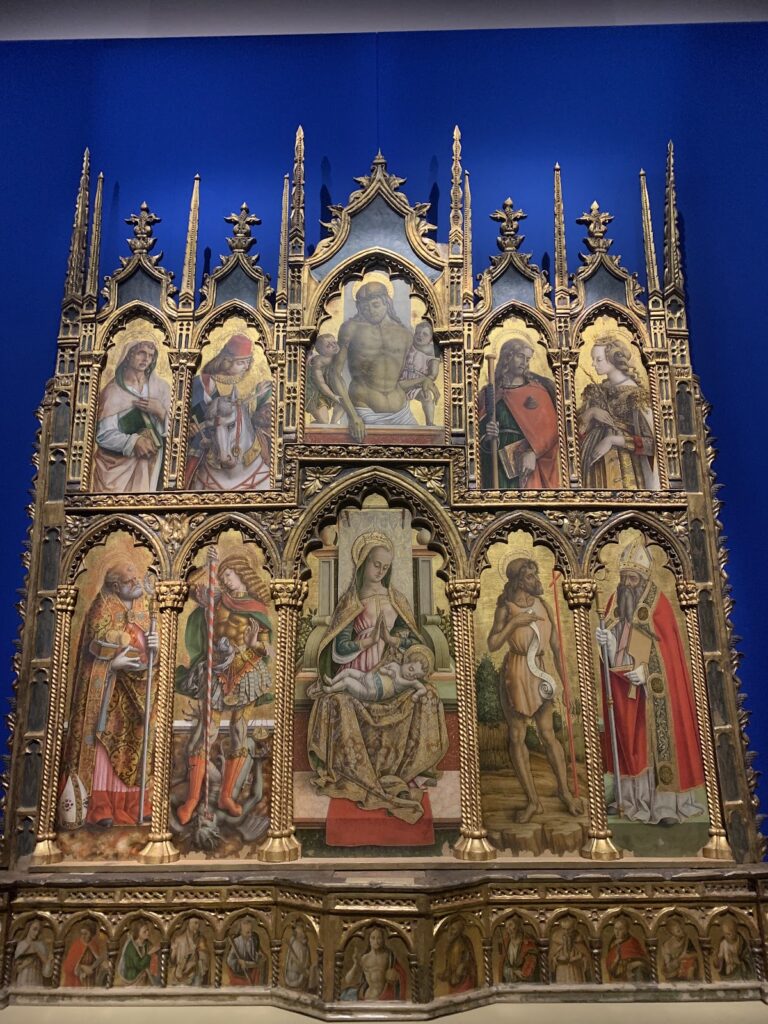
The painting collection is particularly strong in fifteenth-century Italian works, especially from the Tuscan and Lombard schools. It includes Sandro Botticelli’s Madonna of the Book (1480–1481) and Lamentation over the Dead Christ (around 1495), Giovanni Bellini’s Pietà (1455–1460), Fra Filippo Lippi’s Pietà (1437–1439), and Piero della Francesca’s Saint Nicholas of Tolentino (1454–1469).
Other works include Andrea Mantegna’s Madonna and Child (1490–1500) and Profile of a Man (around 1448–1450), Piero Pollaiuolo’s Portrait of a Lady in Profile (around 1470), Giovanni Battista Moroni’s The Gentleman in Black (around 1567), Vincenzo Foppa’s Portrait of Francesco Brivio (around 1495), and Raphael’s Crucifix. The collection also contains works by Ambrogio Borgognone, Giovanni Antonio Boltraffio, Andrea Solari, Bernardino Luini, Lorenzo Lotto, Cima da Conegliano, Francesco de Tatti, and Cosmè Tura.
Named examples by these artists include Borgognone’s Madonna and Child and Saint Catherine of Alexandria, Lotto’s Madonna and Saints and Saint Catherine of Alexandria, Solari’s Madonna and Child, Ecce Homo, Rest on the Flight into Egypt, and Saint John the Baptist, and Tura’s Terpsichore, created around 1460 with Angelo Maccagnino.
Venetian and northern European works
Venetian painting of the eighteenth century is represented by Canaletto’s Prato della Valle in Padua (1741–1746) and Capriccio with Ruins, Cima da Conegliano’s Marriage of Bacchus and Ariadne (1505) and Theseus Killing the Minotaur, and Francesco Guardi’s Gondolas on the Lagoon. Paintings by Fra Galgario include portraits of a knight of the Constantinian Order, a gentleman, and Giovanni Francesco Albani. The Constantinian Order is a dynastic chivalric order associated with the House of Bourbon-Parma and the Spanish Bourbon dynasty.
Sculpture
The sculpture collection includes Lorenzo Bartolini’s Trust in God and Giovanni Angelo Del Maino’s carved Marriage of the Virgin. These works form part of the museum’s broader presentation of Italian art within historic rooms rather than in a separate sculpture gallery.
Decorative arts and textiles
Carpets and furnishings
The holdings include Persian carpets from the sixteenth century. Among them are a late-sixteenth-century carpet associated with Herat, a carpet from the first half of the sixteenth century possibly attributed to Tabriz, and a late-sixteenth-century carpet associated with Isfahan.
Applied arts and arms
Other decorative-art holdings include a notable group of clocks, Limoges enamels, medieval and Renaissance French and Lombard goldsmiths’ work, carpets, tapestries, jewelry, textiles, lace, ceramics, glass, and arms. Limoges enamels are decorated metal objects made with techniques associated with Limoges in France, while cabinet bronzes are small bronze works intended for display as luxury furnishings or collectible objects. Together with the armor and the furnishings, these objects preserve the wide collecting scope that shaped the museum’s rooms.