House Manzoni: A Literary Museum and Historic Palace in Milan


Site at a Glance
- Rating
- 4.5
- Popularity
- Medium
- Country
- Italy
- Primary era
- Modern
- External website
- Open
- Eras represented
- Modern
- Civilizations
- Italian
- Site type
- Domestic
- Remains
- Elite Residence
On this page8 sections
History
Manzoni’s Milanese Home
House Manzoni is a historic palace in Milan, Italy, whose present appearance largely reflects an 1864 remodeling in the Renaissance Revival style. Alessandro Manzoni, the nineteenth-century Italian novelist and poet best known for The Betrothed, lived there from 1814 until his death in 1873.
After returning to Milan from Paris in 1810, Manzoni lived with his wife, Enrichetta Blondel, and his mother, Giulia Beccaria. The family first stayed on Via San Vito al Carrobbio and later moved to the Beccaria family residence on Via Brera. On 2 October 1813, Manzoni purchased the building then numbered 1171 on Via Morone from Alberico De Felber for 16,000 lire. He moved into it several months later and began modernizing the property, including work on the facade facing Piazza Belgiojoso.
Remodeling and Literary Associations
In 1864, Manzoni commissioned the sculptor and decorator Andrea Boni to remodel the palace. The work reinterpreted Renaissance architectural forms and decoration in a style associated with the cultural climate of post-unification Italy. The house also hosted meetings of Il Conciliatore, a Milanese literary and intellectual circle connected with reform-minded cultural debate in the early nineteenth century.
During Manzoni’s final years, Cavour, Giuseppe Garibaldi, and Giuseppe Verdi visited the house to pay their respects. Cavour and Garibaldi were central figures in the political unification of Italy, while Verdi was one of the country’s leading nineteenth-century opera composers.
From Private Residence to Museum
After Manzoni’s death, his heirs sold the palace in 1873 to Count Bernardo Arnaboldi-Gazzaniga. In tribute to the writer, the count opened Manzoni’s study and bedroom to visitors on the anniversary of his death. Attilio Ville acquired the house in 1919, followed by the Dubini brothers in 1922. In 1937, the Cassa di Risparmio delle Province Lombarde donated the building to the city.
On 20 March 1941, the palace was transferred to the National Center for Manzonian Studies, an institution devoted to research into Manzoni’s life, writings, and historical importance. Its staff found that parts of the interiors had been altered, so reconstruction began that year under Marino Parenti to restore their appearance during Manzoni’s lifetime. The Second World War interrupted the work, which resumed afterward and was completed in the first half of the 1960s. The study and bedroom were fully restored, and the palace became a museum dedicated to Manzoni’s life and work on 15 December 1965.
The building has also housed the Historical Lombard Society, a scholarly institution concerned with the history of Lombardy. Its specialized library contains more than 40,000 volumes on the subject, while the society is now located in the National Braidense Library. The museum and palace remain associated with the National Center for Manzonian Studies, and the building is identified as being owned by the Lombardy Region.
Remains
Facade and Exterior
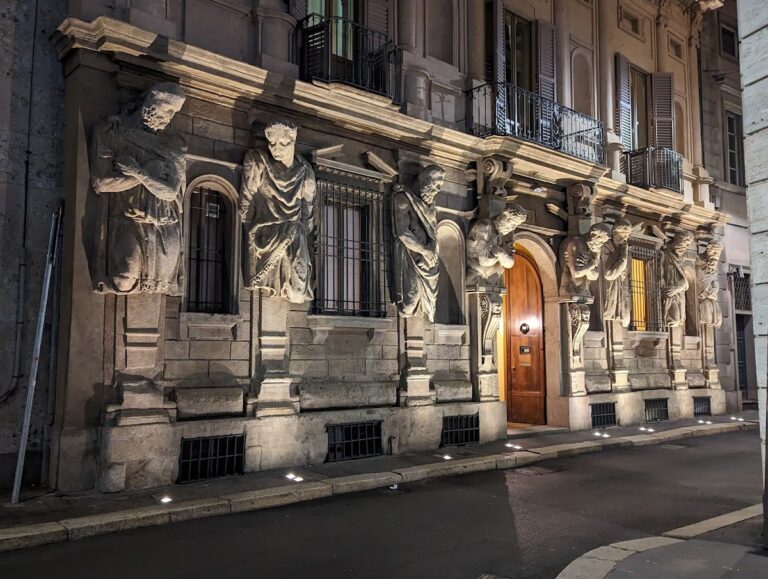
House Manzoni stands at Via Morone 1 in central Milan, with its principal facade facing Piazza Belgiojoso. The palace predates the 1864 remodeling, but its present exterior largely derives from Andrea Boni’s intervention. The facade draws on Lombard Renaissance architecture and is covered with elaborate red terracotta ornament, made from fired clay. Its portal and balcony form the most prominent elements of the exterior.
Museum Rooms and Interior
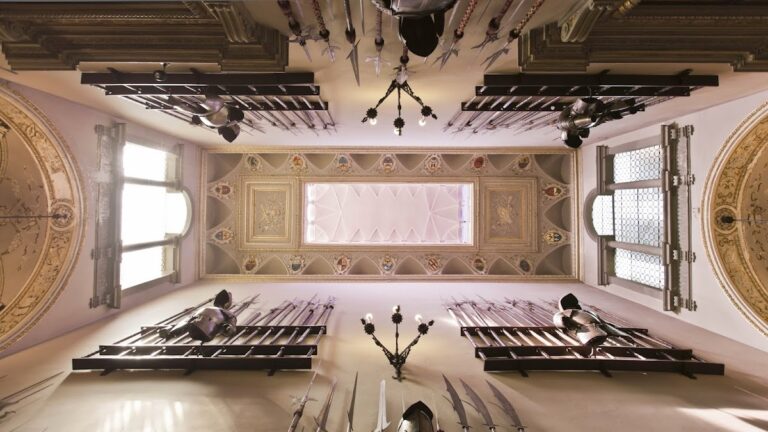
The museum occupies two ground-floor rooms overlooking the garden and six rooms on the first floor. Original furnishings and period ornaments have been preserved in the museum rooms, particularly in Manzoni’s study and bedroom. These interiors were reconstructed after the Second World War in order to recover the appearance of the rooms during the writer’s lifetime.
Research and Library Spaces
The ground floor contains the National Center for Manzonian Studies and has also housed the Historical Lombard Society. The society’s specialized library holds more than 40,000 volumes devoted to the history of Lombardy, adding a scholarly function to the palace’s preserved domestic and museum spaces.
Nearby sites