Laufen Castle: A Medieval Castle Above the Rhine Falls


Site at a Glance
- Rating
- 4.6
- Popularity
- Low
- Country
- Switzerland
- Primary era
- Medieval
- External website
- Open
- Eras represented
- Medieval, Early Modern, Modern
- Civilizations
- Carolingian, Holy Roman Empire, Swiss
- Site type
- Domestic
- Remains
- Castle
On this page8 sections
History
Laufen Castle is a castle in Laufen-Uhwiesen, Switzerland, whose construction began around the 850s. First documented in 858, it became the ancestral residence of the Barons of Laufen, who held the castle as feudal vassals of the Bishopric of Constance, the ecclesiastical principality governed by the bishops of Constance.
Medieval feudal residence
A vogt, a medieval official who governed on behalf of a higher lord or institution, exercised direct administrative control at Laufen. The castle therefore served both as an aristocratic residence and as a centre of local authority.
Zurich reconstruction
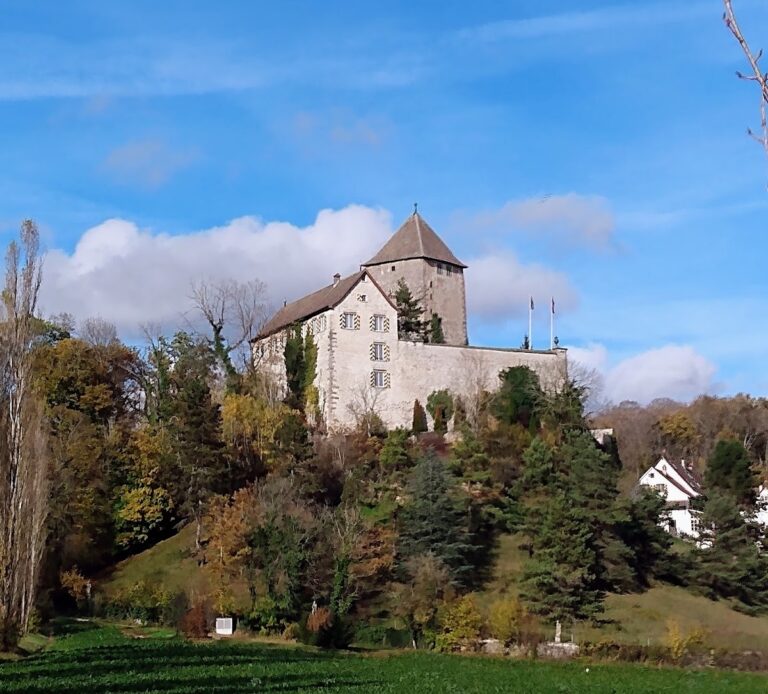
After the Old Zurich War, a conflict between Zurich and the Swiss Confederacy from 1439 to 1450, the Fulach family acquired Laufen Castle. Zurich authorities purchased it in 1544 and immediately reconstructed the fortress. Much of the appearance associated with Laufen today dates from this transformation.
From fortress to artistic residence
The French invasion of 1798 and the creation of the Helvetic Republic, a centralized Swiss state established under French influence, altered the former feudal system. Laufen was subsequently viewed less as a defensive work and more as a picturesque residence. Johann Heinrich Bleuler the Elder, a Swiss painter and printmaker, established an art workshop there between 1799 and 1804. His son, Johann Ludwig Bleuler, later opened a painting school at the castle. The Bleuler family became its principal tenants in 1830 and purchased it in 1845.
Zurich ownership and recent reconstruction
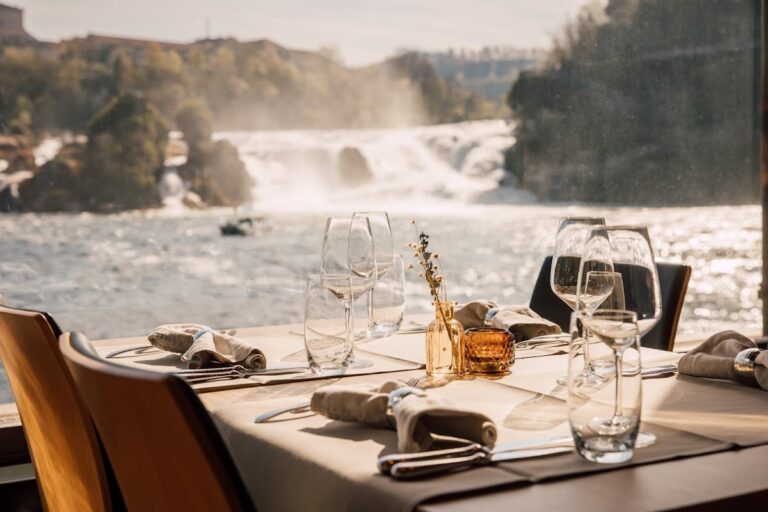
Laufen Castle returned to Zurich ownership in 1941 and underwent extensive reconstruction in the following years. A restoration and expansion project between 2009 and 2010 added a visitor centre in the former staff quarters, an exhibition in the northern part of the castle, and connections between the castle and the river levels. Laufen is a Swiss heritage site of national significance and now contains a restaurant, a youth hostel, and the northern exhibition.
Remains
Castle above the Rhine
The castle stands on the left bank of the High Rhine, the river section extending from Lake Constance toward Basel, on steep rock above the Rhine Falls. Its buildings overlook the river and waterfall, while Wörth Castle is visible on the opposite bank in the canton of Schaffhausen. This elevated position places the castle directly above the river landscape that shaped its setting.
Railway and river connections
The Rheinfall railway line passes through a tunnel cut into the rock beneath the castle and follows the left bank of the Rhine. A nearby railway station is connected to the castle by a walkway and elevator. Modern additions include the visitor centre, the northern exhibition area, and a wheelchair-accessible circular walkway with a glass lift linking the castle level with the river level. A path descends from the castle toward the Rhine Falls and reaches viewpoints near the water.
Nearby sites