Wörth Castle: A Medieval Customs Fortress on the Rhine Falls


Site at a Glance
- Rating
- 4.2
- Popularity
- Low
- Country
- Switzerland
- Primary era
- Medieval
- External website
- Open
- Eras represented
- Medieval, Early Modern, Modern
- Civilizations
- Habsburg, Swiss
- Site type
- Military
- Remains
- Castle
On this page8 sections
History
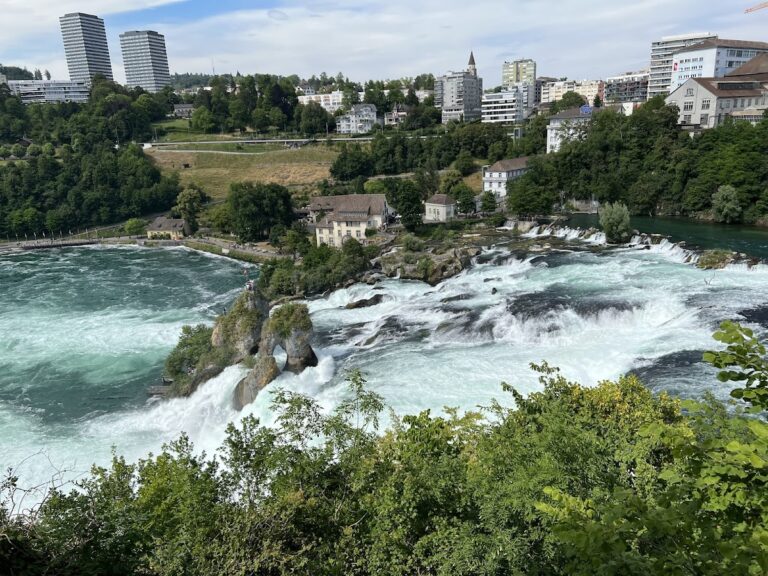
Wörth Castle is a medieval fortification in Switzerland, in Neuhausen am Rheinfall. Built in 1348, it occupied a small island in the basin of the Rhine Falls and served both as a customs station and as a secure point for transferring goods between riverboats and wagons.
Medieval Customs Station
The site stood on the east-west trade route linking Lake Constance with Basel. The Rhine Falls and the rapids near Schaffhausen interrupted navigation, so merchandise had to be unloaded from boats and carried overland before being loaded again. Wörth controlled this transfer area and collected customs duties. Its predecessor, Burg im Fischerhölzli, later called Burg Werd, had been built in the eleventh century. Archaeological excavations in 2004 identified 1348 as the construction date of the present castle.
In the thirteenth century, Wörth was a fief of the Habsburg dukes, members of a major European ruling dynasty that controlled extensive territories and feudal rights. The earliest known holders were the Lords of Jestetten, whose family later used the name Meyer von Werd. The Schultheissen of Randenburg, officials exercising judicial or administrative authority for a ruler or town, acquired the castle in 1291. The Lords of Fulach held it from 1422, and in 1429 it passed to Allerheiligen Abbey in Schaffhausen, a Benedictine monastery.
Abbey Fief and Schaffhausen Administration
In the late 1790s, the custodian Gertzler held Wörth as a hereditary fief from Allerheiligen Abbey. His rights extended beyond the castle to the salmon fisheries, customs duties, vineyard, forest, and fields. He collected customs for the abbey, handed over two-thirds of the salmon catch, and could cut timber for his own subsistence. He paid an annual lease of 30 thaler for the vineyard and fields, while the abbey could revoke the fief if its obligations were not met.
Goethe visited the castle on 18 September 1797. He entered the establishment for a glass of wine, asked Gertzler about his work, and noted conditions at Wörth in his diary. After Allerheiligen Abbey was abolished in 1524, the castle became an administrative district of the city of Schaffhausen. The city transferred it to the Canton of Schaffhausen in 1832, and the canton remains its owner.
Transformation into a Restaurant
Railway construction reduced the importance of the water route and its associated transshipment work. In 1835 and 1836, the Canton of Schaffhausen rebuilt Wörth as the Café and Dining Establishment Schlösschen Wörth. The former customs station and salmon-fishing operation opened as a restaurant on 2 February 1837, Candlemas. The renovation costs were charged to Allerheiligen Abbey, the former owner. Wörth is listed in the Swiss inventory of cultural property of national and regional significance as a Class B object of regional importance.
Remains
Island Fortress and Tower
Wörth is a water castle on a small island in the Rhine, surrounded by the waters of the Rhine Falls basin. The island was historically called Werd, a word meaning “river island.” The surviving castle consists largely of an irregular hexagonal tower standing on rock encircled by the river. Its basic form may reach back to the castle’s original construction period, and the tower rises through three storeys.
A bridge once connected the right bank of the Rhine with the castle’s walled courtyard, which was enclosed by a ring wall. The island is now reached by a footbridge or gangway. The courtyard preserves the arrangement of a fortified customs and transshipment point, while the present landing connection reflects Wörth’s later role in river transport.
Courtyard Building and Alterations
A palace-like building occupied the northern side of the courtyard. Its upper level originally included a projecting timber clerestory, an upper storey with windows that brought light into the building above the lower sections. In 1621, the timber feature was replaced by a stone floor. The building’s three storeys were fitted with halls of different heights, measuring eleven, ten, and nine feet.
The remodelling of 1621 and 1622 inserted additional floors, opened new windows, and changed the ring wall and gate. Parts of the wall and entrance were altered or demolished during this work. These changes left the castle with a mixture of medieval foundations and later structural modifications.
Modern Additions and Present Use
A covered panoramic terrace was added in the 1960s, affecting the historic appearance of the castle. At the same time, a modern concrete self-service restaurant, kiosk, and toilet facilities were built beside the historic structure on the island, together with a landing stage for excursion boats.
Wörth now contains a restaurant, a shop, and a fast-food establishment connected with a terrace overlooking the Rhine Falls. The castle also serves as the departure point and terminal for Rhine excursion boats, continuing the island’s association with movement across the river while retaining its medieval tower and courtyard setting.
Nearby sites