Rheinau Abbey: A Benedictine Monastery on a Rhine Island in Switzerland


Site at a Glance
- Rating
- 4.7
- Popularity
- Low
- Country
- Switzerland
- Primary era
- Early Modern
- External website
- Open
- Eras represented
- Early Modern
- Civilizations
- Holy Roman Empire
- Site type
- Religious
- Remains
- Monastery
On this page18 sections
History
Rheinau Abbey is a Benedictine monastery in Switzerland, traditionally founded around 778 on an island in the Rhine. Its surviving complex largely reflects the Baroque rebuilding of the eighteenth century, while its history extends from the early medieval period to its suppression in 1862. Dedicated to the Virgin Mary and, from 1114, also to Saint Fintan of Rheinau, the abbey became an imperial abbey with extensive religious, legal, and landed privileges.
Foundation and early community
A foundation legend tells of a noble fisherman who was swept toward the Rhine Falls but survived. He is said to have established the monastery at the place where he believed his life had been restored. The historical foundation is associated with Duke Wolfhard, son of Ruthard and father-in-law of Louis the Pious, the Carolingian ruler.
The monastery faced difficulties in its early development. Wolfhard’s son Wolfinus, also called Ethico, and his grandson Wolfenus are said to have rebuilt it from the ground up. Wolfenus received assistance from the Irish monk Fintan, who lived at Rheinau for more than twenty years as an inclusus, a religious recluse who chose a secluded life in or beside a religious institution. Fintan died in 878 with a reputation for holiness, and later devotion to him became a defining part of Rheinau’s religious identity.
The first written reference to the monastery dates from 844. Monks from St. Gall and Reichenau repopulated the community, probably no earlier than 837, and Gozbert, summoned from St. Gall by Wolfen, is the first identifiable abbot after the refoundation. In 858, Louis the German elevated Rheinau to an imperial abbey. This status placed the monastery under royal protection, freed it from local territorial claims, allowed the monks to elect their own abbot, and gave them the right to appoint their own secular protective advocate. Wolfen had transferred the monastery to Louis and received it back for life on 12 April 858.
The transfer of the relics of Saint Blaise from Rome increased Rheinau’s renown. Part of those relics was moved to Albzell in 866 or 870, helping to support the later development of St. Blasien. By 885, the community numbered 44 monks, most of them from the regional nobility. Rheinau maintained links with St. Gall and, from the early twelfth century, with Hirsau Abbey. These relationships contributed to the compilation of the Liber Ordinarius Rhenoviensis, a book governing the order of worship. A community of nuns also occupied the western part of the island between the eleventh and thirteenth centuries.
Medieval organization and lordship
Rheinau’s religious and administrative structure expanded during the Middle Ages. A prior, cellarer, chamberlain, and custodian appear after 1200, while a schoolmaster is known by 1288. A monastery school already existed in the thirteenth century, and the Benedictine Rule was explicitly associated with the community by 1297. The abbey’s liturgy was preserved in the Graduale Rhenaugensis. Its medieval library held valuable liturgical manuscripts and an eighth-century codex described as probably the oldest codex in Switzerland, although the existence of a writing workshop at Rheinau remains uncertain.
The abbey’s prosperity alternated with periods of pressure from its protective advocates and from the bishops of Constance. These disputes were especially acute during the Investiture Controversy, the medieval struggle over the appointment of bishops and other church officials by popes, emperors, and secular rulers. Bishop Solomon II of Constance strongly supported Rheinau between 876 and 889. Conrad of Constance, later recognized as a saint, served as abbot from 963 to 975.
Count Rudolf of Lenzburg fortified the settlement beside the monastery in 1126. After the Lenzburg line died out, protection passed in 1173 to Emperor Frederick I and later to Henry VI. The Freiherren of Krenkingen then became the abbey’s protective advocates, or Vögte, secular officials who exercised legal or administrative authority for a monastery. In 1241, Emperor Frederick II bought the protective jurisdiction back from them for 1,200 marks of silver. The abbey’s older rights were confirmed in the Golden Bull, and its abbot also held the right to mint coins.
Rheinau exercised secular jurisdiction, apart from criminal justice, in the town of Rheinau and at Altenburg. Its possessions and rights extended on both sides of the Rhine from the Untersee through the Klettgau and Alpgau toward the eastern Black Forest. Farms, land, vineyards, patronage rights, ferry and tavern rights, protective jurisdictions, rents, and tithes formed part of this estate. Manors and local officials administered these holdings, with an administrator taking on this role from 1496.
Reformation and Catholic renewal
From 1455, Rheinau held a protection treaty with the Old Swiss Confederacy against the territorial claims of the Counts of Sulz and other noble families in the Klettgau. During the same period, criminal jurisdiction passed to local authorities. The abbey later acquired the lordship of Ofteringen in 1678 and purchased those of Mammern and Neuburg in 1687.
The Reformation reached Rheinau from Zurich in 1529. The monastery was abandoned briefly and plundered, but it was restored and repopulated in 1532. It then became an important center of the Catholic Counter-Reformation, the Catholic reform and institutional response to the spread of Protestantism. From 1603 until its suppression, Rheinau belonged to the Swiss Benedictine Congregation, a federation of Swiss Benedictine monasteries that coordinated religious life and governance.
Baroque rebuilding and later suppression
Rheinau enjoyed a late period of prosperity in the eighteenth century under Abbot Gerold II Zurlauben. He sponsored the rebuilding of the monastery church, which was dedicated in 1710, and the reconstruction of the conventual buildings, completed by 1744. Earlier building campaigns had taken place under Abbot Johann Theobald Werlin and Gerold I Zurlauben. The resulting complex preserved the abbey’s monastic functions while giving them a unified Baroque architectural setting.
The upheavals following the French invasion of Switzerland brought another interruption. The abbey was temporarily dissolved in 1798 and plundered during the French occupation, then restored in 1803 under the Act of Mediation. In 1834, the abbey’s territory and the town of Rheinau were assigned to the restored canton of Zurich, and the monastery was placed under cantonal control. During the 1830s, the canton prohibited the admission of novices, ended the continuation of the monastery school, and restricted the arrival of monks from other monasteries.
The Zurich Grand Council dissolved the abbey in 1862, when eleven monks remained. Its last abbot, Leodegar Ineichen of Urswil-Hochdorf, died in 1876. After the dissolution, his staff went to Beuron Abbey, while an older late-Gothic staff was transferred to Saint Meinrad Archabbey in Indiana. The archive went to the State Archives of the canton of Zurich, and the library was dissolved in 1864. Much of its printed and manuscript material passed to the Zurich Central Library, while records and legal documents entered the cantonal archives.
Later uses and continuing religious life
The former abbey buildings became a cantonal hospital and nursing institution in 1867 and later housed a psychiatric clinic, which closed at the end of 2000. Since March 2003, the Spiritual Way Community, a young Catholic religious community, has continued a form of religious life on the monastery island and operates a retreat house. The former abbey church serves as the parish church of Rheinau. The former monastery buildings also accommodate the Musikinsel Rheinau music center, while subsidiary buildings have been used since 1999 by the Fintan Foundation for social therapy, biodynamic agriculture, and related activities.
Parts of the subsidiary buildings were conserved between 2003 and 2005 by the Fintan Foundation and cantonal authorities. The former Imperial Hall in the guesthouse was restored with historically based wall paintings. The abbey’s art collection, inventoried in 1818 at about 2,300 works, was largely sold, although approximately 200 objects have since been located.
Remains
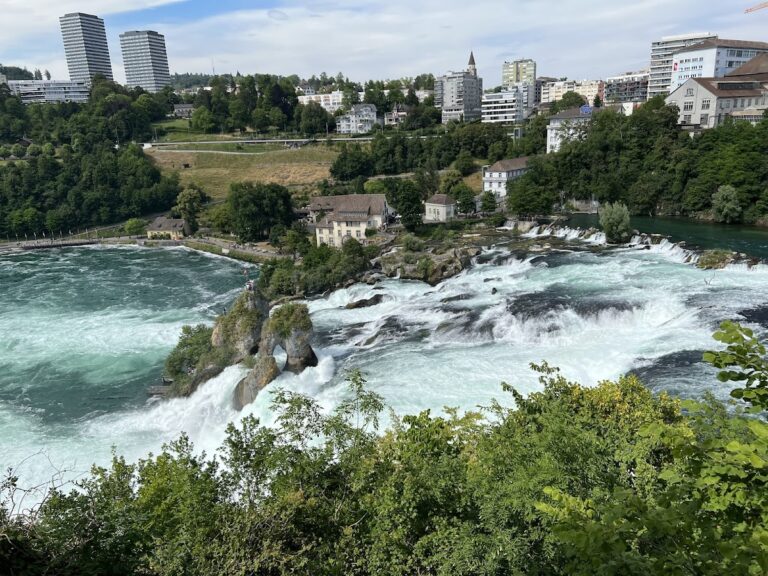
Rheinau Abbey occupies an island surrounded by a loop of the High Rhine. Until about 1580, the entire monastic complex stood on the island, whose access was closed by a tower known as early as 1247. Utility buildings were later established beyond the Rhine bridge. The surviving layout is principally the result of the eighteenth-century rebuilding, with the church, conventual buildings, guest facilities, agricultural structures, gardens, cellars, and later subsidiary buildings forming the material remains of the former abbey.
Church and interior furnishings
Baroque church
The present church was built between 1705 and 1710 in the Baroque style, replacing an earlier religious complex that included a pre-Romanesque Marian basilica mentioned in 888 and a Romanesque basilica consecrated in 1114. Franz Beer of Blaichten, a master builder from Vorarlberg, carried out the Baroque rebuilding. The church is dedicated to the Assumption of Mary and retains a monumental double-tower facade with distinctive tower caps.
Inside, frescoes by Francesco Antonio Giorgioli of Meride accompany stucco epitaphs for the abbots by Pontian Gigel, Michael Schnell, and Franz Schmuzer. Johann Reindl, a sculptor from Constance, made the pulpit in 1756. Constance metalworkers Hans Jörg Allweiler and Franz Scheuermann produced the wrought-iron choir screens. Franz Carl Stauder painted the altarpiece of the Marian altar, while Franz Ludwig Hermann, court painter at Constance, painted the altarpiece of the Saint Blaise altar.
Fintan monument and furnishings
Johann Josef Auer carved the baptismal font and other woodwork, including Fintan’s tomb, which was designed by the painter Hans Martin Lampard of Tiengen. Anton Joseph Schupp of Villingen made the Fintan altar, the choir-organ console, and the standing figures on the choir stalls. The sacristy contains vestment cupboards decorated with intarsia, a surface ornament made by inserting contrasting pieces into a supporting material, produced in the monastery workshop.
Fintan’s Baroque funerary monument occupies the position associated with his grave in the earlier Romanesque basilica. His relics were discovered in 1446 and are preserved in a sarcophagus in the abbey church. The church also possesses a historic six-bell peal. Its second bell is the Apostle, or Peter, Bell; the fifth is the Mary Bell; and the sixth is called Osanna. The first bell weighs approximately 2,150 kilograms.
Organs and conservation
The main organ was built between 1711 and 1715 by the Augsburg organ builder Johann Christoph Leo. Friedrich Haas rebuilt it in 1840 and 1841 as an early Romantic instrument. The Kuhn organ workshop restored its 1715 Baroque state between 1988 and 1990, following an earlier restoration in 1941.
Johann Christoph Albrecht built the choir organ in 1710, and Johann Conrad Speisegger largely rebuilt it in 1746. After the abbey’s dissolution, it became unplayable and was partly stripped. Restoration took place in 1944 and 1945, followed by a thorough overhaul by Orgelbau Kuhn in 1990 and 1991 that returned it to its 1746 condition. The church underwent several renovations after 1952, with the principal conservation campaign taking place from 1973 to 1991. The latest renovation of the towers, including the repainting of their caps, was completed in 2009.
Library and collections
Library pavilion
The library built under Abbot Gerold II Zurlauben occupied a pavilion projecting northward from the east wing. Its ceiling was formed by five cross vaults carried on half-pillars. The library was dissolved in 1864, and in 1881 a further 38 hundredweight of books were sold to an antiquarian in Basel. The sale included illuminated parchment manuscripts and a Gutenberg Bible.
The former library held the Codex Rhenaugensis, the Graduale Rhenaugensis, other Gregorian manuscripts, and approximately 300 fifteenth-century printed works. Six of these were unique copies, while the Missale speciale was known in only four copies. The early printed books covered schooling, theology, and monastic life. Surviving Rheinau holdings at the Zurich Central Library include 270 medieval codices, almost 1,000 early-modern manuscripts, and about 13,000 printed works, including 306 incunabula, books printed in Europe before approximately 1501.
Dispersed artistic heritage
The abbey’s wider collections included liturgical manuscripts, prayer and service books, historical and scientific works, numismatic books, heraldic and genealogical materials, an art cabinet, paintings, and other artworks. Objects known to have left the collection include the Fintan chalice, now in the Cluny Museum in Paris, and a Roman reliquary bust of Saint Maurice, now in the Swiss National Museum.
Conventual and agricultural buildings
Principal monastery buildings
Johann Michael Beer constructed the principal conventual buildings according to plans prepared by Caspar Moosbrugger in 1702 and 1719. These buildings, completed by 1744, have largely retained the form created during the Baroque rebuilding. The former monastery and subsidiary structures include a guesthouse, stables, a monastery barn, cellars, residential buildings, and a women’s guesthouse built between 1740 and 1744.
Mühlesaal
The Mühlesaal building was constructed between 1727 and 1729 under Gerold II Zurlauben. Michael Beer built it to a design by Peter Thumb, replacing a mill erected in 1559 under Abbot Heinrich Schenk von Castell. Its original interior contained a two-storey ceremonial hall six metres high. Jacob Appiani of Porto Ceresio created the stucco decoration in 1729, and Jakob Stauder painted the ceiling.
Between 1862 and 1867, the hall was divided into two storeys when the complex was converted to new uses. Its paintings and stucco were lost, but its two-winged door with intarsia decoration survived and was restored in 1977 and 1978. The original dimensions of the hall were intended to be reconstructed, while the lost paintings and stucco could not be recovered.
Cellars and gardens
The abbey had a large wine cellar, reflecting the importance of agriculture and viticulture to its maintenance. The cellar is still used by the State Winery of Zurich. A separate wine cellar built beyond the bridge between 1585 and 1588 was among the later utility buildings associated with the complex.
The former monastery garden is used for propagating organic seed and breeding new vegetable varieties. A garden devoted to grape varieties is used to test vines for ecological wine production. These present uses continue agricultural activities associated with the physical organization of the former monastic estate.
Nearby sites