Munot: Schaffhausen’s Circular Artillery Fortress


Site at a Glance
- Rating
- 4.7
- Popularity
- Medium
- Country
- Switzerland
- Primary era
- Early Modern
- External website
- Open
- Eras represented
- Early Modern, Modern
- Civilizations
- Swiss
- Site type
- Military
- Remains
- Fort
On this page14 sections
History
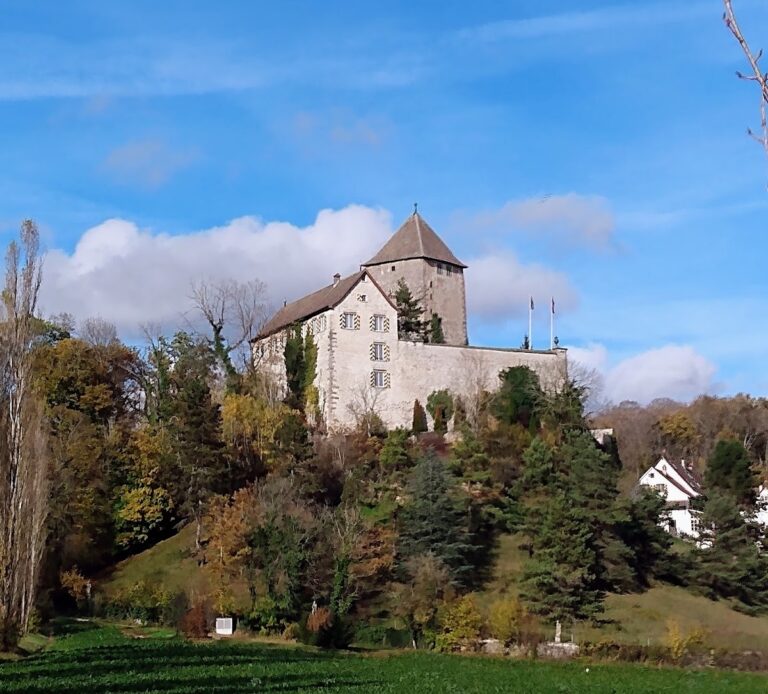
Munot is a circular fortress in Switzerland, rising above the center of Schaffhausen and its old town. Built between 1564 and 1589 as a sixteenth-century artillery fortress, it formed part of the city’s defenses and became Schaffhausen’s landmark and a symbol of its civic power.
Medieval fortified site
A fortified place called Annot or Unot is recorded here from 1098. The name comes from a Middle High German expression meaning “without need.” The site was initially held by a nobleman, probably a Vogt, a medieval official who could exercise administrative or judicial authority over a territory or fortified place. The proposal that Roman forces previously built a watchtower here as part of their Rhine frontier defenses remains unverified.
Before the present fortress, the site included the Zwingolf, an advanced defensive platform. It was demolished in 1561, creating the immediate setting for a new military structure.
Construction and changing artillery
On 6 November 1563, Schaffhausen’s city council decided to build a new artillery fortress. Work began in 1564 and continued until 1589 under Heinrich Schwarz, the city master builder. The design was probably influenced by knowledge of Albrecht Dürer’s work on rondelles, circular artillery towers or fortifications designed to mount guns and resist artillery fire. Construction partly depended on compulsory civic labor and cost 47,528 guilders, roughly the price of 800 town houses.
Munot represented a transition between the medieval castle and the modern fortress. Yet its military value was questioned soon after completion. During the twenty-five years of construction, artillery had advanced considerably, while the newer bastioned system was spreading through Europe. Bastions were projecting, usually angular sections of fortifications that allowed defenders to cover walls and reduce blind spots, and Munot’s circular design was already outdated in comparison.
Seventeenth-century plans and the French occupation
During the Thirty Years’ War, the major European conflict of 1618 to 1648, Schaffhausen considered strengthening Munot with earthworks and an outwork. In 1646, Johann Georg Werdmüller prepared a plan estimated to cost 165,627 guilders. The project was abandoned after the Peace of Westphalia, the treaties concluded at Münster and Osnabrück in 1648 that ended the war.
French troops occupied Schaffhausen and Munot on 1 October 1798. French officers had appeared in the city on 15 June, and André Masséna arrived on 15 November to request quarters for French troops wounded in the battles of Ostrach and Stockach. General Jean-Baptiste Jourdan established an ammunition depot, and Munot was equipped with artillery.
The bombardment of 1799
On 13 April 1799, Austrian forces under General Maximilian Baillet von Latour and Major Michael von Kienmayer positioned about 6,000 men near Herblingen and Büsingen. Their artillery stood at Buchthalen on the Windegg. After the city and fortress failed to answer a demand for surrender, the Austrians began bombarding them at about 3 p.m. Munot’s garrison returned fire, but the city was stormed at about 5 p.m. The garrison threw its guns into the moat, where Austrian troops seized them. French forces then burned the Grubenmann Bridge to prevent pursuit.
This was Munot’s only military engagement. The bombardment caused serious damage, and the fortress subsequently lost its military importance. From 1804, its masonry was quarried for the expanding city. The removal of sandstone slabs from the battlements also allowed rainwater to penetrate the vaults.
Preservation and civic life
From 1826, Johann Jakob Beck, a drawing teacher at the cantonal school, campaigned to preserve Munot. Restoration undertaken on his initiative by 1839 saved the fortress from collapse. The restored building was rededicated during a large celebration on 30 October 1839, when the Munotverein was founded. Beck became its first president and was known as the “Munot Father.” The Munotverein remains the civic association responsible for managing the fortress and organizing cultural activities there.
Eugène Viollet-le-Duc examined Munot’s architecture in detail in 1854. The fortress now serves as a municipal events venue and cultural center. Summer Saturday evening dances, known as Munot balls, have been held for more than a century and include the quadrille, or Française. The Munotverein also holds an annual children’s festival after the summer holidays, traditionally ending with a large fireworks display.
A hand-rung bell is sounded every evening at 9 p.m. by the fortress keeper, whose residence is in the tower. The keeper also cares for a small herd of fallow deer in the moat. The bell remained silent for the first and only time in hundreds of years during the women’s strike on 14 June 2019.
The city of Schaffhausen owns the Munot vineyard, which covers 76 ares. It contains 49 ares of Blauburgunder vines and 27 ares of Tokayer or Pinot Gris vines, producing approximately 5,000 to 7,000 liters of Munötler wine each year. In 2025, the old concrete bridge over the Hirschgraben on Munot’s north side was replaced by a steel structure.
Remains
Circular fortress
Munot is a cylindrical fortress built on a high hill above Schaffhausen’s center and old town. Its circular masonry body is about 50 meters in diameter and rises approximately 25 meters to the upper gun platform. The walls are about 4 meters thick, and a tower with a steep roof rises another 15 meters. The structure uses ashlar and rubble stone made from local and surrounding Malm limestone. Its masonry is distinguished by regular courses of rubble and carefully shaped stones.
Walls and upper platform
Two slightly projecting bands circle the tower. They emphasize the levels of the ground floor and upper platform while also serving as drip courses that direct rainwater away from the masonry. A spiral staircase connects the different levels. The upper platform is open to the air and contains guns and the flag of the canton. A model of Munot is displayed inside the fortress.
Vaulted casemate
Inside the fortress is a massive vaulted casemate, a strongly protected chamber used for artillery, storage, or shelter. It is approximately 4 meters thick and rests on nine pillars. The courtyard was not originally designed to be roofed. Four circular light shafts illuminate the casemate.
Moat defenses
A dry moat encircles the fortress and formed an obstacle to approaching forces. Its defensive arrangements include three moat caponiers, fortified structures projecting into a moat so defenders could fire along or across it. Each caponier is covered by a stone dome that protects the artillery below. This arrangement anticipated later protective armored cupolas, although cupolas made of cast iron or cast steel were not introduced until the nineteenth century.
Artillery positions and entrance
The fortress has a circular artillery arrangement with relatively few gun ports for its size. Some areas have restricted visibility and firing angles. A postern, or small secondary entrance, opens toward the direction of attack through a very thick wall that is otherwise blind, making the entrance difficult to defend. Small, low artillery casemates in the moat were intended to reduce dead ground and prevent attackers from using the moat to reach the walls.
Moat enclosure and tower residence
The moat contains the enclosure for the fallow deer kept at Munot. The fortress keeper’s apartment occupies the tower, linking the present care of the enclosure and the evening bell tradition with the surviving structure.
Vineyard and approach structure
The Munot vineyard occupies 76 ares of land belonging to the city of Schaffhausen. Its 49 ares of Blauburgunder and 27 ares of Tokayer or Pinot Gris form a cultivated part of the fortress’s present physical setting. On the north side, a steel bridge now crosses the Hirschgraben after replacing the former concrete bridge in 2025.
Nearby sites