Kroměříž Castle: A Historic Baroque Residence in the Czech Republic
Visitor Information
Google Rating: 4.7
Popularity: Medium
Official Website: www.zamek-kromeriz.cz
Country: Czechia
Civilization: Early Modern
Site type: Domestic
Remains: Palace
History
Kroměříž Castle is located in the town of Kroměříž, in the modern Czech Republic. The site originally developed on the remains of an early medieval stronghold associated with Great Moravia, an influential Slavic state of the 9th and early 10th centuries. This fortified position later became the foundation for a ducal court and an episcopal residence.
The earliest recorded owner of the site was Bishop Jan II of Olomouc, who acquired the settlement of Kroměříž in 1110. By the mid-13th century, specifically in 1261, Bishop Bruno of Schauenburg raised the settlement to the status of a town and oversaw the construction of a Gothic castle intended to centralize the administration of the bishopric. This castle stood as a stronghold of ecclesiastical and regional power.
During the early 16th century, the fortress underwent a significant transformation under Bishop Stanislav Thurzo, who replaced the medieval austerity with Renaissance-style residence features, reflecting new architectural tastes and the region’s evolving role.
The mid-17th century brought turmoil when, in 1643, Swedish forces led by General Lennart Torstenson captured and destroyed much of the town and its castle during the Thirty Years’ War. Later in the century, Bishop Karel II of Lichtenstein-Castelcorn commissioned a major reconstruction, resulting in the current early Baroque form completed with input from imperial architects Filiberto Lucchese and Giovanni Pietro Tencalla.
A serious fire in 1752 damaged the castle’s upper floors and interiors, prompting a two-decade-long restoration under Bishop Hamilton that reinstated and enhanced the building’s features. The castle played a prominent role in 1848–1849 as the seat of the Imperial Diet of the Austrian nations, an event known as the Kroměříž Diet, where important political assemblies took place.
At the close of World War II, retreating German troops set fire to the castle tower, causing considerable harm. Restoration efforts were carried out shortly after, between 1947 and 1948, to repair the damage. Recognized for its historical and cultural value, the castle complex, along with its adjacent Podzámecká and Květná gardens, was declared a national cultural monument in 1995 and became part of the UNESCO World Heritage List three years later.
Today, the Kroměříž Castle remains property of the Olomouc Archbishopric and functions as a center for research, housing extensive collections of art, manuscripts, music, and books amassed over several centuries.
Remains
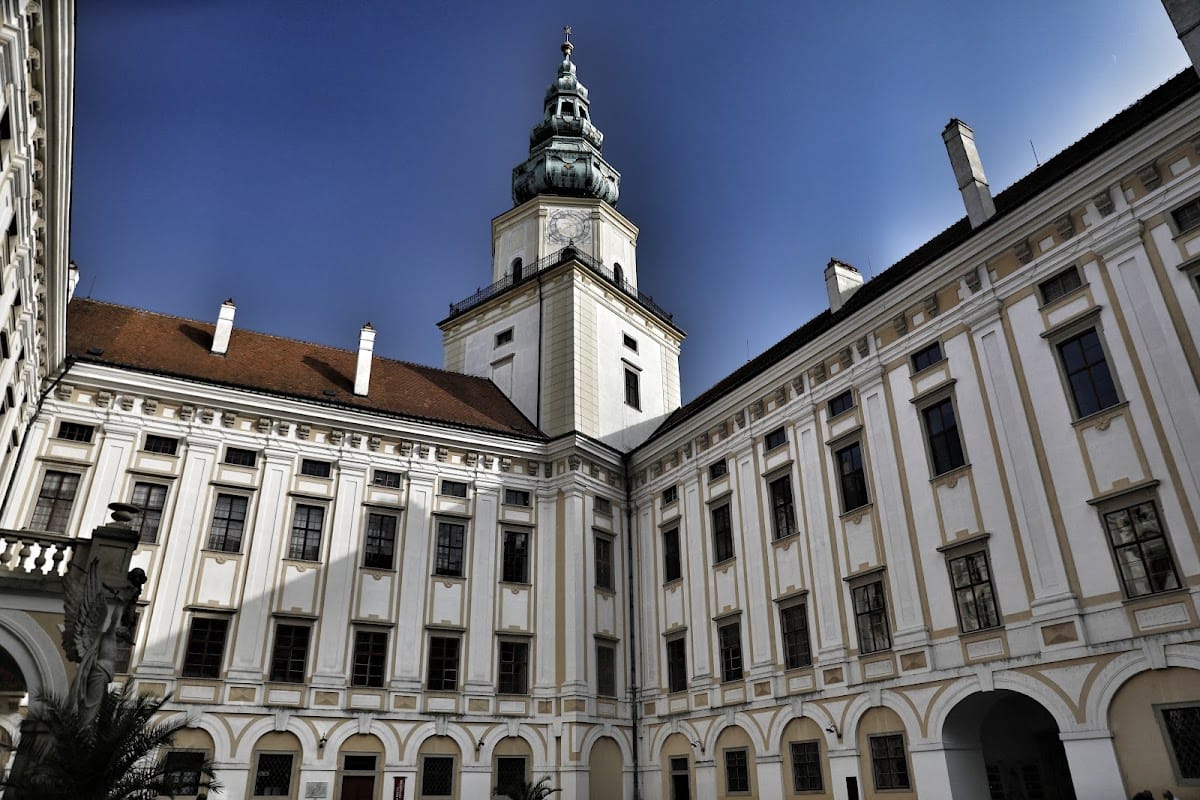
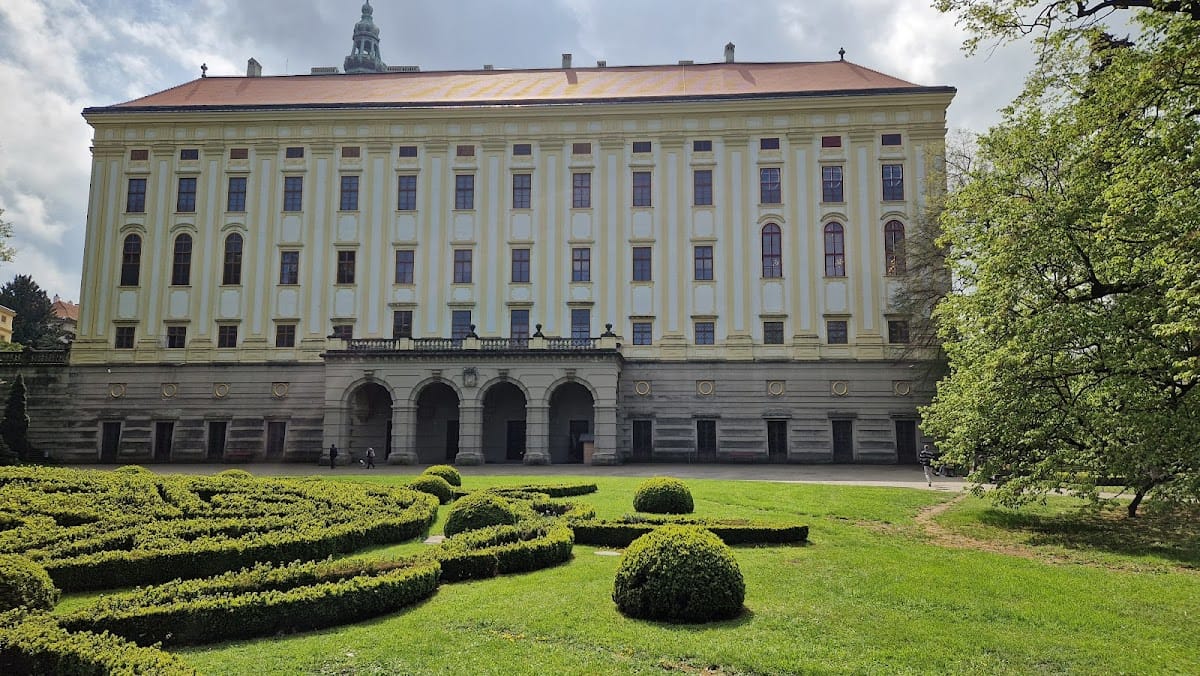
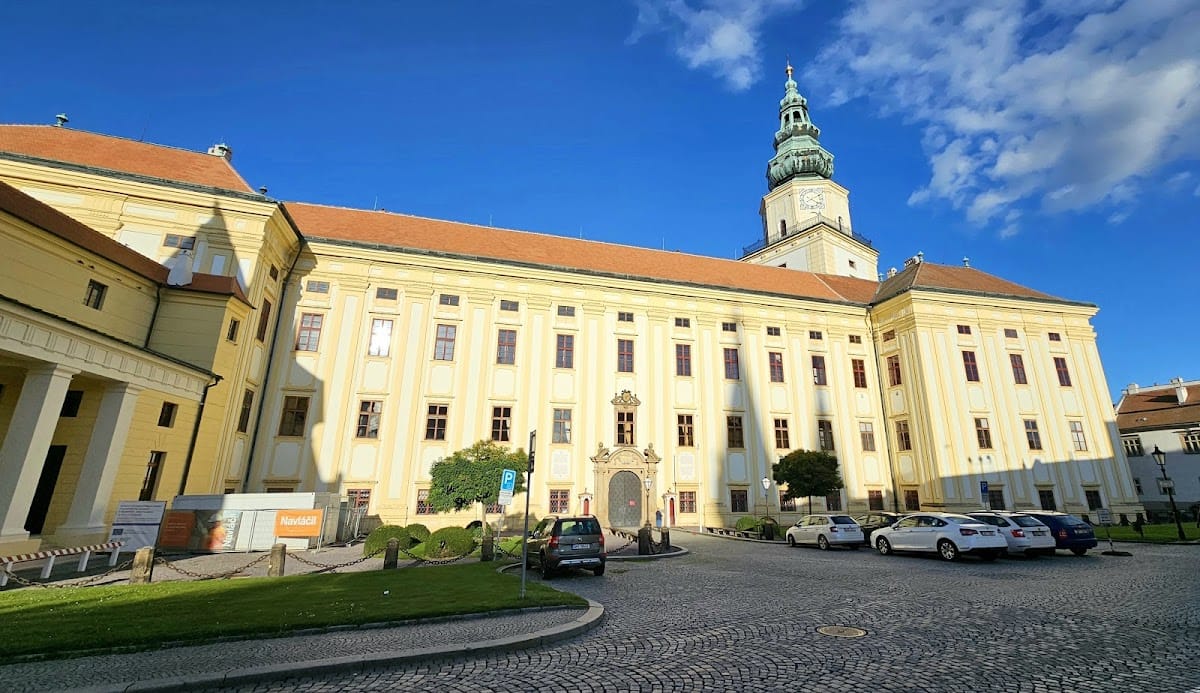
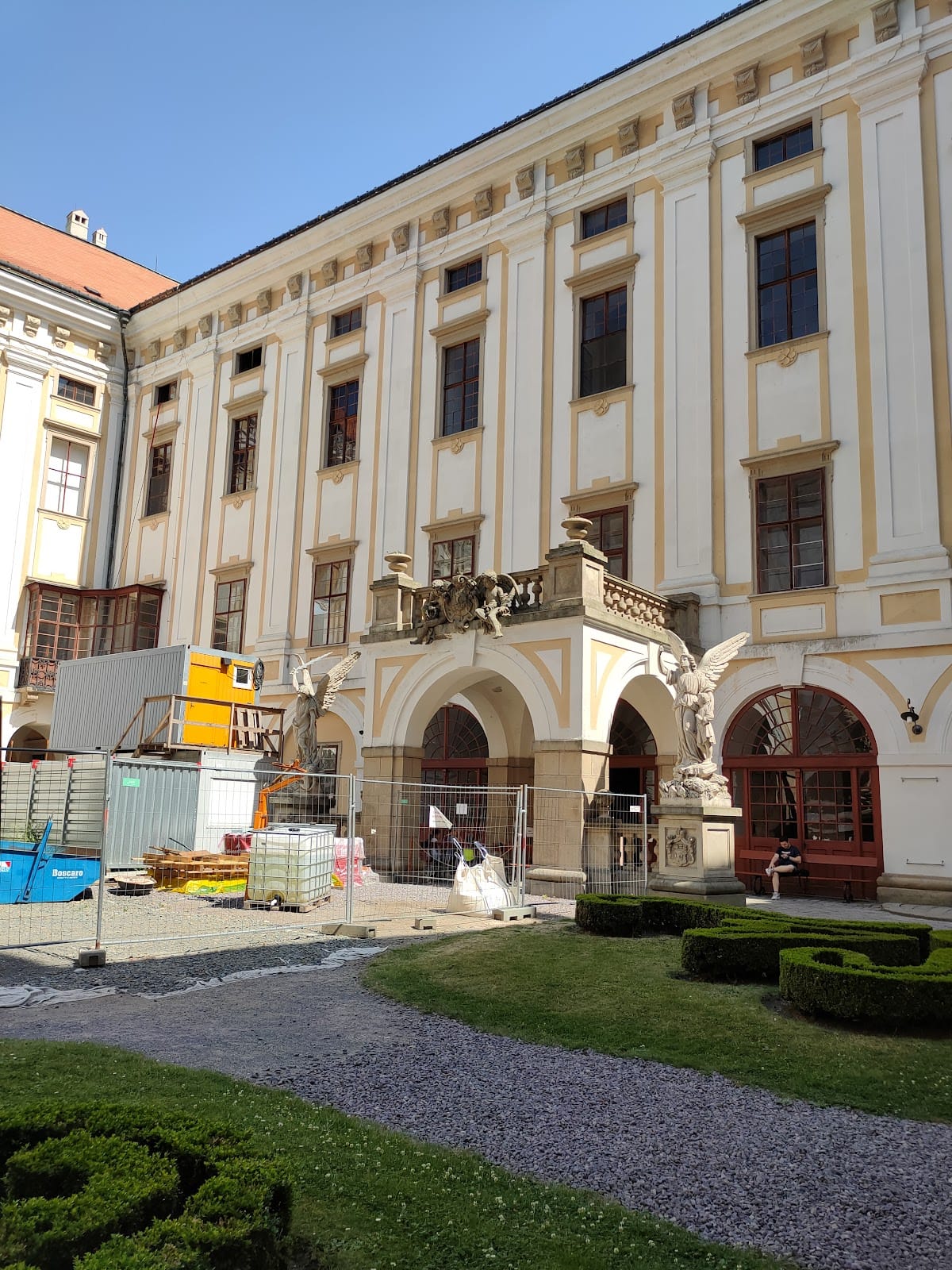
Kroměříž Castle is a two-story building designed in the early Baroque style, occupying a roughly rectangular area about 75 by 80 meters. Its layout is distinguished by four bastion-like projections at the corners, known as risalits, and a central courtyard providing light and access. The castle’s most striking feature is an 84-meter-high tower, initially built as a medieval four-sided defensive keep and later remodeled and covered with copper roofing in 1768. This tower shows evidence of multiple fires over the centuries, notably in 1643, 1752, and during World War II, followed by restoration work.
Internally, the castle divides its floors according to function and status. The ground floor was traditionally devoted to economic and service activities, the second floor contained important state rooms for official ceremonies, and the third floor emphasized the bishop’s secular and ecclesiastical authority.
On the ground floor, the garden wing includes the Sala terrena, a space that connects the castle to the adjacent Podzámecká Garden. This area retains its original form from the late 17th century, consisting of three large halls richly decorated with stucco work by Baldassare Fontana and Jean Baptiste Dusart, painted frescos by Paolo Antonio Pagani, and two artificial grottoes adorned with stalactite-like formations, shell ornaments, and a fountain centered around a statue of Apollo.
Among the representative interiors, the Assembly Hall, built in a Rococo style, stands out with dimensions of 30 by 14 meters and a height of 16 meters. It features elaborate ceiling oil paintings by Franz Adolph von Freenthal and is brightly illuminated by twenty-two chandeliers. Originally used for grand dining and ceremonial occasions, this hall was adapted during the Imperial Diet sessions of 1848–1849 to include a wooden tiered podium.
The Small Dining Room contains 18th-century furniture and wall paneling decorated with 111 paintings illustrating animal, biblical, and mythological scenes. The Throne Hall, once housing Titian’s original painting “Apollo and Marsyas,” served to receive distinguished guests and exhibits ornamental stucco ceilings along with painted wood paneling.
Other significant rooms include the Council Room, used during the 1848 Diet by Slavic deputies, furnished in neo-Baroque style and displaying a portrait gallery of key Olomouc bishops and archbishops. The Imperial Room commemorates the historic meeting between Tsar Alexander III and Emperor Franz Joseph I in 1885.
The Feudal Hall represented the bishops’ temporal power and was the venue for feudal courts and assemblies. Its walls are adorned with artificial marble and gilded Rococo carvings, with the ceiling decorated by frescoes from Franz Anton Maulbertsch. The Old Library, dating from the late 18th century, is decorated with frescoes by Josef Stern celebrating the founders of the collection and houses four large 17th-century globes.
The private Chapel of St. Sebastian, consecrated in 1766, includes sculptures, stuccoes, and an altar crafted by František Ondřej Hirnle’s workshop, with paintings by Josef Stern. The altar painting depicting St. Sebastian’s martyrdom likely originated from Vienna.
Kroměříž Castle’s art collections include 538 paintings featuring works by masters such as Titian, Lucas Cranach the Elder, and Paolo Veronese. Its music archive preserves manuscripts by composers including Haydn and Mozart. The library holds nearly 90,000 volumes, including medieval manuscripts. Additionally, a notable numismatic collection boasts more than 10,000 coins and medals.
The castle gardens complement the architectural ensemble. The adjacent Podzámecká Garden is designed in a romantic style, while the nearby Květná Garden reflects Baroque principles with geometric layouts. Both gardens were developed under Bishop Karel II of Lichtenstein-Castelcorn, with design contributions from architects Lucchese and Tencalla.
Nearby sites