Buchlov: A Medieval Royal Castle in Czechia


Site at a Glance
- Rating
- 4.5
- Popularity
- Medium
- Country
- Czechia
- Primary era
- Medieval
- External website
- Open
- Eras represented
- Medieval, Early Modern
- Civilizations
- Holy Roman Empire, Kingdom of Bohemia
- Site type
- Military
- Remains
- Castle
On this page16 sections
History
Buchlov is a hilltop royal castle in Czechia above Buchlovice, built in the first half of the thirteenth century in a transitional Romanesque-Gothic period. It served as a strategic stronghold with economic, defensive, and administrative functions, including royal judicial authority known as the hunting law. The oldest late Romanesque part was constructed by a workshop associated with the Cistercian monastery at Velehrad. The castle’s foundation charter has not survived, but its first written reference dates from 1300, when Protiva of Buchlov was named as its burgrave, the official responsible for administering and defending a castle.
Royal Castle and Noble Pledges
Buchlov remained royal property until 1425. During this period, the Crown repeatedly pledged it to wealthy Moravian noble families that had lent money to the monarchy. From 1425, the castle was pledged to the Liechtensteins. Damage inflicted by the forces of Matthias Corvinus, the fifteenth-century king of Hungary, led to a major rebuilding in the 1490s. Ctibor and Adam of Cimburk carried out the work in the late Gothic style.
In 1511, King Vladislaus II Jagiellon, the late fifteenth- and early sixteenth-century ruler of Bohemia and Hungary, granted Buchlov to Arkleb of Boskovice for his services against the Turks. Arkleb sold the castle to the Lords of Žerotín in 1520. In 1542, Jan Ždánský ze Zástřizl purchased the estate, beginning more than a century of Zástřizl ownership.
The Zástřizl Residence
The Zástřizl family made the most extensive changes to Buchlov. They rebuilt the upper castle in the Renaissance style, a revival of classical forms that spread through Europe from the fifteenth century, adapting it for representative and residential use. Economic buildings were transferred to a newly formed second courtyard, separating domestic and service functions within the expanding complex.
Most members of the family supported the Bohemian Estates’ uprising, a revolt by the estates against Habsburg authority. After the uprising was defeated, confiscations deprived them of a substantial part of their property. Jindřich Prakšický ze Zástřizl obtained the estate in 1581, but his tenure was brief. He had repeatedly disputed with the leadership of the nearby Velehrad monastery and was murdered during a night ride through the Smraďavka valley in 1582. The killer was never established with certainty; the most probable explanation is that Jindřich died in a personal duel with Vilím Rym.
Petřvald Ownership and the Move to Buchlovice
The Petřvald family held Buchlov from 1644 to 1800 and carried out the castle’s final major building changes. As the Ottoman threat approached, they extended the defences by creating the present first courtyard, with a tower gate and a bastion, a projecting gun platform. Hanuš Zikmund z Petřvaldu also commissioned the Chapel of Saint Barbara on nearby Modla Hill. Built in 1670–1672, it became the burial place of members of the Petřvald and Berchtold families.
A grand Baroque chateau, designed in the style of a villa, was built at Buchlovice between 1698 and 1701. Baroque architecture was a later period known for more elaborate spatial and decorative treatment. The medieval castle could not be adapted easily to the expectations of eighteenth-century aristocratic life, and its owners gradually ceased making further changes there. Buchlov became permanently uninhabited in 1751.
The Berchtolds and Preservation
The Berchtold family, the final owners of Buchlov, lived at Buchlovice while preserving the castle from decay. Leopold I Berchtold and his stepbrother Bedřich Všemír Berchtold assembled natural-history and historical collections at Buchlov, creating a family museum in 1848.
Leopold I Berchtold was also a major humanitarian. As administrator of the Buchlov estate, he assisted poor subjects, orphans, and sick people. In 1797, he opened a hospital at Buchlovice and in the Buchlovice chateau, chiefly for poor patients. He died in 1809 after contracting typhus while visiting patients at the Velehrad lazaret.
Bedřich Všemír Berchtold travelled extensively between 1834 and 1842 and again in 1846, studying nature and expanding his botanical collections. Some of these collections, along with artefacts and curiosities gathered during his travels, were placed at Buchlov. He died in 1876 and was buried at Buchlovice in 1895.
Fire, State Ownership, and Historical Jurisdiction
A severe fire damaged Buchlov in 1931, after which the castle was repaired. In 1945, Buchlov and the Chapel of Saint Barbara family tomb passed to the Czechoslovak state. Buchlov has been protected as a cultural monument since 1968 and became a national cultural monument on 1 January 2002. It remains state-owned and is administered by the National Heritage Institute.
From the fourteenth century, Buchlov exercised extensive authority over forest poaching and illegal fishing. This judicial power, called the hunting law, later extended to other misdemeanours and crimes in Buchlov and neighbouring estates, including robbery, murder, sexual offences, and witchcraft. Punishments for poaching were exceptionally severe and commonly included hanging or beheading. The jurisdiction passed with the castle from owner to owner until an imperial decree abolished it in 1749.
Remains
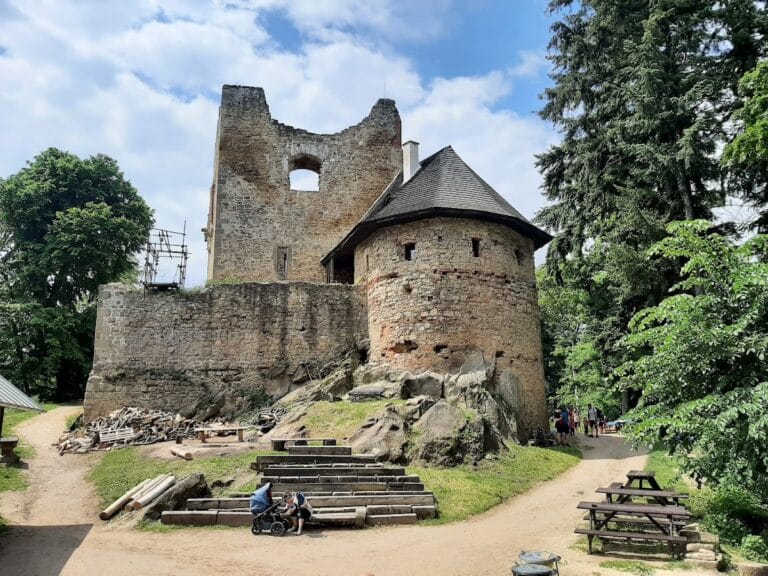
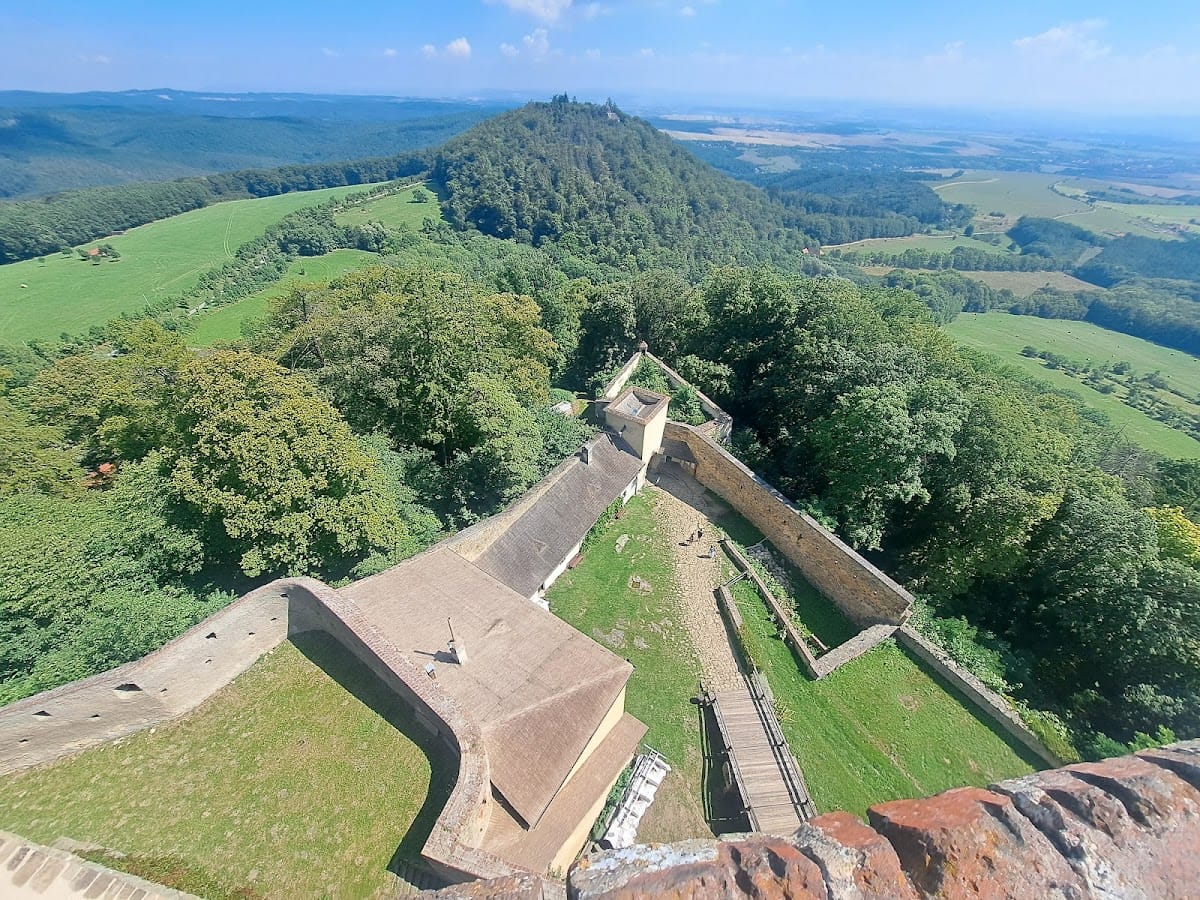
Buchlov occupies Buchlov Hill in the forested Chřiby range, at approximately 510–522 metres above sea level. Its surviving form combines a Romanesque foundation with Gothic and Renaissance construction and later Baroque additions. The original core was arranged around two large prismatic towers, a substantial southern palace, and enclosing walls. Further building in the 1370s added another tower and an early Gothic chapel, while the upper castle preserves residential rooms associated with Gothic and Renaissance aristocratic life.
Courtyards and Defensive Buildings
First Courtyard
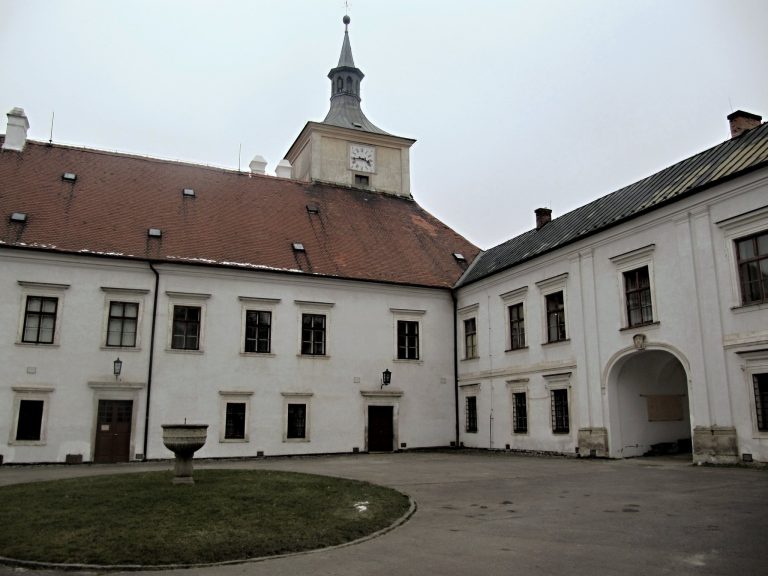
The first courtyard retains its seventeenth-century form. It is entered through a Baroque gate connected with a bastion, and a wooden bridge leads onward toward the second courtyard. These features belong to the Petřvald-era expansion of the outer defences, undertaken as the Ottoman threat approached.
Second Courtyard
The second courtyard is enclosed by economic buildings and the Renaissance tower called Andělka. A Baroque passage through the burgrave’s building connects the two courtyards. The name Andělka is linked with Josef Anděl, a thief imprisoned in the tower after breaking into the Buchlovice chateau.
Inner Castle
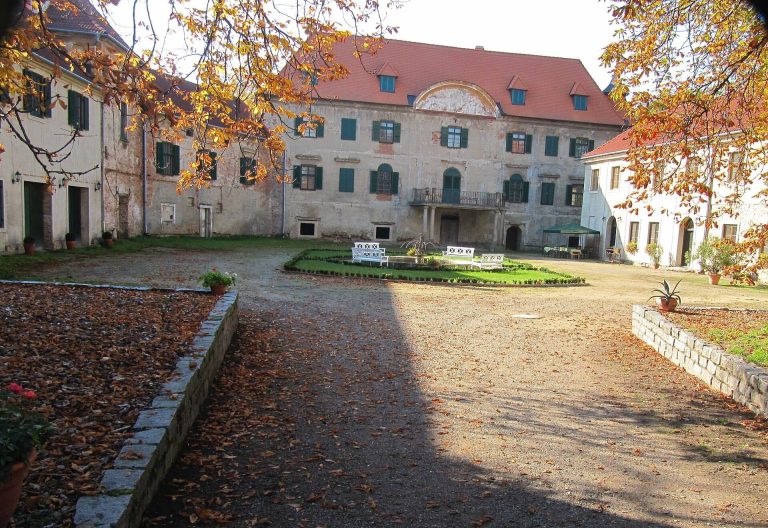
The medieval core stands beside a Renaissance building dated 1602. A terrace with a clock tower leads through the ground floor of the tower to the inner courtyard, whose surrounding buildings belong to several construction periods. The residential rooms of the upper castle form a well-preserved group with period furniture and works of art, preserving the character of aristocratic interiors from the Gothic and Renaissance periods.
Chapels and Collections
Early Gothic Chapels
Buchlov contains an early Gothic chapel on an upper floor of the southeastern entrance tower. Another early Gothic chapel was added during the building work of the 1370s. The castle also houses the Buchlov Madonna, a sculpture dated to the mid-fourteenth century, and works by the Baroque painter Petr Brandl.
Collections and Tower
The displays include natural-history and archaeological collections, together with artefacts and curiosities assembled by the Berchtolds. A dominant tower rises 35 metres and has an open square viewing platform. Its stated outlook extends across the Chřiby range, the Lower Morava Valley, and Hostýn, with views toward Pálava and possibly as far as Vienna in clear weather.
Chapel of Saint Barbara
The Chapel of Saint Barbara stands on neighbouring Modla Hill, about one kilometre from the castle. Its major rebuilding in 1670–1672 gave the funerary chapel its Baroque form. It contains the remains of members of the Petřvald and Berchtold families and forms an associated part of Buchlov’s historic complex.
Courtyard Lime Tree
One of the castle courtyards contains a lime tree associated with a tradition about a soldier named Vlček. According to the story, Vlček was accused of treason and sentenced to death. He invoked a miracle and divine judgment, after which a young lime tree supposedly grew again when transplanted with its roots upward. The tree remains in the courtyard as the physical feature linked with this tradition.