Lukov Castle: A Medieval Royal Fortress in Czechia


Site at a Glance
- Rating
- 4.7
- Popularity
- Medium
- Country
- Czechia
- Primary era
- Medieval
- External website
- Open
- Eras represented
- Medieval, Early Modern
- Civilizations
- Holy Roman Empire, Kingdom of Bohemia
- Site type
- Military
- Remains
- Castle
On this page17 sections
History
Lukov Castle is a medieval royal fortress in Czechia, near the village of Lukov, founded probably in the first half of the thirteenth century as a Gothic castle within the territorial defensive system of Moravia. Its original form was probably Romanesque, and its successive owners expanded it from a royal stronghold into an extensive noble residence and fortress. The castle later endured warfare, financial disputes, abandonment, and the loss of parts of its fortifications before conservation work began in the twentieth century.
Origins and Royal Ownership
The rocky hill was probably occupied before the castle was built. Excavations in the southern outer defensive enclosure during the 1980s recovered pottery associated with the Urnfield culture, a late Bronze Age tradition linked to cremation burials and urn cemeteries. The castle’s founder is unknown. A castellan named Bun de Lucowe appears in a record from 1219, and a 1235 charter witnessed by Lambertus, priest of Lukov, may also refer to the stronghold. The first dependable written evidence dates to 1 November 1332, when Margarethe, widow of Zdislav of Sternberg, issued a document at Luckow.
The circumstances in which Lukov passed from royal control to the Lords of Sternberg remain unclear. Around 1334, Charles IV, the king of Bohemia who later became Holy Roman Emperor, recovered Lukov among castles and estates returned to the Bohemian and Moravian crown after having been pledged or alienated. By 1342, however, the castle was again held by the Sternbergs.
The Sternberg Lordship
Matouš of Sternberg adopted the designation “of Lukov” from 1362, and his son Albrecht used it from 1367. After Matouš died in 1371, Margrave John Henry transferred the Lukov lordship to Matouš’s sons Zdeněk and Jan Ješek on 26 April 1372. Their tenure was conditional on maintaining the peace of the land. The following year, the land register described them as joint holders of an inheritance that included the Lukov estates and the Holešov fief.
Although the castle remained legally indivisible, the brothers divided the property into two practically independent portions. Zdeněk received the Holešov half, while Jan Ješek received the Lukov half. Their political alignments later diverged during the Moravian civil war. Zdeněk supported Margrave Jobst, whereas Ješek eventually joined the faction of Prokop. Ješek’s costly way of life and continuing feuds brought about the collapse of his estate. He lost his property through debt in 1409, and it reverted to the Lukov share. In 1412, Zdeněk’s son Albrecht seized the castle, although it is uncertain whether he took his father’s portion or recovered the possession formerly held by his uncle.
A document of 10 December 1392 mentions the castle church dedicated to Saint John and the relics of the True Cross kept there. During the fifteenth century, Matouš of Sternberg from the Holešov branch acquired the remaining Lukov lordship. Inheritance disputes led to the separation of Holešov as an independent lordship in 1446.
War, Rebuilding, and Renaissance Transformation
During the Bohemian-Hungarian War, a fifteenth-century conflict involving the Bohemian and Hungarian political spheres, troops of Matthias Corvinus, king of Hungary, burned Lukov Castle. Under Matouš’s son Albrecht, the stronghold was rebuilt and enlarged into one of the most extensive castle complexes in Moravia. This rebuilding created the principal form of the large late medieval fortress.
Albrecht arranged the childhood betrothal of his only daughter Ludmila to Smil of Kunstadt. Her guardian later annulled the arrangement in an effort to prevent Lukov from passing to the Lords of Kunstadt. Nevertheless, Ludmila’s rights passed to Smil and Wilhelm of Kunstadt in 1511 in return for 2,600 Schock groschen. The lordship passed in 1522 to the Moravian governor Jan Kuna II of Kunstadt. His sons inherited it in 1540 and sold it in 1547 to the wards of Zikmund Nekeš of Landek.
Přemek and Jan Nekeš jointly assumed the lordships of Lukov and Vsetín after reaching adulthood in 1557. After 1568, Zikmund and Václav Nekeš divided the estate, with Václav receiving Lukov. Under the Nekeš family, the castle was radically remodelled as a Renaissance residence and fortress.
Lukov during the Thirty Years’ War
Václav Nekeš died childless in 1607, leaving his niece Lukrecia as lifelong holder of Lukov, Vsetín, and Rymice. His will directed that Lukov and the Přílepy estate should pass to the Lords of Víckov after her death. Lukrecia, a Catholic, had married the Protestant Arkleb of Víckov in 1598. After Arkleb died in 1608, she married Albrecht von Wallenstein in May 1609. She died in 1614, and Wallenstein founded a Carthusian monastery at Štípa in 1616 in accordance with her wishes. He nevertheless retained Lukov, contrary to Václav Nekeš’s testamentary provision.
The Thirty Years’ War, a European conflict from 1618 to 1648 shaped by religious and dynastic struggles, brought Lukov into direct military conflict. After Wallenstein changed sides during the Estates’ uprising in 1619 and declared for Ferdinand II, the Moravian Estates confiscated his property and placed it under their directorate. The directorate granted Lukov to Jan Adam of Víckov, the legal heir, as compensation for damage caused by imperial troops on his estates at Čejkovice and Boleradice. After the Battle of White Mountain, Jan Adam fled abroad, his estates were confiscated, and Lukov was returned to Wallenstein.
Rebel Valachs captured and occupied Lukov in the winter of 1620–1621 before taking several other Moravian castles and towns. Johann Georg of Jägerndorf besieged the castle in 1621 but withdrew from Moravia after failing to obtain support from Gábor Bethlen. In 1625, Wallenstein transferred the lordship to the emperor, who granted it to his Viennese courtier Stephan Schmidt of Freihofen. Johann Amos Comenius, a Protestant educator, theologian, and philosopher, stayed with Schmidt that year while trying to reconcile the opposing political camps.
On 30 September 1626, Jan Adam of Víckov returned to Lukov with 200 Danish musketeers and approximately the same number of allied Valachs. Schmidt surrendered the castle without a fight. Imperial forces commanded by Baltasar von Marradas recaptured it in mid-October 1627, and Jan Adam probably died during the operation. Schmidt went into exile in 1630 because he refused to convert to Catholicism despite supporting the emperor. Ferdinand II allowed him to return to Lukov in autumn 1631, and Schmidt died there in 1632.
Decline and Abandonment
Schmidt’s son-in-law, Johann Friedrich Minkwitz of Minkwitzburg, inherited Lukov after his death. He had administered the estate during Schmidt’s exile but became increasingly indebted. In 1643, his son Johann Friedrich II inherited a severely mismanaged lordship. Johann Friedrich II and his wife lived at the castle until his death in 1678, although creditors effectively controlled the estate. His son, Johann Friedrich III, continued to hold Lukov and resisted claims by the Rottal family until he was compelled to sell the lordship to Johann Josef of Rottal in 1710.
Johann Josef of Rottal became involved in a lengthy dispute with his subjects over their obligations and tax payments. The failed lawsuit and the estate’s continuing financial difficulties led him to sell the lordship in 1724 for 200,000 gulden to Johann Friedrich, Count of Seilern-Aspang. Seilern established the Lukov–Kralice primogeniture entail in 1750, and his son Christian August inherited it the following year.
After the last Minkwitz lord left, Lukov served as the administrative seat of the lordship rather than as a principal residence. That role ended when Johann Friedrich von Seilern-Aspang moved the administration to the village of Lukov in 1750. The last records of habitation date from 1787–1789. The castle then decayed, and it was described as derelict in 1804. Parts of its fortifications were later sold as building material. The lordship’s final administrative seat was Lešná Castle, completed south of Lukov in 1894.
Conservation and Archaeological Research
Lukov has been protected as a cultural monument since 1964. Extensive voluntary restoration and archaeological research began in 1983, and the Friends of Lukov Castle association was founded in 1990. Working with the Brontosaurus Movement, the association helped conserve the ruins. Major stabilization work secured parts of the surviving complex, and the castle reopened to the public in 2004. Archaeological work also continued in the southern outer defensive enclosure and elsewhere across the site.
Remains
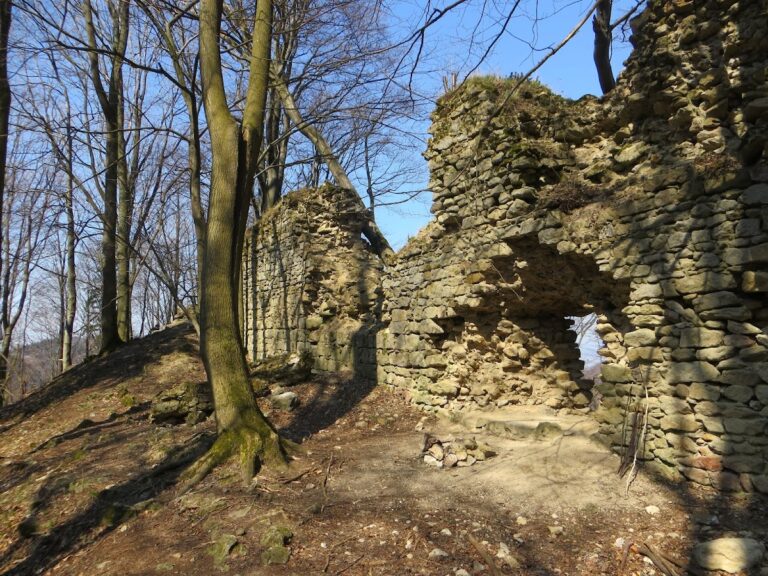
Lukov is a large Gothic hill castle preserved as a ruin on a rocky spur between the valleys of the Bělovodský and Lukovský streams. It stands in the southern Hostýn Mountains at approximately 515 metres above sea level, while the Králky nature reserve occupies the southern slope of the castle hill. The complex developed from an early royal castle into an expanded fortified residence with an upper and lower castle, defensive enclosures, a gate tower, a bridge, palatial buildings, a chapel, and the Johanka bastion.
Upper Castle and Early Buildings
Royal Castle and Chapel
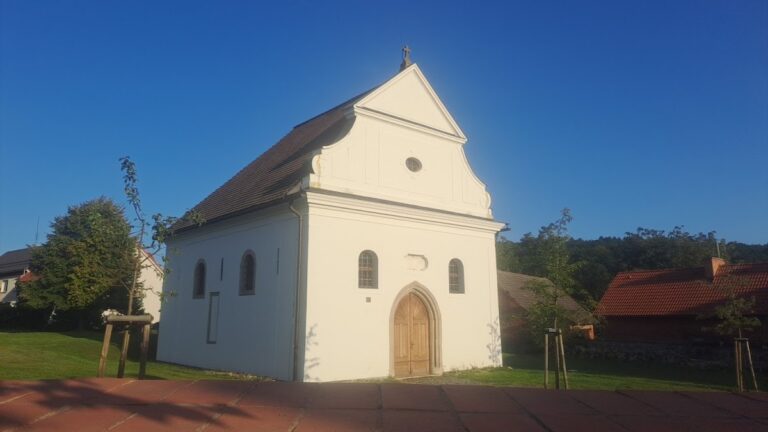
The earliest masonry indicates that the oldest parts were probably built during the second quarter of the thirteenth century. The original royal stronghold was probably Romanesque. Its chapel began in that period and was later reconstructed in the Gothic style. A new eastern palace was also added, giving the upper castle a more developed residential and defensive arrangement. The surviving structures are fragmentary and have been stabilized and conserved as part of the present ruin.
Gate Tower and Bridge
A gate tower with a bridge formed an entrance to the fortified complex. The castle was later remodelled extensively as a Renaissance fortress under the Lords of Landek. This transformation altered the earlier medieval arrangement and added to the defensive character of the site. The present remains preserve parts of the successive medieval and Renaissance phases.
Lower Castle and Fortifications
Lower Castle
The lower castle was incorporated into the enlarged complex during its later medieval development. Its walls were still standing in 1861, when the castle’s defensive remains were described. Subsequent sales of fortification elements as building material contributed to the loss of parts of the defensive fabric. The lower castle now survives in ruined and conserved form.
Johanka Bastion
The Johanka bastion, a projecting fortified position, was added beside the lower castle during the fifteenth-century rebuilding. Together with the lower castle walls, it formed part of the expanded defensive system created after the castle was burned during the Bohemian-Hungarian War. The bastion remains among the identifiable elements of the ruined complex.
Archaeological Evidence
Southern Outer Enclosure
The southern outer defensive enclosure, or zwinger, is a passage or defended space between lines of fortification. Excavations there in the 1980s recovered pottery from the Urnfield culture dating from the eighth to ninth centuries BC. This material provides evidence for prehistoric activity on the castle hill before the medieval fortress was built.
Conserved Ruins
Archaeological research and stabilization have secured sections of the castle while preserving the surviving fabric as a ruin. Investigations have examined the layout and construction of the complex, including its upper and lower areas, chapel, eastern palace, entrance works, and later fortifications. Between 2004 and 2006, 35 species of terrestrial gastropods were recorded at the castle, adding an ecological dimension to the study of the conserved site.