Kawasaki Daishi: A Shingon Buddhist Head Temple in Japan


Site at a Glance
- Rating
- 4.3
- Popularity
- High
- Country
- Japan
- Primary era
- Medieval
- External website
- Open
- Eras represented
- Medieval
- Civilizations
- Japanese
- Site type
- Religious
- Remains
- Sanctuary
On this page13 sections
History
Kawasaki Daishi, the popular name of Heiken-ji in Japan, is a head temple of the Chizan branch of Shingi-Shingon Buddhism founded in 1128 by the priest Sonken and Hirama Kanenori. Shingon Buddhism is an esoteric Japanese Buddhist tradition centred on ritual, sacred images, mantras, and initiation. The temple is formally known as Kongōzan Kinjōin Heiken-ji and is associated with the mountain name Kongō-san and the temple title Kinjō-in.
Foundation and imperial recognition
The temple’s foundation tradition begins with Hirama Kanenori, a former samurai from Owari. After a false accusation cost him his status and estate, he travelled through several provinces before making his living as a fisherman in the lower Tama River area near Tokyo Bay. At the age of 42, he is said to have dreamed that Kōbō-Daishi instructed him to recover a sacred image from the sea. Kōbō-Daishi, also known as Kūkai, was a major Japanese Buddhist monk traditionally regarded as the founder of Shingon Buddhism. After Kanenori found a wooden image in his fishing net, he washed and worshipped it before building a small chapel.
Sonken was travelling from Kōya-san when he heard the story of the recovered image. He joined Kanenori, and together they established Heiken-ji in 1128. The temple consequently developed the unusual practice of enshrining an image of Kōbō-Daishi himself as its principal object of worship. Kanenori was reportedly rehabilitated in 1134 and recovered his former estate in Owari. Before returning there, he assigned half of its income to the temple as an endowment.
According to temple tradition, Sonken sought imperial recognition for Heiken-ji. Through the intervention of Bifuku-in and Emperor Toba, the temple was subsequently admitted among the imperial prayer temples. This tradition placed the newly founded institution within a wider network of religious establishments connected with the court.
Edo-period pilgrimage
Kawasaki Daishi became especially prominent during the late Edo period. Tokugawa Munetake, the second son of the eighth Tokugawa shogun, visited in 1753 to pray for his wife during her traditionally unlucky age and returned in 1756 for his own yakudoshi. Yakudoshi refers to ages traditionally regarded as especially vulnerable to misfortune, including 42 for men and 33 for women. After both years passed without serious misfortune, Munetake became a patron and financial supporter of the temple. Tokugawa shoguns later visited during their own yakudoshi, strengthening the temple’s public profile.
In 1813, the eleventh Tokugawa shogun visited Kawasaki Daishi at the age of 41, which was traditionally regarded as a man’s year of impending misfortune. The temple’s location near the Tōkaidō road also supported its growth as a pilgrimage destination. The Daishi pilgrimage road branched from the main route near Kawasaki-juku, bringing worshippers toward the temple.
Railways, New Year worship, and war
The Daishi Electric Railway opened on 21 January 1899 to carry worshippers to Kawasaki Daishi. It became the predecessor of the present Keikyū Daishi Line and of Keikyū’s railway operations. Promotion by the railway company and newspapers connected with the temple helped establish modern hatsumode as a widespread practice. Hatsumode is the first New Year visit to a Buddhist temple or Shinto shrine.
Kawasaki Daishi has remained closely associated with hatsumode. New Year worship drew 2.72 million visitors in 2006, placing the temple third in Japan and first in Kanagawa Prefecture, while 2.96 million were recorded in 2012.
On 15 April 1945, an American attack during the Kawasaki air raid burned many of the temple buildings. The complex was almost completely destroyed during the Second World War, including its library, and the loss of historical documents made the early history of Heiken-ji difficult to reconstruct in detail. Reconstruction proceeded after the war and restored the temple as a functioning religious complex.
Ritual traditions and civic recognition
A Great Opening is held once every ten years. During the observance, worshippers receive a special red talisman printed with “Namu Amida Butsu.” The most recent observance mentioned here took place from 1 to 31 May 2024.
Kawasaki City designated the temple’s Hiki-goe Nenbutsu and Sōban Nenbutsu traditions as important customary skills on 8 February 2019. Hiki-goe Nenbutsu began in 1834 under the 35th abbot, with the rebuilding of the main hall in view. It is performed from 20 to 22 March during the memorial observance centred on 21 March, the traditional date of Kōbō-Daishi’s entry into eternal meditation. The practice involves opening and closing the curtain before the principal image and is therefore also called the Nenbutsu of pulling the curtain. It is additionally performed during the major goma rituals in May and September. Goma is a Buddhist fire ritual, and during those observances the curtain is not moved.
Sōban Nenbutsu began around 1897 under its first leader, after he moved from Kizuki in present-day Nakahara Ward to Nakase in the Daishi-gawara area. It was performed in the temple’s Fudō Hall from around 1998 and has generally been held since 2016 on the second floor of the worshippers’ rest facility, normally on the third Sunday afternoon. Hiki-goe lasts about ten minutes, while Sōban consists of fourteen musical pieces and takes about forty minutes. Learning its difficult drum techniques requires approximately three to five years, and the group has about twenty-five members.
Remains
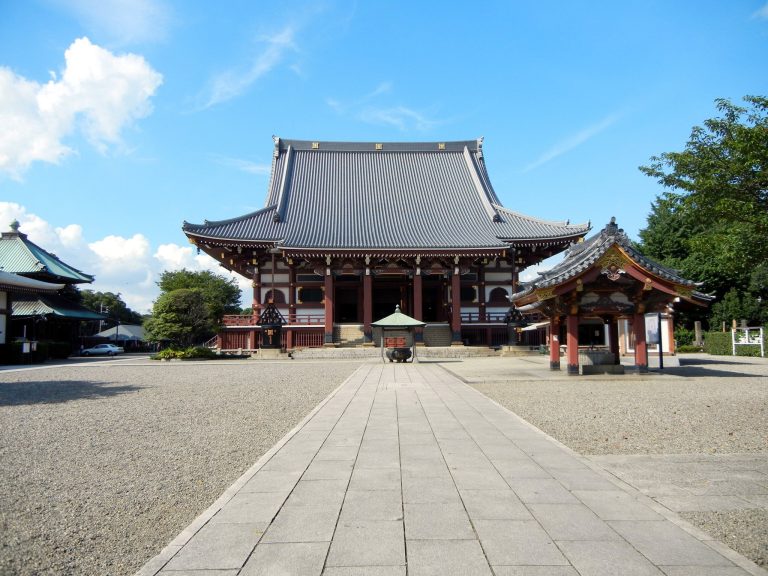
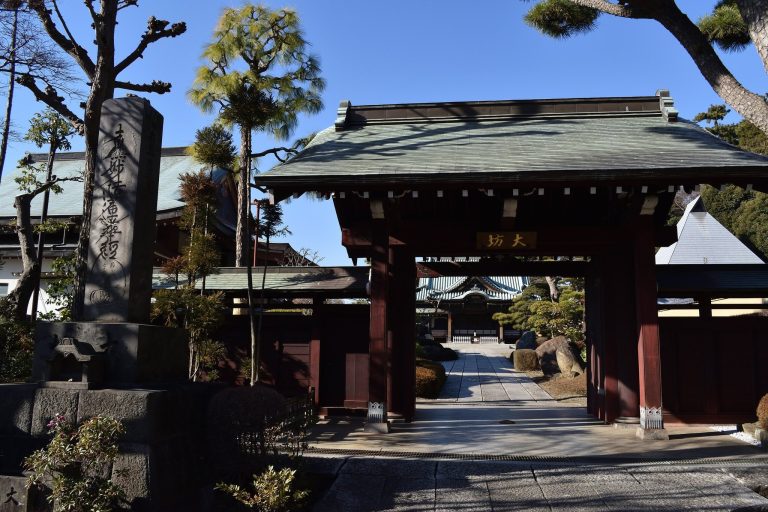
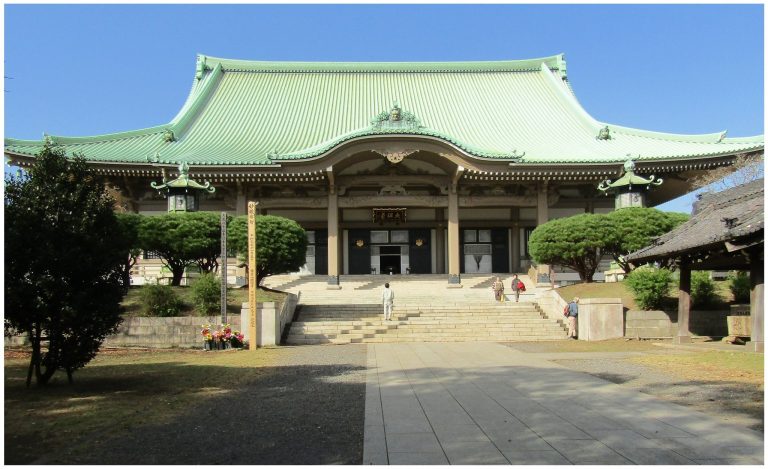
The surviving temple complex includes a main hall, Fudō Hall, and a facility for worshippers’ rest. Its central religious focus is a wooden image of Kōbō-Daishi, traditionally said to be the image recovered from the sea by Hirama Kanenori. The image is kept within an altar enclosure, with ritual performers seated in the outer worship area before it. Extensive physical losses in the 1945 air raid mean that the present complex incorporates postwar reconstruction.
Principal worship space
Wooden image and altar enclosure
The wooden image of Kōbō-Daishi is housed within an altar enclosure in the main worship space. Before the enclosure, the nenbutsu performers sit during ritual observances. The arrangement keeps the principal object of worship at the centre of both the temple’s devotional practice and its distinctive curtain-pulling ceremony.
Hiki-goe curtain
During Hiki-goe Nenbutsu, performers operate the curtain before the principal image by pulling a rope from behind the altar enclosure. The curtain opens and closes during the March memorial observance. During the May and September goma rituals, the Hiki-goe practice continues without moving the curtain.
Performance areas and instruments
Sōban Nenbutsu arrangement
During Hiki-goe Nenbutsu, the Sōban group sits in the outer worship area in front of the enclosure. Two gongs are struck separately on the left and right, the group leader sits in the centre, and about twenty singers sit behind. The setting links the performers’ sound and movement directly with the enclosed image.
Gongs and drum patterns
Sōban Nenbutsu uses paired metal gongs approximately 36 centimetres in diameter and is organised around distinct gong and drum patterns, including a “six-character” section. A full sequence has ten named stages: drum setting, long section, half-seat, invocation nenbutsu, ball insertion, great-opening nenbutsu, crossroads of the six paths, six-character section, middle conclusion, and drum nenbutsu. A performance using one drum and four gongs takes about an hour, while one using three gongs takes about forty minutes.
Fudō Hall and reconstructed buildings
Fudō Hall forms part of the temple complex and was used for Sōban Nenbutsu from around 1998. Since 2016, the performance has generally taken place on the second floor of the worshippers’ rest facility. These spaces belong to the reconstructed temple complex that followed the burning of many buildings during the 1945 air raid.