Bōnotsuka Kofun: A Late Fourth-Century Burial Mound in Japan


Site at a Glance
- Rating
- 3.6
- Popularity
- Very Low
- Country
- Japan
- Primary era
- Classical
- External website
- Open
- Eras represented
- Classical
- Civilizations
- Yamato
- Site type
- Burial
- Remains
- Burial Mound
On this page9 sections
History
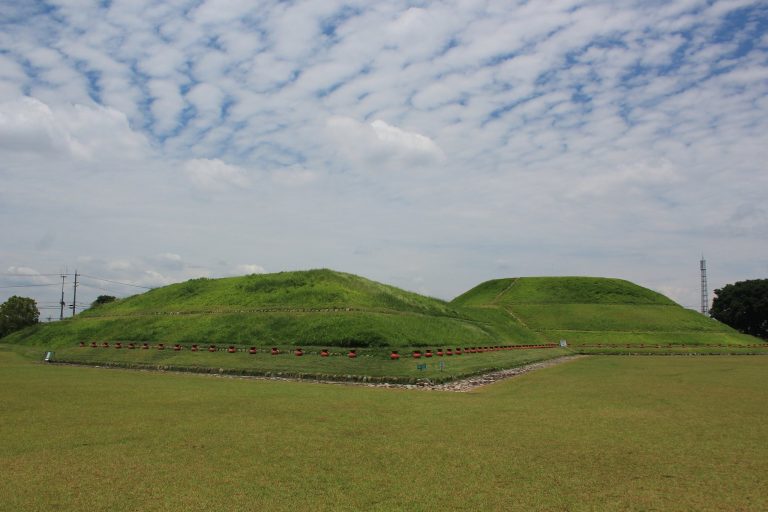
Bōnotsuka Kofun is a large keyhole-shaped burial mound in Japan, located in Kakamigahara, Gifu Prefecture. It was probably built in the late fourth century, at the end of the early Kofun period, an era when large burial mounds were constructed across Japan. The mound is the second largest kofun in Gifu Prefecture and the largest in Kakamigahara.
A Mound Among Regional Tombs
Bōnotsuka Kofun stands on the eastern edge of the Kakamigahara Plateau in southern Gifu. It is one of nine tumuli known in Unuma Haba-cho. The surrounding area also contained the early- and middle-period Ichirinyama and Ishozuka kofun, while the later Unuma Nishimachi Kofun has disappeared. Together, these monuments reflect the area’s use for burial over several phases of the Kofun period.
Disturbance and Investigation
The burial mound was robbed before the sixteenth century and disturbed again around 1886 and 1902. Sherds of medieval tea bowls and Haji ware plates from the central robbers’ pit indicate that the earlier disturbance had taken place by the fifteenth or sixteenth century. Previously known grave goods were rediscovered in 1972. A survey in 1992 confirmed the extent of the surrounding moat, while excavations from 2015 to 2019 and in 2021, together with ground-penetrating radar work in 2020, formed six investigations reported in 2022. The 2017 investigation examined the burial facility.
Preservation and Historical Interpretation
Bōnotsuka Kofun became a Gifu Prefectural Historic Site on March 25, 1957, and a National Historic Site on October 11, 2024. In 2014, a local land-management association donated land within the kofun area, supporting its preservation. The mound’s three-tier construction, its cylindrical haniwa arrangement associated with the Kinai region, and its locally characteristic jar-shaped pottery provide evidence for examining how the Yamato polity, an early state-centered power based around present-day Nara and Osaka, extended its influence into Mino, the historical region corresponding broadly to southern and central Gifu Prefecture.
Remains
The monument has a keyhole plan, known in Japanese as a zenpo-koen-fun, combining a rectangular front section with a circular rear section. The front points southwest, and the rear mound lies at the opposite end. The approximately 120-meter mound was built in three tiers and surrounded by a shield-shaped moat. Much of the lowest tier was formed by cutting and shaping the natural ground.
Mound and Moat
The circular rear mound measures about 68 meters in diameter and rises approximately 10.7 meters. The rectangular front section is about 64.5 meters wide and 8.2 meters high. Earlier recorded measurements give slightly different figures, placing the rear diameter at about 72 meters and its height at 10 meters, while the front is listed as approximately 66 meters wide and 7.8 meters high. Chert stones formed a covering of fukiishi, stones laid over a mound to protect and reinforce its surface. A shield-shaped moat enclosed the mound.
Burial Facility
A vertical pit stone chamber lies in the central area of the rear mound, slightly northwest of its center. This type of burial facility was made by excavating a pit, lining it with stone slabs, and covering it with large roof stones. The chamber follows a northeast-southwest alignment parallel to the mound’s main axis. Its burial pit was cut in a single step and measures approximately 6.3 meters long and 4.8 meters wide. The chamber itself is estimated at about 5 meters long and 1 meter wide, although its complete dimensions remain uncertain. Slabs were stacked to form the sides, and five roof stones were identified.
Haniwa and Grave Goods
The uppermost, third tier carried a row of cylindrical haniwa, clay objects placed on or around burial mounds. Some had morning-glory-shaped forms. No row was identified on the first or second tiers. Horse-shaped haniwa are also said to have been found, although their details are unknown. Jar-shaped vessels were arranged around the burial pit. Stone products and magatama, curved comma-shaped ornaments, were recovered or transmitted from the stone chamber, while excavations also produced small round-bottomed jars, pedestal cups, food-shaped earthen objects, beads, tubular beads, and other stone products.
Preserved Finds
Excavated objects from Bōnotsuka Kofun are displayed at the Kakamigahara City History and Folklore Museum, located within the Kakamigahara Municipal Central Library. These objects, together with the mound’s burial chamber, surface stones, haniwa, and pottery, provide material evidence for the monument’s date, construction, and regional connections.