Nitta Shrine (Ōta City): A Shrine Dedicated to Nitta Yoshioki


Site at a Glance
- Rating
- 4.2
- Popularity
- Low
- Country
- Japan
- Primary era
- Modern
- External website
- Open
- Eras represented
- Early Modern, Modern
- Civilizations
- Japanese, Tokugawa
- Site type
- Religious
- Remains
- Sanctuary
On this page15 sections
History
Nitta Shrine (Ōta City) is a Shinto shrine in Japan, founded in 1358 during the Nanboku-chō period and dedicated chiefly to the warrior Nitta Yoshioki. The fourteenth-century Nanboku-chō conflict divided Japan between rival Northern and Southern Imperial Courts, and Yoshioki fought for the Southern Court. The shrine was established beside his reputed burial mound to calm his spirit, reflecting Goryō Shinkō, the religious practice of appeasing people believed to have died unjustly or violently.
Yoshioki and the founding of the shrine
Nitta Yoshioki was the second son of Nitta Yoshisada. After his father and elder brother were killed, he remained a leading supporter of the Southern Court. He campaigned with his younger brother Nitta Yoshimune and their cousin Wakiya Yoshiharu, continuing the Nitta family’s resistance to the Northern Court and its military allies.
The traditional account of Yoshioki’s death appears in the Taiheiki, a medieval war chronicle describing conflicts between the imperial courts and warrior governments. Ashikaga Motouji, the military governor of Kamakura, is said to have feared Yoshioki’s advance and to have conspired with Hatakeyama Kunikiyo, his regional deputy. They employed Takezawa Ukyō-no-Suke, a former Nitta retainer, and Edo Tōtōmi-no-kami to draw Yoshioki into a trap.
Takezawa pretended to have returned to the Nitta side and gradually won Yoshioki’s confidence. He brought the court lady Shōshō no Tsubone to him, but she learned of the planned assassination and warned Yoshioki. After showing sympathy for him, she was killed. The conspirators then staged the confiscation of Takezawa’s lands as a punishment and used the incident to send Edo Tōtōmi-no-kami into the Nitta camp.
After Ashikaga Takauji died in April 1358, Takezawa persuaded Yoshioki that many soldiers were prepared to help him retake Kamakura. On the morning of October 10, Yoshioki and a small group of close retainers were lured to the Yaguchi Ferry on the Tama River. Their boat had been sabotaged, and after reaching the opposite bank they died either by suicide or in combat. The number of retainers is given as 13, although local tradition commonly counts 14.
Spirit worship and local traditions
The ambush became associated with supernatural retribution. On October 23, a storm reportedly swept the boatmen who had assisted the plot into the river. When Edo Tōtōmi-no-kami turned back, Yoshioki’s vengeful spirit was said to have appeared and struck him with lightning. He died several days later after falling from his horse and becoming insane. A fire attributed to the same episode destroyed the buildings of Enmei-ji, formerly known as Renge-ji.
Yoshioki was also said to have appeared in Kunikiyo’s dream. Lightning then destroyed more than 100 houses and several dozen Buddhist temples and halls in the Iruma area, while mysterious lights were seen nightly near Yaguchi. Local residents established the shrine to pacify the spirit, and it later became revered as Nitta Da Myōjin. The principal enshrined figure is therefore not only a historical warrior but also a deified person whose worship grew from fear, remembrance, and the wish to protect the community.
During the Edo period, the shrine attracted strong devotion from the warrior class. This was partly connected with the belief that the Tokugawa family descended from the Nitta lineage. Another tradition states that Ukanomitama no Ōkami, an agricultural guardian deity, was brought from Fushimi Inari in Kyoto to protect the rice cultivation of Yaguchi Village.
From the Edo period to modern reconstruction
In 1746, Matsudaira Yorihiro, lord of the Moriyama domain in Mutsu Province, erected the monument known as the “Stele of the Divine Lord of Nitta at Yaguchi.” A shrine building followed in 1871, and the shrine received prefectural-shrine status in 1873. In 1909, Yoshioki was granted the posthumous court rank of Junior Third Rank by imperial order.
The shrine buildings were destroyed in an air raid in April 1945. A temporary main sanctuary and offering hall formerly located at Meiji Shrine were transferred to Nitta Shrine, restored, and re-erected there in 1960. The transferred buildings use Shinmei-zukuri, a Shinto style associated with simple forms and straight roof lines, while the shrine’s present buildings are also described as using Nagare-zukuri, whose gabled roof extends forward to shelter the entrance.
A treasure hall was added in 1977. In 2008, the shrine held a grand festival for its 650th anniversary, and a weeping cherry tree was planted to commemorate the occasion.
Drama, arrows, and annual observance
The story of Yoshioki’s death inspired an Edo-period puppet-theater drama by Hiraga Gennai, written under the pen name Fukuchi Kigai. The five-act work premiered in Edo in 1770 and was performed in Osaka later that year. Its popularity led to a kabuki adaptation, first staged in Edo in 1794. The treacherous boatman became a major role after Ichikawa Danjūrō VII performed it during the Tenpō era. In 2015, the National Theatre presented the complete four-act production after a 119-year interval.
A late-Edo tradition connects the shrine with the origin of the modern hamaya, a ceremonial arrow used as a talisman to ward off evil and invite good fortune. Hiraga Gennai was said to have fashioned arrows called yamori from unusual bamboo growing in the precincts, decorating them with five-colored paper and the Nitta family emblem. Worshippers traditionally bought two arrows, leaving one at the shrine and taking the other home for protection.
The principal annual festival takes place on October 10, regarded as Yoshioki’s death anniversary. Its rites seek to console the enshrined spirit and pray for the prosperity of the Imperial household, the security and development of Japan, and the welfare and prosperity of worshippers and the wider population.
Remains
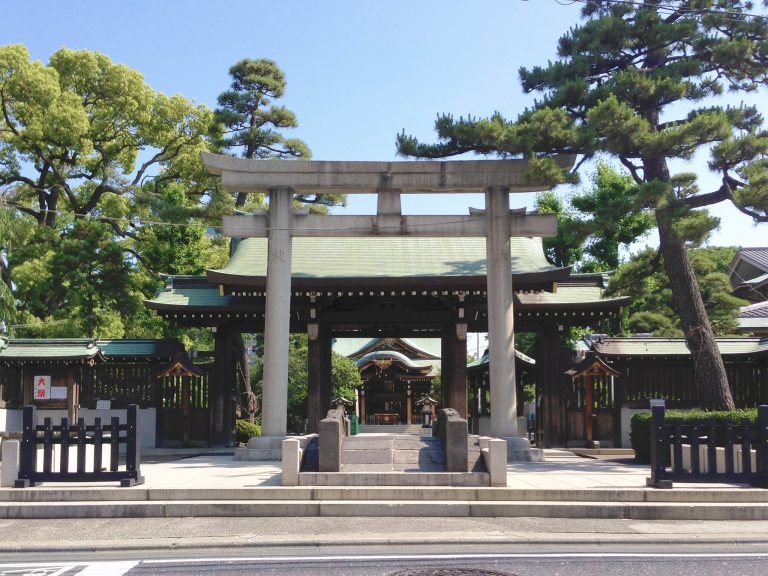
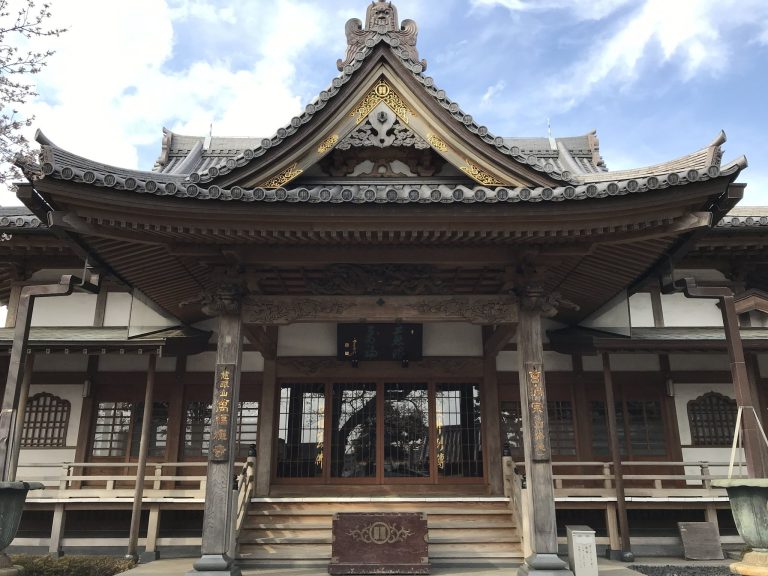
The precinct is entered through a torii and shrine marker, with the main building standing at the rear of a green-covered approach. The shrine buildings belong to the Nagare-zukuri tradition, in which the front slope of a gabled roof projects outward to create a covered entrance. The present sanctuary complex dates from the 1960 reconstruction after the wartime destruction.
Sacred landscape and surviving trees
Yoshioki’s burial mound
Behind the shrine is a circular mound approximately 15 meters in diameter. It is traditionally identified as the body mound, or torso mound, of Nitta Yoshioki and is enclosed by a fence. The mound is also called Arayama and Mayoizuka. Local belief held that entering it would bring a curse.
Funasugi cedar and Flag Bamboo
A large cedar called Funasugi once stood at the mound’s center. Tradition held that it grew from Yoshioki’s boat, or from the boat and his armor buried there. Lightning later destroyed the tree. Bamboo behind the mound is traditionally called Flag Bamboo because it was believed to have grown from a white Minamoto clan banner. It was said never to extend beyond the sacred boundary and to split with a crackling sound during thunder.
Sacred zelkova
The precinct also contains a zelkova tree traditionally regarded as about 700 years old. Lightning split the tree, and the 1945 air raid damaged it, yet it survived and continues to produce foliage in spring. Mistletoe grows on its upper part. Local tradition associates touching the tree with long life, recovery from illness, and rejuvenation.
Stone features and commemorative monuments
Guardian-lion statues
An older guardian-lion statue originally belonged to a male-and-female pair. The female, closed-mouth figure was lost during the war, leaving the open-mouth figure. Its date of manufacture is unknown. The present guardian-lion statue was made in 1965 by the stonemason Kazama Hachitaro.
Festival lifting stone
A stone weighing approximately 180 to 240 kilograms recalls an older festival practice. Young men competed to lift it, and those who succeeded carved the weight and their names into its surface before dedicating it. The practice is regarded as a former religious rite and a coming-of-age ritual.
Waymarker and war memorial
A stone waymarker for Nitta Shrine was originally erected beside the present Dai-ni Keihin road, now National Route 1. A religious confraternity from Hishikubo in Azabu built it in April 1817. Another stone monument, erected in 1967, commemorates the war dead of the Yaguchi district. A memorial service for them is held annually on April 10.
Treasure hall
The treasure hall is an azekura-style storehouse built in 1977. This construction uses interlocking horizontal timber logs. The hall preserves sacred objects transferred from Ise Grand Shrine after its sixtieth periodic rebuilding in 1976, including a sacred comb box, a bow, and a shield. It also houses shrine treasures that survived the wartime destruction.