Ikegami Honmon-ji Temple: A Major Nichiren Buddhist Head Temple in Tokyo


Site at a Glance
- Rating
- 4.3
- Popularity
- Medium
- Country
- Japan
- Primary era
- Early Modern
- External website
- Open
- Eras represented
- Early Modern, Modern
- Civilizations
- Japanese, Tokugawa
- Site type
- Religious
- Remains
- Temple
On this page19 sections
History
Ikegami Honmon-ji Temple is a major Nichiren Buddhist temple in Tokyo, Japan, traditionally founded in 1282 at the place where Nichiren is believed to have died. Nichiren was a thirteenth-century Buddhist teacher who established a tradition centered on devotion to the Lotus Sutra. The temple is formally known as Choeizan Daikoku-in Honmon-ji and is regarded as one of Nichiren Buddhism’s fourteen sacred sites and seven principal head temples.
Foundation and Nichiren’s final days
On 8 September 1282, the ailing Nichiren left Minobu for therapeutic treatment in Hitachi. He reached the residence of Ikegami Munenaka in Musashi Province on 18 September and spent the final twenty-odd days of his life there. During the same month, a temple building was erected on the hill behind the Ikegami residence. Nichiren is traditionally said to have consecrated it and named it Honmon-ji of Choeizan, establishing the origin of the present temple.
Nichiren died on 13 October 1282. After his death, Ikegami Munenaka donated a temple estate measuring 69,384 tsubo, a traditional Japanese unit of area of approximately 3.3 square meters. The number was chosen to correspond to the number of characters in the Lotus Sutra. This donation provided the institution with its early estate, and the temple subsequently became known as Ikegami Honmon-ji. Nichirō, one of Nichiren’s leading disciples, succeeded him as head of the temple.
The former Ikegami residence is believed to have occupied the valley west of the temple. A private Buddhist chapel built there in 1276 was later called the Lotus Hall and became the basis of the affiliated temple Daibo Honkyo-ji. The western valley is therefore connected both with Nichiren’s final days and with the early development of the temple institution.
Patronage and institutional change
During the Kamakura and Muromachi periods, Ikegami Honmon-ji prospered under the protection of warrior families in the eastern provinces. In the early modern period it served as a prayer temple for feudal lords, including Katō Kiyomasa and the Kii branch of the Tokugawa family. Katō Kiyomasa was a powerful late-sixteenth- and early-seventeenth-century lord and military commander known for supporting Buddhist institutions.
During the Edo period, the temple supported the Fuju-fuse branch of Nichiren Buddhism. After the dispute known as the Minobu–Ikegami controversy, it came under the authority of Kuon-ji. The Tokugawa family ruled Japan through the shogunate from 1603 to 1867, and its regional branches and court-connected relatives maintained family cemeteries and religious patronage at temples such as Ikegami Honmon-ji.
The temple’s institutional network once included 36 subsidiary temples. Following relocations, mergers, and closures, 24 temples, including the main temple itself, remain associated through the organization known as the Rōshi-kō. The Nichiren Buddhist system of head and subordinate temples was dismantled in 1941, so the institutions formerly linked through it are now described as former head temples and former subordinate temples.
War damage, preservation, and religious observance
Air raids during the Second World War destroyed almost all of the temple buildings. The five-story pagoda, main gate, sutra repository, and hōtō survived, while most other prewar halls were later rebuilt or newly constructed. The complex was progressively restored after the war, preserving both its surviving early-modern structures and its continuing religious function.
Ikegami Honmon-ji has long held the annual O-Eshiki observance from 11 to 13 October in memory of Nichiren’s death. It is fundamentally a memorial Buddhist service. Its principal event takes place on the night of 12 October, when a mandō procession, featuring elaborate lantern structures, accompanies devotional chanting. The modern public observance also includes temporary stalls extending from the temple precincts toward Ikegami Station. Approximately 300,000 worshippers attend, and particularly large years have drawn nearly one million.
Part of Nichiren’s tooth relic was transferred to the affiliated Shakado of Honkyo-ji and enshrined there in 1723. The precincts also contain early-modern graves associated with the Uesugi family of Yonezawa, the Hosokawa family of Kumamoto, and the Kano painting lineage. Among the notable burials are Nichiren, the professional wrestler Rikidōzan, and the writer Kōda Rohan.
A memorial tablet for 125 sailors who died when USS Oneida sank outside Yokohama after being rammed by the British steamer Bombay on 24 January 1870 was installed at the temple in May 1889, following a Buddhist memorial ceremony.
Archaeology and collections
Excavations of three early-modern daimyo burial sites and three graves belonging to the Kobikichō Kano family were carried out by the temple, the Ota Ward Board of Education, and the archaeological research laboratory of Rissho University under Professor Sakazume Shuichi. The investigations clarified the upper and lower structures of early-modern graves, including burial facilities that had received comparatively little study.
During repairs to the five-story pagoda between 2002 and 2003, surrounding graves were reorganized. The investigated graves were dismantled, moved slightly, reinforced, and restored, and the results were published in an excavation report. The process connected the conservation of the pagoda with further understanding of the cemetery’s early-modern structures.
The five-story pagoda and hōtō are nationally designated Important Cultural Properties. The pagoda received designation in 1911, the wooden seated image of Nichiren in 1928, and the hōtō in 2010. Other designated buildings, sculptures, manuscripts, ritual objects, and historical documents are also preserved at the temple.
More than 1,000 materials related to the Lotus Sutra, collected by the scholar Kabutogi Shōryō, were donated to Ikegami Honmon-ji in December 1995. The collection includes an original letter by Nichiren and an illustrated biography of Nichiren dating from the Azuchi–Momoyama period. The temple’s eastern valley became Honmon-ji Park, opened as Tokyo City Honmon-ji Park in December 1938 and transferred to Ota Ward after the war. The temple’s youth organization received the Shoriki Matsutaro Award in 1986 and its main award in 1992.
Remains
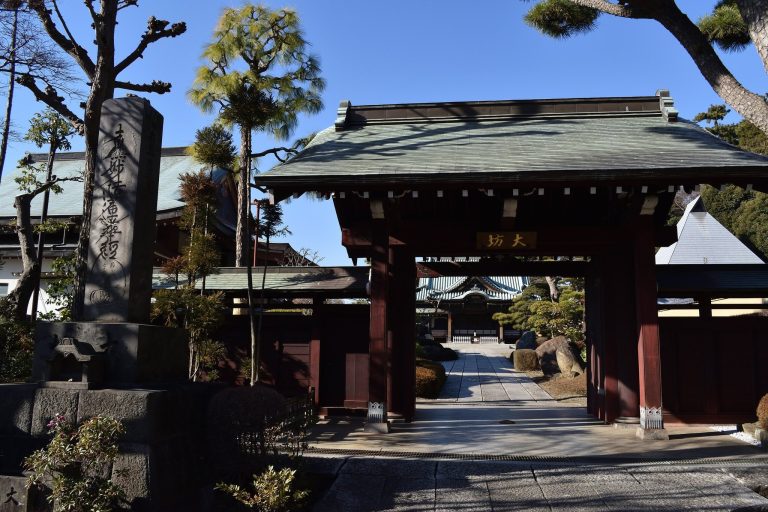
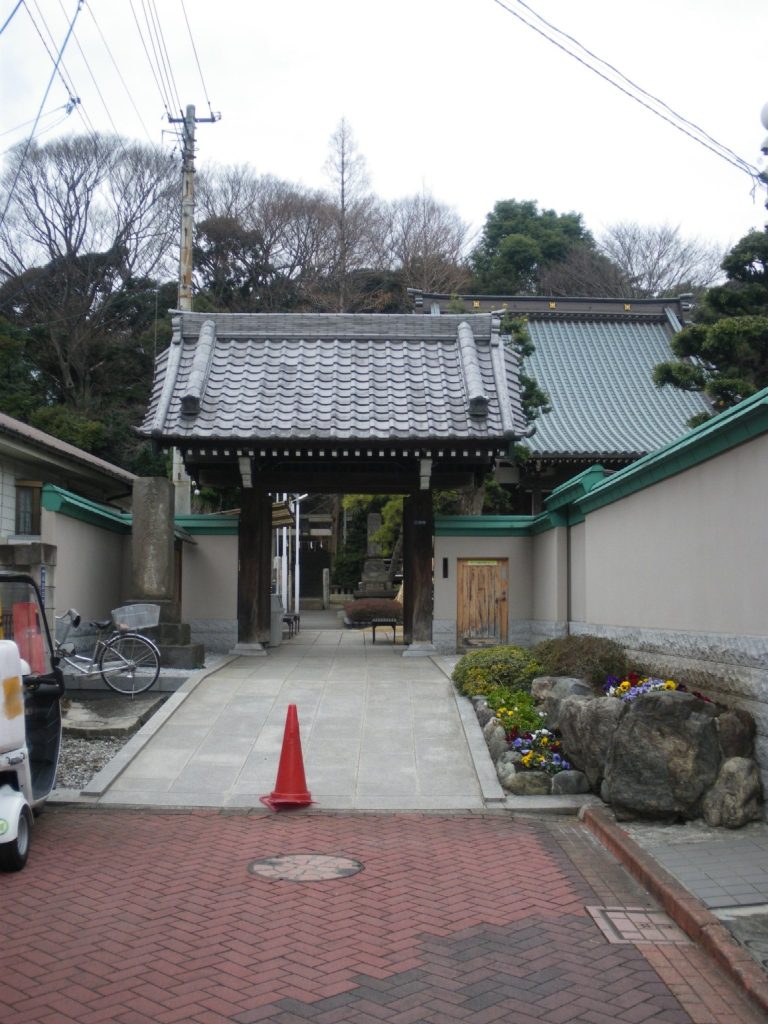
The principal buildings stand on a steep-sided hill. A stone stairway of 96 steps, known as Shikyōnan-zaka, rises from the main gate toward the central sanctuary. The central precinct is arranged beyond the stairway and Niomon gate, while halls, repositories, gardens, cemeteries, and the western and eastern valleys extend around it.
Approach and central precinct
Shikyōnan-zaka and Niomon
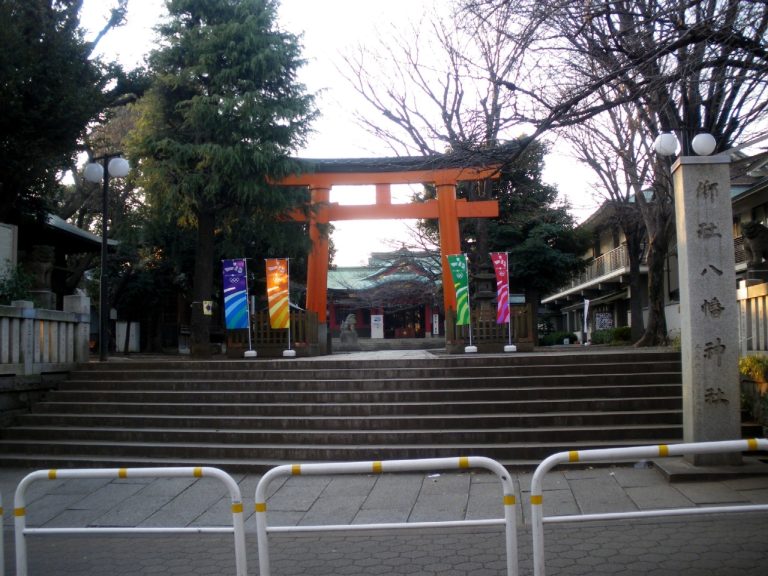
Shikyōnan-zaka forms the principal stone approach from the main gate up the hill. Its construction is traditionally associated with the patronage of Katō Kiyomasa. At the top stands Niomon, the gate before the central sanctuary. The space in front of it contains Choei Hall, a statue of Nichiren, and a memorial monument.
Main hall and associated buildings
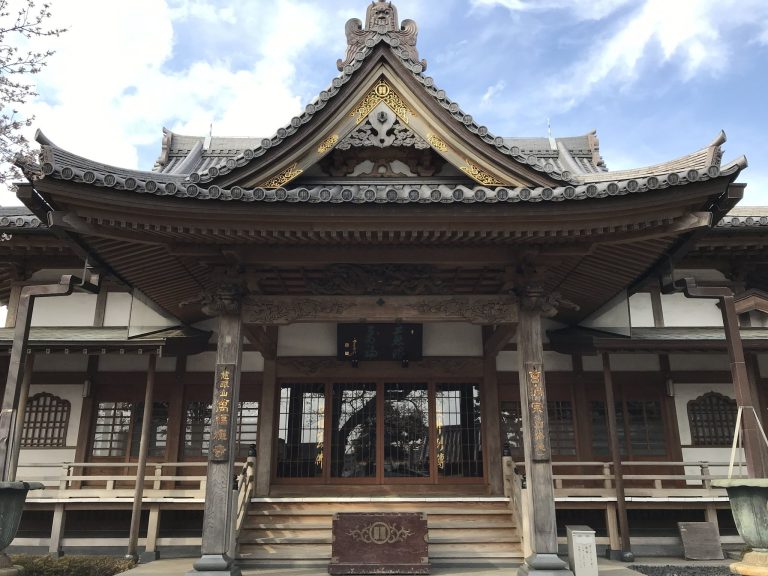
The main hall lies beyond Niomon. On the west side of the central precinct are Nichō Hall, the bell tower, the temple treasure hall, and the sutra repository. A kyōzō, or repository for Buddhist scriptures, the sutra repository was built in 1784 and is one of the major buildings that survived the wartime air raids.
The north side contains the main sanctuary, guest hall, Rōhō Hall, and Shōtō-en garden. Shōtō-en is a non-public garden that opens for limited periods. The temple’s main gate, sutra repository, five-story pagoda, and hōtō retain their prewar fabric, while most of the other prewar halls were rebuilt or newly constructed after the air raids.
Five-story pagoda
The five-story pagoda stands within the cemetery on the eastern side of the precinct. Built in 1607, it is an early Edo-period wooden structure with tiled roofs on the first and second stories and copper-sheet roofing above. It underwent dismantling and conservation from October 1997 to March 2003. The work was accompanied by the reorganization and archaeological investigation of nearby graves.
Hōtō
The hōtō is an Edo-period Buddhist memorial tower, a form generally associated with relics or commemorative enshrinement. Built in 1828, it has a roof combining tile and copper. It stands in the western valley near the Tokugawa graves and Daibo Honkyo-ji.
Cemeteries and western valley
Tokugawa and other family graves
The temple grounds contain burial monuments of the Kii branch of the Tokugawa family. They include memorial towers for Matsuhime, a daughter of Tokugawa Yorinobu; a four-year-old child of Yorinobu; Yoshu-in, a consort of Tokugawa Ieyasu and mother of Yorinobu and Tokugawa Yorifusa; Myōsō-in, a consort of Tokugawa Ienari and mother of Tokugawa Narimasa; Tenshin-in, a consort of Tokugawa Mitsusada and a princess of the Fushimi-no-miya family; Yōrin-in, Yorinobu’s wife and a daughter of Katō Kiyomasa; Kantoku-in, a consort of Tokugawa Yoshimune; and Reigaku-in, a daughter of Mitsusada and elder sister of Yoshimune.
Other graves include those of the Uesugi family’s Enkō-in and the Hosokawa family’s Seikō-in and Kōsei-in. Three graves of the Kobikichō Kano family are represented by Kano Yōboku Tsunenobu, Kano Josen Shūshin, and Kano Seisen-in Yasunobu. A memorial monument beside the five-story pagoda commemorates soldiers of the former Manchukuo army.
Ikegami residence earthwork
A long embankment running north to south west of the Kii Tokugawa family cemetery is regarded as a surviving earthwork of the Ikegami residence. Part of its eastern slope is faced with stonework apparently associated with construction of the Tokugawa cemetery. The western valley containing the hōtō, Tokugawa graves, and Daibo Honkyo-ji is regarded as the former residential section, or root enclosure, of the Ikegami residence.
Daibo Honkyo-ji and the Shakado
Daibo Honkyo-ji occupies the western valley associated with the former Ikegami residence. Its Shakado preserves the place where part of Nichiren’s tooth relic was enshrined in 1723. The institution developed from the private Buddhist chapel built in 1276, later known as the Lotus Hall.
Images, manuscripts, and ritual materials
Wooden image of Nichiren
The temple preserves a wooden seated image of Nichiren made in 1288. An inscription beneath the figure’s knees gives the date as 8 June 1288 and names Nichiji and Nichijō as its principal donors.
Manuscripts and religious objects
Among the temple’s designated works is a manuscript by Nichiren dating from 1276, traditionally known as the Brothers’ Treatise. Associated holdings include letters and mandalas by Nichiren, works by Nichirō, portraits of Nichiren and later priests, a printed Buddhist canon associated with Tenkai, and a wooden ritual incense burner.
The archives also contain original and illustrated Lotus Sutra materials from the medieval and early-modern periods. These include a letter by Nichiren and the illustrated biography Annotated Pictorial Biography of Saint Nichiren. Together with the surviving buildings and graves, these materials preserve the religious, institutional, and commemorative history of Ikegami Honmon-ji.
Honmon-ji Park
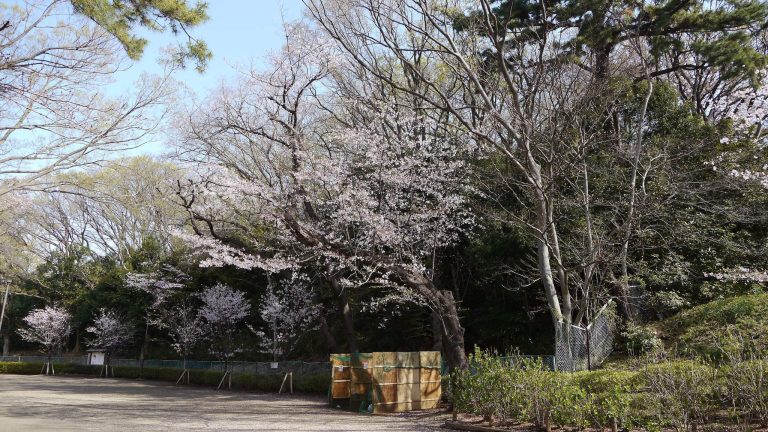
The eastern valley below the main buildings forms Honmon-ji Park. It contains a play area, athletic ground, Benten Pond, and paths along the hillside. The park was opened as Tokyo City Honmon-ji Park in December 1938 and became an Ota Ward park after the war.