Järvitaipale Fortress: A Russian Border Fortification in Finland


Site at a Glance
- Rating
- 3.4
- Popularity
- Very Low
- Country
- Finland
- Primary era
- Early Modern
- External website
- Open
- Eras represented
- Early Modern
- Civilizations
- Russian
- Site type
- Military
- Remains
- Fort
On this page11 sections
History
Järvitaipale Fortress is an eighteenth-century Russian fortification in Savitaipale, Finland, begun in 1791 as part of Russia’s southeastern Finnish fortification system. Its star-shaped plan was designed for defence during the period following the Russo-Swedish War of 1788–1790. The fortress guarded an important road toward Lappeenranta and was intended to delay a Swedish attack before it reached the interior of the country.
Strategic setting and construction
Savitaipale was ceded to Russia under the Peace of Turku in 1743. The road to Lappeenranta ran through Tuohikotti and Savitaipale between Lakes Matalajärvi and Riihijärvi, giving the area military importance. General Alexander Suvorov, an eighteenth-century Russian field marshal associated with military campaigns and fortification planning, recognized this strategic value after Swedish troops used the road during the Russo-Swedish War of 1788–1790.
Construction began in 1791. Local peasants were required to supply building materials and horses, while as many as 706 soldiers took part in the fortification work. The completed fortress accommodated two companies, approximately 200 soldiers. Its armament initially consisted of six cannons and was later increased to ten. The position formed part of Russia’s wider effort to strengthen southeastern Finland after the war.
Military use and later recognition
Järvitaipale Fortress remained active until the end of the Finnish War. After that conflict, it lost its strategic value. The Finnish Heritage Agency listed the fortress in 1966, and it is also classified as one of Finland’s nationally significant built cultural environments and registered as an archaeological site.
A research project held from 5 to 9 May 2008 investigated the fortress. It has never been repaired, allowing its surviving earthworks and structures to retain their historical form. Together with Liikkala Fortress, Järvitaipale is described as one of the only two intact eighteenth-century border fortresses in Finland.
Remains
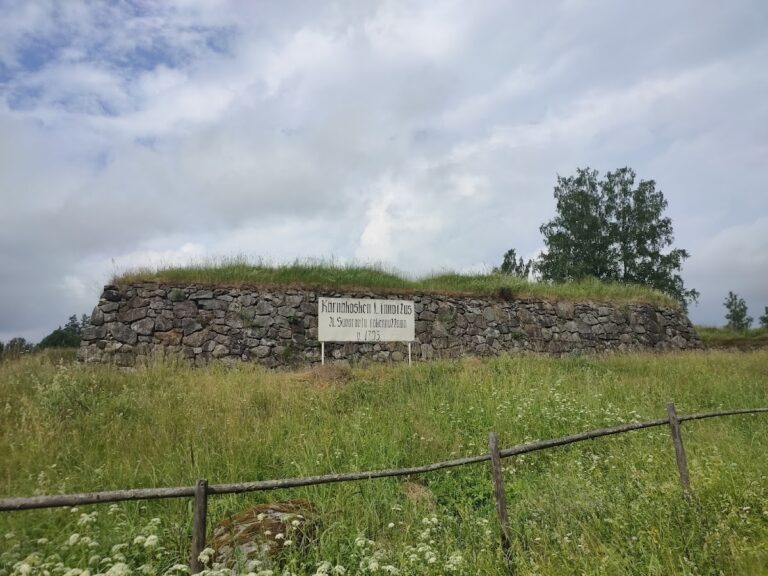
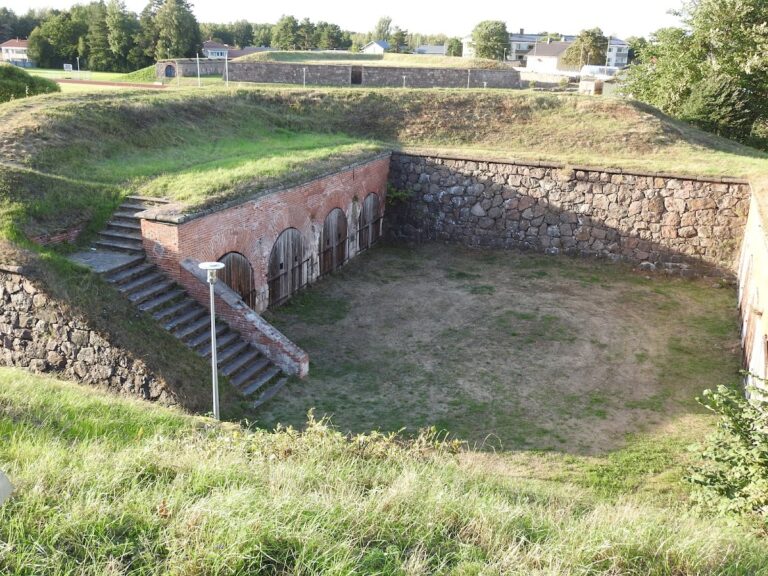
Järvitaipale Fortress occupies 74 hectares beside Regional Road 377 in Savitaipale, approximately 40 kilometres from Kärnäkoski Fortress. It is a caponier fortress, meaning a defensive work or covered passage designed to direct fire along a ditch. The star-shaped plan measures about 196 metres from end to end and 106 metres across. Two bastions and six tenailles, projecting defensive elements placed before the main enclosure, form the principal outline.
Central fort and bastions
Central courtyard
The central fort contained a courtyard with a barracks, provisions store, powder magazine, well, and warehouse. These buildings and facilities supported the garrison housed within the fortress and formed the core of the defensive position.
Bastions and ramps
The two bastions have flanks measuring 15 metres each. Earthen ramparts, about 0.7 metres high, protect them, and several firing trenches remain associated with the works. Ramps in the central sections measure approximately 5 metres in length and 2 metres in width.
Connecting works and outer defenses
Northern connecting trench
On the northern side, a connecting trench extends for 32 metres and is 7 metres wide. It ends in a pointed, arrow-shaped redoubt, a detached or enclosed defensive work.
Moat and enclosing defenses
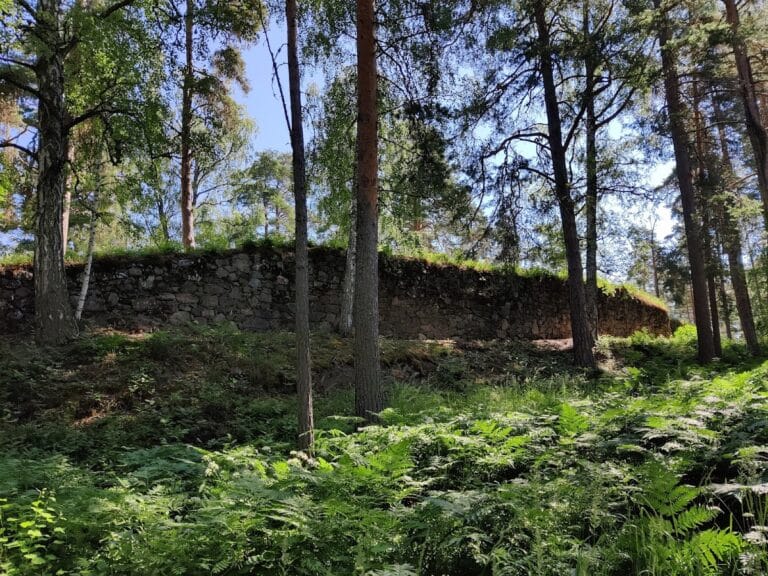
A moat and an escarp wall surround the fortress. Two corner forts link the bastions, while a network of obstacles near the embankments forms part of the defensive equipment. These elements organize the outer edge of the star-shaped fortification.
Northern redoubt
The northern redoubt has two flanks measuring 11 metres each and a third flank measuring 8 metres. A ditch surrounds the work, separating it from the adjoining fortification structures.