Fortress of Lappeenranta: A Swedish and Russian Border Fortification in Finland


Site at a Glance
- Rating
- 4.5
- Popularity
- Medium
- Country
- Finland
- Primary era
- Early Modern
- External website
- Open
- Eras represented
- Early Modern, Modern
- Civilizations
- Russian, Swedish
- Site type
- Military
- Remains
- Fort
On this page15 sections
History
The Fortress of Lappeenranta is a Swedish-built bastion fortification in Finland, founded in 1721 to protect an important border settlement during the eighteenth century. It surrounded the old town, formerly called Villmanstrand, and formed part of Sweden’s eastern frontier-defence system against the Russian Empire.
Before the fortress
Before the fortifications were established, the site was associated with the Lapvesi market, which drew local residents and merchants from Viipuri. During Swedish rule, Per Brahe the Younger, Sweden’s governor-general of Finland, founded Villmanstrand in 1649. The town’s houses were concentrated around its market square.
Swedish frontier fortification
After the Treaty of Nystad in 1721 made the town an important Swedish border settlement, Sweden created a border commission led by Axel Löwen, a general and state counsellor. In 1722, Löwen installed a small garrison to secure the border crossing and assist returning refugees. He then joined Johan Henrik Friesenheim and Berndt Olof Stackenberg in deciding to fortify Lappeenranta.
The new works protected the town’s tar trade. Pickets and chevaux de frise, defensive obstacles made from projecting stakes or spikes, were erected, and 112 soldiers were assigned to defend the trading post. Construction began in 1722, with the principal work continuing until 1728. Carl Fredrik and Anders Johan Nordenberg, together with Jacob Johan Faber, were selected in 1723 to design the fortress.
Construction proceeded slowly because money was repeatedly scarce. Work resumed toward the end of the 1730s, when the Hat Party, a Swedish political faction that controlled the government and supported military expansion, provided additional funds. Adam Reinhardt Brunow directed the renewed work, but the Russo-Swedish War of 1741 to 1743 interrupted it.
War and transfer to Russia
In 1741, after a fierce assault, Lappeenranta was plundered and burned. A monument near the fortress approaches commemorates the battle. Under the Treaty of Åbo in 1743, Villmanstrand passed from Sweden to the Russian Empire. Russian troops and Russian-speaking settlers increased the town’s population, while a Russian garrison was established and the Saimaa flotilla, a military fleet operating on the inland waters of the Saimaa lake system, was based there.
The fortifications had been badly damaged during the 1741 battle and were renovated in the 1750s. During the Russo-Swedish War, the Saimaa fleet functioned as a third garrison of Lappeenranta.
Suvorov’s reconstruction
In the 1790s, the Russian general Alexander Suvorov took command of the fortress and expanded it within Russia’s defensive system in southeastern Finland. After inspecting the region for three weeks on behalf of Catherine II in 1791, he prepared a Finnish defence plan for a possible war with Sweden. He identified Villmanstrand Fortress as one of two central posts in the proposed defensive line.
From 1791 to 1792, Suvorov directed extensive fortification work. He spent about three months at Villmanstrand in 1791 supervising the restoration of a fortress that was then almost completely destroyed. The rebuilding included older town bastions, new fortifications on the southern side, the Nikolayevsky Redoubt southwest of the fortress, and military canals. These works contributed to the later system known as the Suvorov defensive line.
The expansion displaced the civilian population from inside the ramparts. Residents gradually moved into the districts that now form central Lappeenranta. The town did not become a battlefield during the remainder of Russian rule. After the Russo-Swedish War of 1808 to 1809, Finland became part of the Russian Empire and the frontier with Sweden moved west to the Tornio River, reducing the fortress’s strategic importance.
Closure and later history
By decree of Emperor Nicholas I, the fortress officially closed in 1835 and was transferred to the municipal authorities. The area subsequently declined, and its former military buildings deteriorated. After the Finnish Civil War, a prisoner-of-war camp was established there in 1918. It held up to approximately 3,000 captured Red Guard personnel, the socialist forces in the conflict, and around 500 prisoners were executed. The camp became associated with arbitrary executions.
Most of the western ramparts were restored in 2002 to approximate their original appearance. The fortress is protected by the state and is a registered archaeological site.
Remains
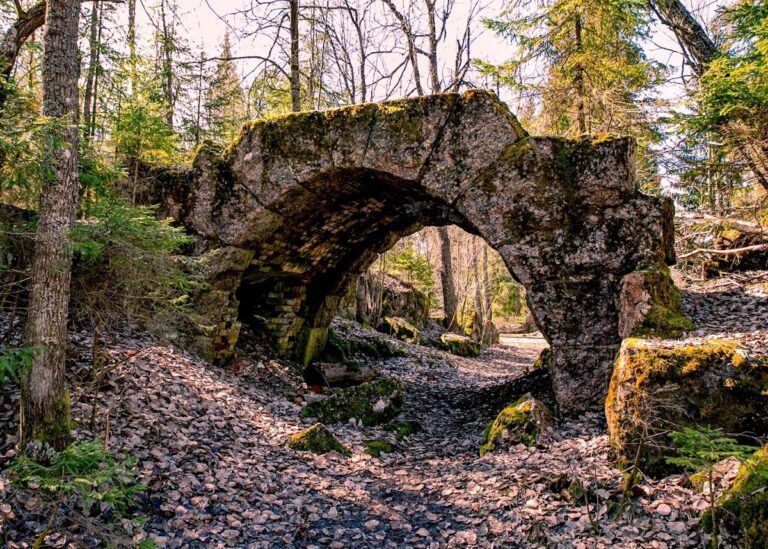
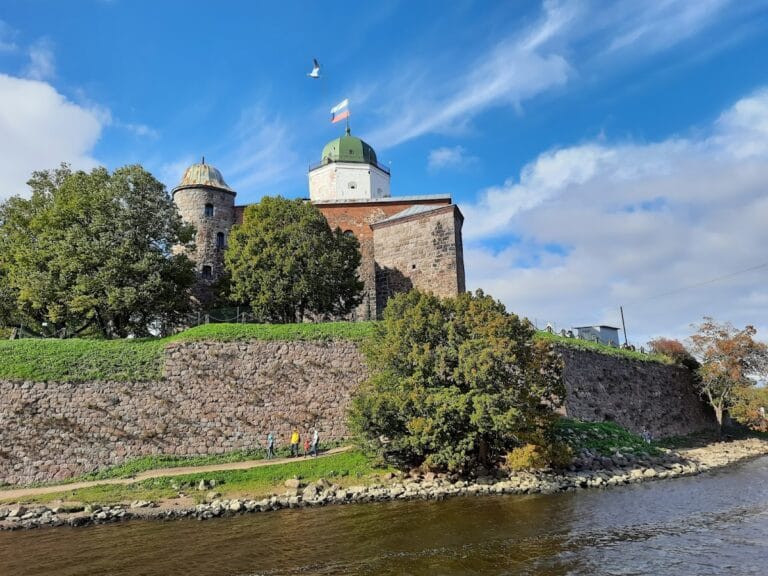
The fortress occupies a high promontory beside Lake Saimaa. Its bastioned defences surround Lappeenranta’s old town, with the eastern side of the town crossed by the fortified lines. A ditch surrounded the complex, and a bridge provided passage across it. The surviving site combines earthworks, later military structures, religious buildings, former institutional buildings, and modern additions.
Fortifications and waterworks
Ramparts and bastions
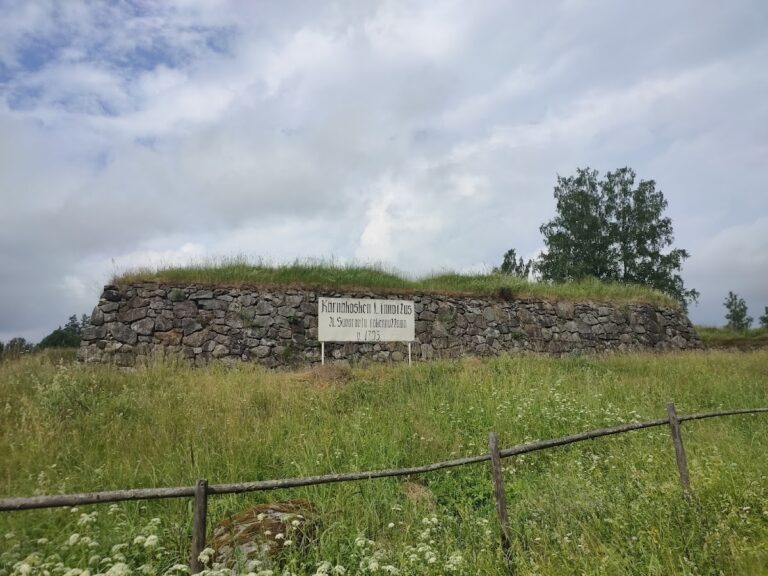
The fortress is organized as a system of bastion fortifications, with projecting sections designed to let defenders cover adjoining walls with fire. The 1791 to 1792 reconstruction rebuilt the older town bastions and added new fortifications along the southern side. The western ramparts were restored in 2002 and brought closer to their original form.
Nikolayevsky Redoubt
The Nikolayevsky Redoubt was constructed southwest of the fortress during Suvorov’s rebuilding works. It belongs to the defensive expansion that reshaped the fortress during the Russian period.
Suvorov military canals
Military canals were excavated during the same rebuilding programme. They formed part of the frontier-defence works directed by Suvorov in 1791 and 1792.
Religious and civic buildings
Church of the Intercession of the Holy Virgin
The Church of the Intercession of the Holy Virgin was built in 1785 during the Russian period. It is the oldest Orthodox church in Finland and remains part of the fortress complex.
Later buildings and institutions
The complex includes the former women’s prison, residential buildings, a dance-school building, and a regional radio studio. It also contains the South Karelia Museum, the Art Museum, a café, and a summer theatre. The YLE building, constructed in 1972, is the newest structure within the fortress.
Battle monument
A monument near the approaches commemorates the bloody battle for Lappeenranta in 1741. According to a local legend, the log mounted on the monument was carried downhill by a stream of blood that reached the fortress gates.
Nearby sites