Hamina Fortress: A Star Fort in Finland


Site at a Glance
- Rating
- 3.9
- Popularity
- Very Low
- Country
- Finland
- Primary era
- Early Modern
- External website
- Open
- Eras represented
- Early Modern, Modern
- Civilizations
- Russian, Swedish
- Site type
- Military
- Remains
- Fortified Town
On this page18 sections
History
Hamina Fortress is a Swedish-built star fort in Finland, constructed in the early 1720s as a planned fortified town on the coast of the Gulf of Finland. Its Renaissance-inspired design combined a central square with streets radiating toward the fortifications. The fortress protected the coastal road and was intended to hinder a Russian advance after the Treaty of Nystad moved the Russo-Swedish frontier toward Vehkalahti.
From Vehkalahti to Fredrikshamn
The fortress occupies the former marketplace of Vehkalahti, which received city rights in 1653 under the name Vehkalahden Uusikaupunki. The town was destroyed during the Great Northern War, a conflict fought mainly from 1700 to 1721 that ended Sweden’s dominance in the eastern Baltic, in 1712. After the war, Sweden began building new defences under Axel von Löwen, a Swedish military engineer and fortification designer.
In 1723, the fortified town was renamed Fredrikshamn in honour of Frederick I, king of Sweden from 1720 to 1751. By 1741, the work had produced only earthworks. During the Russo-Swedish War of 1741 to 1743, a conflict that transferred Hamina to Russia, Swedish forces surrendered the unfinished fortress without a fight in 1742. Russian possession was confirmed by the Treaty of Åbo in 1743, and construction then continued with the fortifications reoriented toward Sweden.
Wars and Russian reconstruction
Fredrikshamn was besieged twice by Swedish forces in 1788. The town’s defence was led by General Vasily Levashov and Colonel von Eck, the garrison commander. On 11 July, an exchange with the fortress batteries suppressed Swedish artillery fire. On 22 July, a Swedish corps under Armfelt, numbering more than 5,000 men, began another siege, but unrest among the Finnish units of the Swedish army led to its abandonment. A later tradition associates the defence with Levashov’s alleged reply to a Swedish demand for surrender: “Russians do not surrender.”
On 15 May 1790, Swedish ships under King Gustav III attacked the town and a Russian galley detachment commanded by Captain First Rank Slizov in the coastal waters. After several hours of fighting, the smaller Russian force lost 26 vessels. Swedish ships entered the harbour and continued bombarding the town, but Gustav III ordered the fleet to withdraw toward Vyborg, leaving the fortress unconquered.
In 1791, Empress Catherine II commissioned General Alexander Suvorov to prepare a defence plan for Russian Finland. Suvorov, a prominent Russian field marshal who also directed major defensive works in Russian-controlled Finland, treated Hamina Fortress and Vyborg Fortress as the two principal elements, or “capitals,” of the defensive line. From 1791 to 1792, he directed extensive works at Hamina, strengthening the northern front, adding the central bastion, and replacing vulnerable earthwork surfaces with masonry.
Decline as a frontier fortress
Hamina Fortress formed part of the south-eastern Finnish fortification system later associated with the Suvorov defensive line. In 1803, its north-facing defences were demolished and replaced by a new masonry bastion because the fortress was considered obsolete and inadequate. The work followed plans by Jan Pieter van Suchtelen, a Dutch-born general in Russian service.
The Finnish War of 1808 to 1809 transferred Finland from Swedish to Russian rule and moved the frontier westward to the Tornio River. Hamina was consequently left in the Russian rear, reducing its strategic importance. From 1811, individual infantry companies were attached to the garrison only temporarily. In the 1830s, Emperor Nicholas I transferred the fortress territory to the town of Fredrikshamn and abolished the office of fortress commander.
The fortress regained a defensive function during the Crimean War, fought from 1853 to 1856, when its defences were reinforced and the commandant’s post was temporarily restored. It served as an active fortress from 1721 to 1836 and from 1845 to 1855, and continued afterward as a garrison.
Restoration and continuing use
Restoration began in 1957. From the 1980s, the Finnish National Board of Antiquities was responsible for renovating the fortress structures. Parts of the complex remain under military control, while other areas have been adapted for cultural and recreational use. The former Finnish Cadet Corps building is now occupied by Finland’s Reserve Officer School.
The fortress is also associated with the Hamina Tattoo, an international military-music festival held every two years, as well as concerts and other public events. These uses continue within a fortified town whose name changed from Fredrikshamn to Hamina after 1917.
Remains
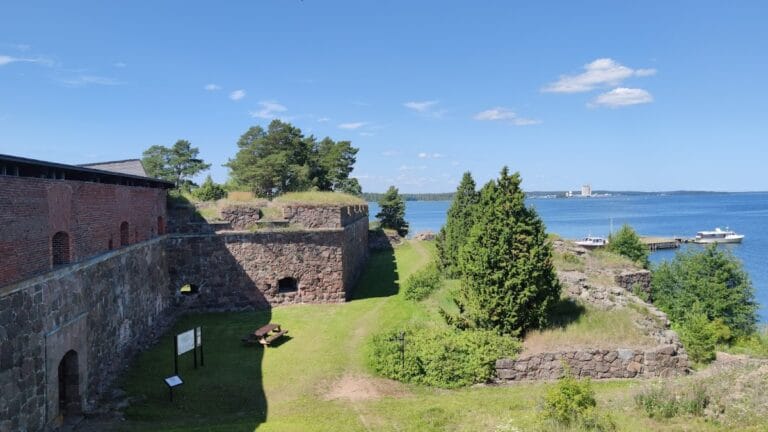
Hamina Fortress is a star fort integrated into Hamina’s city centre. A star fort uses projecting points to provide overlapping fire along its walls and reduce areas that defenders could not cover. The town plan follows the Renaissance ideal of a fortified city, with eight radial streets meeting at the central town-hall square. The original design included six principal bastions named after Finnish fortified towns, while the completed fortress had seven bastions in total. Six survive.
Bastions and internal spaces
Central Bastion
The Central Bastion stands at the northern end of the fortress beside Lake Kirkkojärvi. Built in 1803, it replaced the demolished northern defences and extends for 240 metres. Its masonry contains 58 brick, arched casemates, which are fortified chambers used for protected activities such as storage or artillery. The bastion is flanked by the Puolikuu 1 and Puolikuu 2 caponiers, covered defensive structures projecting into an approach or ditch.
The Central Bastion encloses a large esplanade. A temporary partial covering completed in 1998 provides 5,800 square metres of covered space, including a parade area measuring 30 by 60 metres. The structure was designed for the Hamina Tattoo and is described as Europe’s largest tent. Its space also accommodates about 4,000 people.
Savonlinna Bastion
Savonlinna Bastion lies east of the Central Bastion and north of Kadettikoulunkatu. The main building of the Reserve Officer School and the garrison hospital occupy its area.
Hamina Bastion
Hamina Bastion occupies the eastern part of the fortress, south of Kadettikoulunkatu.
Turku Bastion
Turku Bastion occupies the southern part of the fortress east of Maariankatu. The area is privately owned, and its powder magazine houses a Jaeger Museum.
Helsinki Bastion
Helsinki Bastion was demolished in 1889. Its flag tower, built in 1790, survives, while the former bastion site is now the market square.
Lappeenranta Bastion
Lappeenranta Bastion lies between the market square and Mannerheimintie. Kesäpuisto Park was created within the bastion area during the 1850s. At the edge of the park stands Puistotalo, designed by Karl August Wrede and built in 1884.
Hämeenlinna Bastion
Hämeenlinna Bastion lies north of Mannerheimintie. Its powder magazine now serves as an art gallery and meeting room, while the Hamina Theatre’s summer theatre occupies part of the bastion.
Gates and guardhouses
The fortress originally had three guarded entrances. Access to the town was restricted to these posts, where newcomers surrendered their passports and weapons. The medieval King’s Road between Turku and Viipuri crossed the town between the Lappeenranta Gate and the Viipuri Gate.
Lappeenranta Gate
The Lappeenranta Gate guardhouse was built in 1774 along present-day Mannerheimintie. It served as the fortress and garrison’s main guard post from 1840 to 1974. The building later housed the Reserve Officer School Museum until 1995 and an office of the Finnish Heritage Agency. It is now privately owned, and its exterior retains its original appearance.
Viipuri Gate
The Viipuri Gate guardhouse was built in 1774 along Kadettikoulunkatu beside the main building of the Reserve Officer School. The school still occupies the building, although its appearance has been altered.
Sea Gate
The Sea Gate guardhouse was built in 1776 along Maariankatu to guard the road leading to the harbour. It is now privately owned.