Isshin-ji Temple: A Jōdo-shū Buddhist Temple in Osaka


Site at a Glance
- Rating
- 4.2
- Popularity
- Medium
- Country
- Japan
- Primary era
- Modern
- External website
- Open
- Eras represented
- Modern
- Civilizations
- Japanese
- Site type
- Religious
- Remains
- Temple
On this page18 sections
History
Isshin-ji Temple is a Jōdo-shū Pure Land Buddhist temple in Osaka, Japan, traditionally founded in spring 1185 at the request of Jien, the administrator of Shitenno-ji. Hōnen established a small four-bay-by-four-bay hermitage beside the slope at Shitenno-ji’s west gate and called it a “new retreat.” The hermitage was later renamed Genkū-an. During a pilgrimage to Shitenno-ji, the retired Emperor Go-Shirakawa is said to have visited the retreat and practiced visual meditation on the setting sun with Hōnen.
Foundation and Tokugawa patronage
In 1596, Honyo Sonmu, a monk from Mikawa Province, revived the place through a thousand-day practice of nenbutsu, the recitation of “Namu Amida Butsu” as an expression of devotion to Amida, the Buddha of the Western Pure Land. The temple was re-established as Jumyozan Kansho-in Isshin-ji. Its present name is traditionally connected with Sonmu’s single-minded recitation.
In February 1600, Senchiyo, the eighth son of Tokugawa Ieyasu, died young in Osaka and received his funeral at Isshin-ji. Sonmu’s regional connection with Ieyasu, together with Ieyasu’s adherence to Jōdo-shū, brought the temple his patronage. Ieyasu bestowed the mountain name Bansho-zan, inspired by a solitary pine on the temple slope, and gave the institution the name Kogaku-in, derived from Senchiyo’s posthumous name.
Isshin-ji was drawn directly into the military history of the Tokugawa period during the Siege of Osaka in 1614–15, the campaigns that ended Toyotomi resistance to Tokugawa rule. Ieyasu’s camp was established at the temple beside Chausuyama. The grounds also contain the grave of Honda Tadatomo, who died fighting at the front during the Battle of Tennoji and Okayama in 1615.
A tradition explains the grave’s continuing association with abstinence from alcohol. After being reprimanded for retreating during the winter campaign while drunk, Honda is said to have fought fiercely in the summer campaign and, as he was dying, vowed to save people who ruined themselves through drinking. His grave consequently became a place where visitors made vows of sobriety.
Segaki rites and the bone-Buddha tradition
During the Edo period, Isshin-ji became a special temple administered directly by the Magistrate of Temples and Shrines. It had no ordinary parishioner community. The temple declined during the Bunka-Bunsei era, but its 50th abbot, Shin’a, revived it between the mid-1830s and the mid-1840s.
Year-round segaki rites were central to this revival. Segaki is a Buddhist memorial service for hungry or otherwise unaffiliated spirits. Isshin-ji offered the rites to ordinary people regardless of sect, gaining a reputation as the “Temple of Segaki.” People who had come to Osaka as live-in apprentices began sending portions of their ancestors’ remains to the temple columbarium.
When the columbarium became full, approximately 50,000 sets of remains deposited between 1851 and 1887 were ground into powder and cast into an image of Amida in 1887. This began Isshin-ji’s practice of making bone Buddhas. The burial of the Kabuki actor Ichikawa Danjūrō VIII at the temple in 1854 is also associated with the later arrival of large numbers of funerary urns.
War, reconstruction, and continuing practice
Isshin-ji’s prewar buildings and six bone Buddhas were almost entirely destroyed during the first Osaka air raid, on 13–14 March 1945. Reconstruction began after the war. The remains of the six destroyed images were incorporated into a seventh bone Buddha, together with the ashes of approximately 220,000 people, and the production of the images resumed.
Later bone Buddhas were made from remains collected over periods of roughly ten years. Isshin-ji houses the seventh through thirteenth images. The thirteenth was consecrated in 2007 and contains remains deposited from 1997 through the end of 2006. By January 2020, approximately two million people’s remains were associated with the bone-Buddha tradition.
In 2020, Isshin-ji announced restrictions taking effect in 2021 after increased reburials and the closure of family graves caused a sharp rise in deposits. Bone urns were limited to a smaller size, and remains from reburials were no longer accepted. Several paintings, documents, and related works associated with the temple are Osaka municipal tangible cultural properties. The bone-Buddha custom is an Osaka municipal intangible folk cultural property. Isshin-ji is also the seventh site on the Twenty-Five Sacred Sites of Hōnen pilgrimage and the thirty-ninth site on the Osaka New Forty-Eight Vows pilgrimage.
Remains
Isshin-ji occupies a broad precinct on the edge of the Uemachi Plateau, beside Tennoji Park and along the plateau’s escarpment. Its principal image is Amida. The present complex combines postwar halls with later structures, while the prewar tea room and gate that shaped part of the earlier precinct were lost in the 1945 air raid.
Gates and surviving historic structures
Black Gate
The Black Gate was a large nagaya-mon, or gate incorporating adjoining rooms, relocated from the Tamatsukuri Gate of the third enclosure of Toyotomi Osaka Castle. It was destroyed in the 1945 air raid. Its earlier connection with Osaka Castle linked the temple precinct to the city’s late sixteenth-century fortifications.
Eight-Window Tea Room
The prewar precinct also contained the Eight-Window Tea Room, a tea room in the refined sukiya style associated with the seventeenth-century tea master, landscape designer, and architect Kobori Enshū. The building was lost in the same air raid as the Black Gate.
Nenbutsu Hall
The Nenbutsu Hall survived the bombing but was later moved to Nantan in Kyoto Prefecture. A new Nenbutsu Hall was built at Isshin-ji in 1992. The hall’s name refers to the recitation practice central to the temple’s Jōdo-shū tradition.
Postwar temple buildings
Nōkotsudō
The Nōkotsudō, a hall for housing the bone Buddhas, was rebuilt in 1957. It forms part of the postwar precinct devoted to the temple’s distinctive memorial practice.
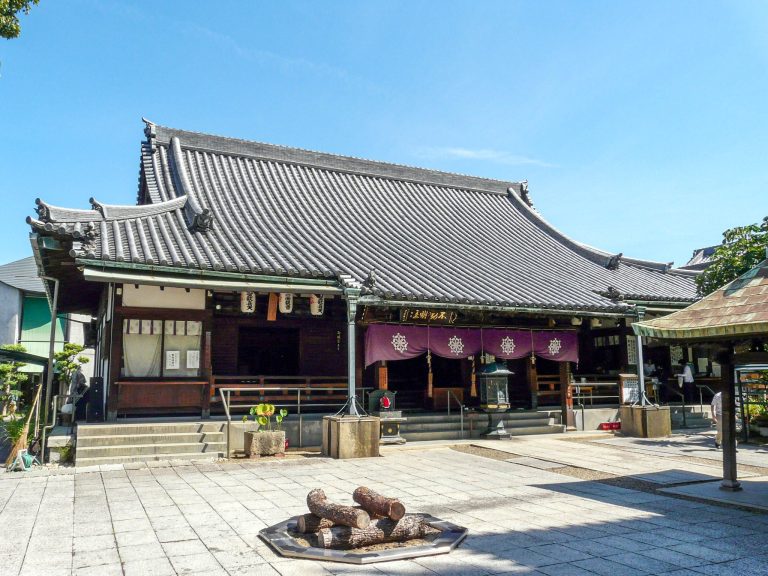
Main hall and Nissōden
The main hall was reconstructed in 1966. Nissōden, the hall for believers and guests, was completed in 1977. Together with the rebuilt Nōkotsudō and the later Nenbutsu Hall, these buildings represent the principal stages of Isshin-ji’s reconstruction after the wartime destruction.
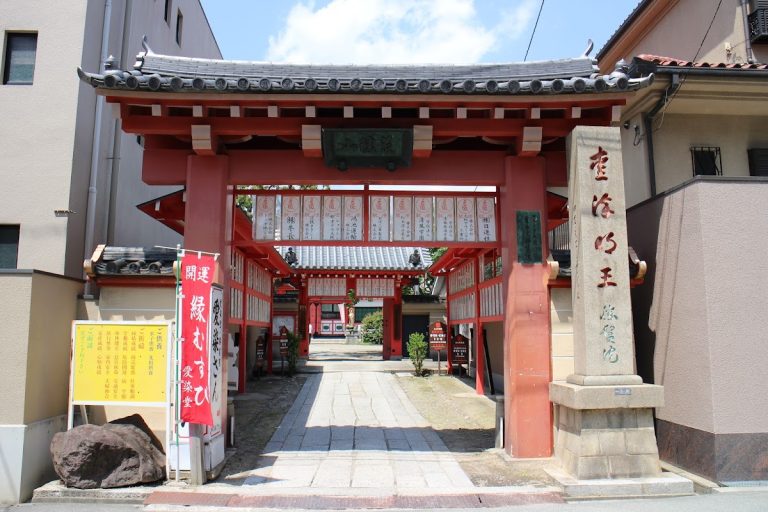
Main gate
Completed in 1997, the main gate is an innovative steel-and-concrete structure designed by Yasuyuki Takaguchi, the temple’s current elder and an architect. Bronze Kongōrikishi guardian figures by the sculptor Mineo Kanbe stand as part of the gate’s decoration. These paired Buddhist guardians traditionally protect temple entrances, with one figure’s open mouth and the other’s closed mouth expressing complementary forces. Celestial-maiden figures by the painter Fuku Akino are also incorporated into the gate.
Sanzen Butsudō
The Sanzen Butsudō was built in 2002 in a church-like form. Inside is a large tempera mural showing Amida, Kannon, and Seishi welcoming the dying. Kannon and Seishi are bodhisattvas traditionally associated with Amida and with assisting the dying. The mural is described as the world’s largest tempera mural. The hall is used for religious services, weddings, and performances by a local experimental theatre group.
Bone Buddhas and associated remains
Amida images
The bone Buddhas are enshrined in the Okotsu Butsudō. Each of the seven postwar images represents Amida and was formed by binding cremated remains into a sculptural shape with resin. The seventh image, completed in 1947, contains fragments of the first six bone Buddhas destroyed in the bombing and the ashes of approximately 220,000 people.
Later images
The eighth bone Buddha was completed in 1957 with the ashes of 160,000 people. The ninth, completed in 1967, contains those of 150,000; the tenth, completed in 1977, contains 127,619; and the eleventh, completed in 1987, contains 145,664. The twelfth was completed in 1997 with the ashes of 150,726 people, while the thirteenth, completed in 2007, contains those of 163,254. Remains from the discontinued Umeda Cemetery were also transferred to Isshin-ji and deposited there.
Paintings and historical records
Municipal cultural-property holdings associated with Isshin-ji include an Edo-period illustrated scroll recounting the temple’s legends, eight surviving historical documents, and an early-eighteenth-century portrait of Sonmu Honyo. The holdings also include a group of temple paintings, among them twenty-five Buddhist paintings.