Imamiya Ebisu Shrine: Osaka’s Shinto Shrine for Commercial Prosperity


Site at a Glance
- Rating
- 4.2
- Popularity
- Medium
- Country
- Japan
- Primary era
- Early Modern
- External website
- Open
- Eras represented
- Early Modern
- Civilizations
- Toyotomi regime
- Site type
- Religious
- Remains
- Sanctuary
On this page10 sections
History
Imamiya Ebisu Shrine is a Shinto shrine in Osaka, Japan, devoted especially to Kotoshironushi as Ebisu, the deity associated with fishing, prosperity, and successful commerce. Its foundation is traditionally dated to AD 600, during the reign of Empress Suiko, when Prince Shotoku is said to have established it as a guardian shrine west of Shitennoji Temple.
Origins and local connections
A second foundation tradition connects Imamiya Ebisu with the division of Hiruko Shrine, also called Kitamuki Ebisu, at Yasaka Shrine in Kyoto. Yasaka parishioners who settled in Imamiya are said to have enshrined the deity at the present site. The relationship between the shrines has continued through ceremonies including the January 8 tea offering, when sacred water from Yasaka Shrine is presented at Imamiya Ebisu.
Imamiya was formerly a fishing village designated as an imperial provisioning estate. Its fishermen supplied offerings to the imperial household and became shrine-affiliated retainers of Yasaka Shrine after receiving a house in the shrine district of Kyoto. Imamiya Ebisu also maintains a close relationship with Hirota Shrine, about 170 metres to the north.
Early-modern development
During the Keicho era, from 1596 to 1615, Toyotomi Hideyori commissioned new shrine buildings, with Katagiri Katsumoto acting as construction magistrate. Hideyori further supported the shrine by donating an estate that yielded 18 koku of rice, a historical rice measure, and issuing a prohibition notice protecting the shrine.
The shrine’s association with Ebisu became increasingly connected with commercial prosperity during the early-modern period. The Toka Ebisu festival began during the middle of the Edo period and had taken its present form by the Genroku era, from 1688 to 1704. A guide to Osaka published in 1675 already depicted the shrine’s Toka Ebisu observance. The deity is known locally as “Ebessan,” a familiar name linked to prayers for success in business.
Institutional and modern history
The separation of Shinto and Buddhism in 1868 altered the shrine’s institutional setting. Under the national shrine-ranking system established in 1871, Imamiya Ebisu was classified as a village shrine, a lower-level prewar category. Its traditional status remained that of a village shrine, while the Association of Shinto Shrines later designated it a Beppyo Shrine, a shrine granted special institutional status within that organization.
The shrine buildings were destroyed by the fire that followed the first Osaka air raid on March 13 and 14, 1945. The main sanctuary, worship hall, offering-food hall, and ritual-implements hall were rebuilt in November 1956. The subsidiary shrines, kagura hall, assembly hall, and shrine office followed in 1966. In January 1963, a 10,000-yen banknote among the New Year’s offerings attracted attention as a reflection of Japan’s period of rapid economic growth.
Today, Toka Ebisu is held from January 9 to 11, with its principal day on January 10. More than one million people take part, praying for commercial success. A procession involving celebrities, geisha, and the shrine’s Fukumusume attendants passes through the surrounding district on January 10. The Fukumusume, whose name means “daughters of good fortune,” are selected each year to serve worshippers by distributing blessed bamboo branches. More than 3,000 applicants seek selection, and the attendants are generally between 18 and 23 years old, with foreign students chosen separately as part of the group.
On December 8, 2017, the shrine adopted regulations excluding organized crime from Toka Ebisu and related activities. The rules prohibit such groups from participating in or exploiting the festival and allow the shrine to request pledges from suppliers confirming that they have no connection with organized crime.
Remains
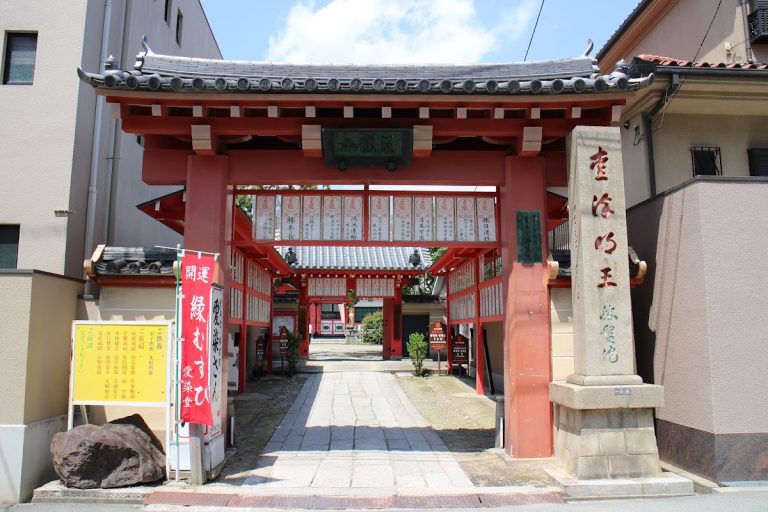
The surviving compound consists of a main sanctuary in the Nagare-zukuri style, a Shinto architectural form in which the front slope of a gabled roof projects forward to shelter the entrance, together with a worship hall, subsidiary shrines, ritual buildings, and administrative structures. Most of the present buildings date from the rebuilding campaigns of 1956 and 1966.
Principal shrine buildings
Main sanctuary and worship hall
The main sanctuary follows the Nagare-zukuri style and was rebuilt in November 1956. The worship hall was rebuilt during the same month. During Toka Ebisu, worshippers receive blessed bamboo branches at the worship hall and decorate them with a shrine talisman and small auspicious ornaments called kichō.
Subsidiary shrines
Okuni Shrine is dedicated to Okuninushi and eight other deities, comprising five sons and three daughters. The building was rebuilt in 1966. The Inari Shrine, dedicated to Ukanomitama, was also rebuilt in 1966.
Ritual and administrative buildings
The offering-food hall and ritual-implements hall were rebuilt in November 1956. The compound also contains a kagura hall for ritual performance, an assembly hall, and a shrine office, all rebuilt in 1966.
Blessed bamboo and festival ornaments
The bamboo distributed during Toka Ebisu is treated as auspicious because it grows straight with regular joints, bends without easily breaking, and retains its leaves and green color. These qualities are associated with household prosperity and success in commerce. The shrine also distributes artificial golden bamboo branches already fitted with talismans and auspicious ornaments.
The ornaments attached to the bamboo include money pouches, money bags, a folding fan, gold koban coins, silver ingots, an eboshi-style hat, a mortar, a mallet, a rice bale, and a sea bream. Distributed talismans include a household-protection paper talisman, a commercial-prosperity paper talisman accompanied by a good-fortune amulet, a gold koban, a fortune-and-virtue amulet, and a larger commercial-prosperity wooden talisman. They are placed in cases with straps so they can be hung from a wall hook, including in homes without a household altar.