Tamatsukuri Inari Shrine: Osaka Castle’s Guardian Shrine

Site at a Glance
- Rating
- 4.3
- Popularity
- Low
- Country
- Japan
- Primary era
- Early Modern
- External website
- Open
- Eras represented
- Early Modern
- Civilizations
- Tokugawa
- Site type
- Religious
- Remains
- Sanctuary
On this page14 sections
History
Tamatsukuri Inari Shrine is a Shinto shrine in Osaka, Japan, traditionally founded in 12 BCE during the eighteenth year of Emperor Suinin’s reign. It was then called Himesha, while its present name refers to Tamatsukuri, an area traditionally associated with the ancient production of magatama beads. Inari is a Shinto deity associated with rice, food, fertility, prosperity, and commerce, and the shrine became closely connected with Osaka Castle.
Early traditions and the Toyotomi period
The shrine’s early history is linked by tradition to the conflict between the Soga and Mononobe clans, powerful ancient families whose rivalry involved both politics and religion. Prince Shotoku is said to have camped on Tamatsukuri Hill, prayed for victory, and built a Kannon hall after winning the battle. Kannon was a Buddhist bodhisattva associated with compassion.
The shrine later stood within the third bailey, an outer fortified enclosure, of Osaka Castle and served as the castle’s guardian shrine. Toyotomi Hideyoshi, the late-sixteenth-century military ruler who unified much of Japan and built Osaka Castle, established Inari worship there in the 1580s to protect the castle. War devastated the shrine in 1576, and Toyotomi Hideyori rebuilt its shrine buildings and elevated stage in 1603.
Tokugawa rule and reconstruction
The buildings burned again during the Summer Campaign of Osaka in 1615, the final military campaign that brought the Toyotomi regime at Osaka Castle to an end. They were rebuilt in 1619 through donations from Naito Nobumasa, the Osaka Castle commissioner, a senior Tokugawa official responsible for administering the castle, together with local parishioners. The shrine continued as Osaka Castle’s guardian during the Tokugawa period and was then known as Toyotsu Inari Shrine.
During the Edo period, the shrine served as the starting point for pilgrimages to Ise. It burned in the Osaka fire of November 1863 and was rebuilt in 1871. During the Meiji period, it became a prefectural shrine, a high-ranking category under the prewar state shrine-ranking system. A royal princess visited on May 27, 1891, and composed an impromptu poem at the request of people present at the shrine.
War damage and later developments
The shrine’s buildings were burned during Osaka’s second major air raid on June 1, 1945. The main sanctuary and worship hall were rebuilt in October 1954. The Naniwa-Tamatsukuri Museum opened within the grounds in 1986 to commemorate the shrine’s two-thousandth anniversary. In 2011, a bronze statue of Toyotomi Hideyori was erected and unveiled at the shrine.
The shrine is affiliated with Shinto, and its registered religious-corporation name is Inari Shrine. It was formerly classified as a prefectural shrine. Its principal deities are Ukanomitama, a food and agricultural deity commonly associated with Inari worship, together with Shimoteruhime, Wakahirume, Tsukuyomi, and Kagutsuchi.
Remains
The present grounds contain the main sanctuary and worship hall, the White Dragon Pond, several associated shrines, a shrine office, an assembly hall, and the Naniwa-Tamatsukuri Museum. The site was originally beside a steep cliff. In 1789, townspeople carried dredged earth from the Higashi-Yokobori River to the grounds in a sand-carrying project intended to create a more level site.
Main grounds and historic features
Main sanctuary and worship hall
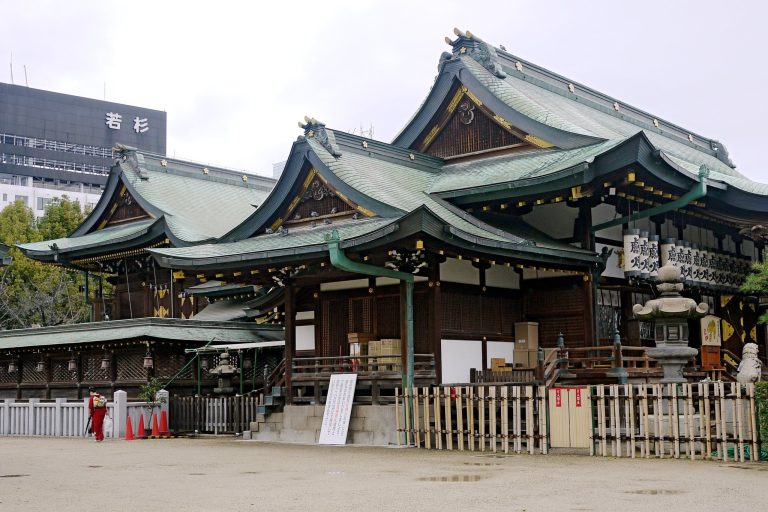
The main sanctuary and worship hall were rebuilt in October 1954 after the wartime destruction of 1945. Together they form the principal surviving shrine buildings within the present precincts.
Hideyori’s stone torii
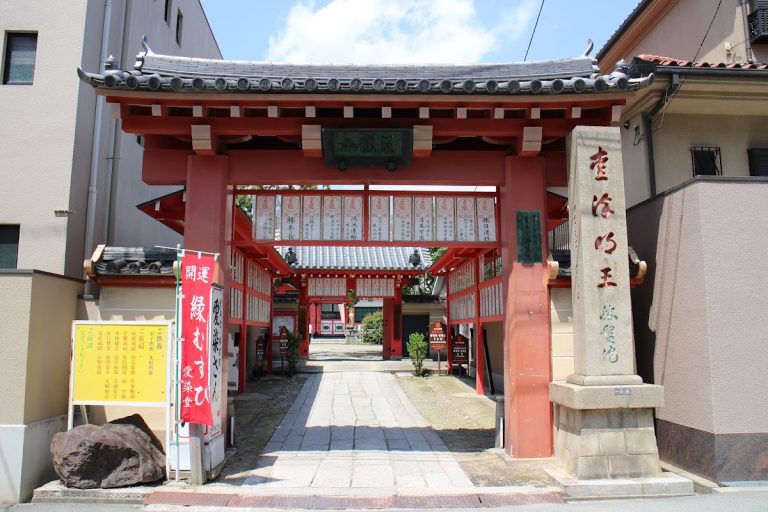
A stone torii, the gateway marking the entrance to a Shinto sacred space, was donated by Toyotomi Hideyori during the 1603 rebuilding. Damage to its foundations in the Great Hanshin-Awaji Earthquake caused its upper and lower sections to be separated, and the two parts were placed separately within the grounds.
Rikyu Well and museum
The Rikyu Well was made in 2006 in reference to the tea master Sen no Rikyu, whose residence stood south of the shrine. The Naniwa-Tamatsukuri Museum, built in 1986, also forms part of the grounds, alongside the shrine office and assembly hall.
Associated shrines and sacred features
Itsukushima Shrine and White Dragon Pond
The Itsukushima Shrine stands within the grounds beside the White Dragon Pond. It is associated with the appearance of the White Dragon Kannon at the pond’s site. Before the separation of Buddhism and Shinto, Benzaiten was worshipped there. Benzaiten was a Buddhist deity associated with music, eloquence, and prosperity. The enshrined deity later changed to Ichikishimahime, a Shinto deity often associated with water and islands, and the shrine became associated with prayers for rain.
Mankei Inari Shrine
The Mankei Inari Shrine was formed during the Kyoho period, from 1716 to 1736, when Inari shrines formerly located in various parts of Osaka Castle were combined into one shrine. It enshrines Ukanomitama.
Shinyama Inari Shrine
The Shinyama Inari Shrine began in 1799, when the Osaka Castle commissioner of the time enshrined a divided spirit of Tamatsukuri Inari Shrine in his castle residence. It was transferred to the present grounds in 1907. Its former location lay within the grounds now occupied by Shimizudani High School. The shrine enshrines Ukanomitama.
Great Deity of the Placenta Mound
The shrine’s association with Toyotomi Hideyori also survives in the Great Deity of the Placenta Mound. Hideyori’s placenta was originally buried at the present site and was later secretly venerated by local people devoted to the Toyotomi family. After the associated shrine was destroyed in the wartime disaster of 1945, it was moved first to Terayama and Higashisaka. It returned to its original location in 1983 for the four-hundredth anniversary of Osaka Castle’s construction, and it is believed to help children suffering from night crying.
A branch shrine, Tamatsukuri Inari Shrine Branch, is located in Uemachi 1-chome. Together with the subsidiary shrines within the main grounds, it forms part of the wider religious network associated with Tamatsukuri Inari Shrine.