Hōraku-ji Temple: A Shingon Buddhist Head Temple in Osaka


Site at a Glance
- Rating
- 4.4
- Popularity
- Low
- Country
- Japan
- Primary era
- Early Modern
- External website
- Open
- Eras represented
- Early Modern
- Civilizations
- Tokugawa
- Site type
- Religious
- Remains
- Temple
On this page12 sections
History
Hōraku-ji Temple is a Buddhist head temple in Osaka, Japan, associated with the Old Shingon school and the Sen’nyuji branch of Shingon Buddhism, an esoteric Buddhist tradition. Tradition dates its foundation to 1178, during the late Heian period, and attributes its establishment to Taira no Shigemori, a senior member of the Taira warrior clan. The temple’s principal object of worship is Fudo Myoo, a wrathful Buddhist deity associated with immovable wisdom and the destruction of spiritual obstacles.
Foundation tradition and sacred names
The foundation story connects Hōraku-ji with the Genpei conflicts, the wars involving the rival Taira and Minamoto clans. Shigemori is said to have created a magnificent temple complex to console the spirits of warriors from both sides. A statue of Cintamani Avalokitesvara, a form of Avalokitesvara associated with a wish-fulfilling jewel and formerly the devotional image of Minamoto no Yoshitomo, was enshrined for this purpose.
The temple’s mountain name, Shikonzan, is linked to another tradition from 1178. After hearing of the virtue of a Song-dynasty Zen master associated with Mount Yuwang, a Buddhist sacred site in China, Shigemori reportedly offered him 3,000 gold ryō, a historical monetary unit, in pursuit of a religious bond. The master is said to have given Shigemori two purple-gold Buddhist relics inherited from Mount Yuwang. The sub-temple name, Komatsuin, derives from Shigemori’s alternative title, Komatsu Naifu.
Destruction and restoration
In 1571, fire caused by Oda Nobunaga’s invasion reduced the temple buildings to ashes. Nobunaga was a major sixteenth-century military leader whose campaigns helped unify much of Japan. Hōraku-ji had been provisionally restored by 1585.
A further institutional transformation took place in 1711, when a monk transferred from Nonaka-dera became abbot. Under his leadership, Hōraku-ji underwent a full restoration as a Vinaya institution, a Buddhist establishment devoted especially to the observance and transmission of monastic discipline. The Edo-period Buddhist monk Jiun entered religious life and trained at Hōraku-ji before later becoming its abbot.
Religious life and heritage
Hōraku-ji continues a monthly observance of Fudo Myoo on the 28th, including fire rituals twice a day. A monthly Kobo Daishi observance takes place on the 21st and includes sutra copying, a Buddhist service, and a sermon. Kobo Daishi is the posthumous religious title of Kukai, the ninth-century founder of Japanese Shingon Buddhism.
The temple is linked with several pilgrimage networks. These include the Thirty-Six Fudo Myoo Pilgrimage of the Kinki Region as stop 3, the Osaka Thirteen Buddhas Pilgrimage as stop 1, and the Eighty-Eight Sacred Places of Settsu as stop 40. Hōraku-ji is also associated with pilgrimage sites connected with En no Gyoja, an ascetic traditionally regarded as the founder of Shugendo, and with the Pilgrimage Route to Shinto-Buddhist Sacred Sites as stop 47, or Osaka stop 6.
Its recognized heritage includes one nationally designated Important Cultural Property and several cultural properties designated by Osaka Prefecture, among them a sculpture and a large camphor tree.
Remains
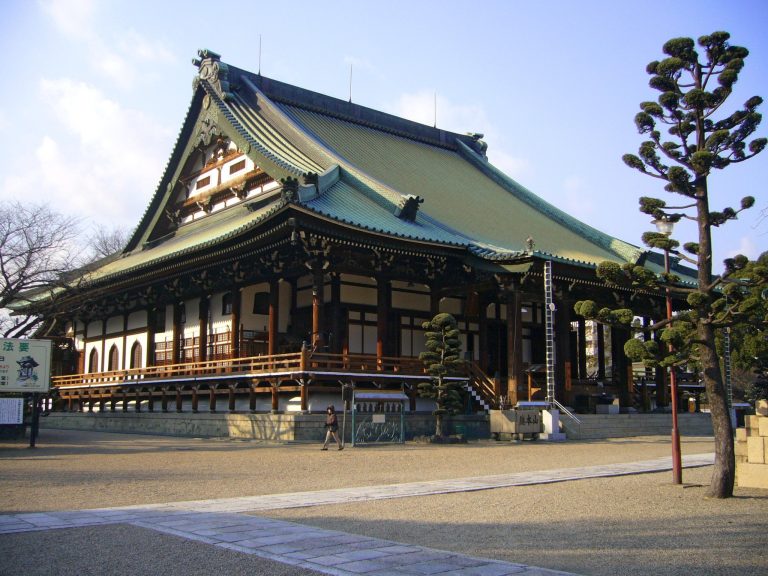
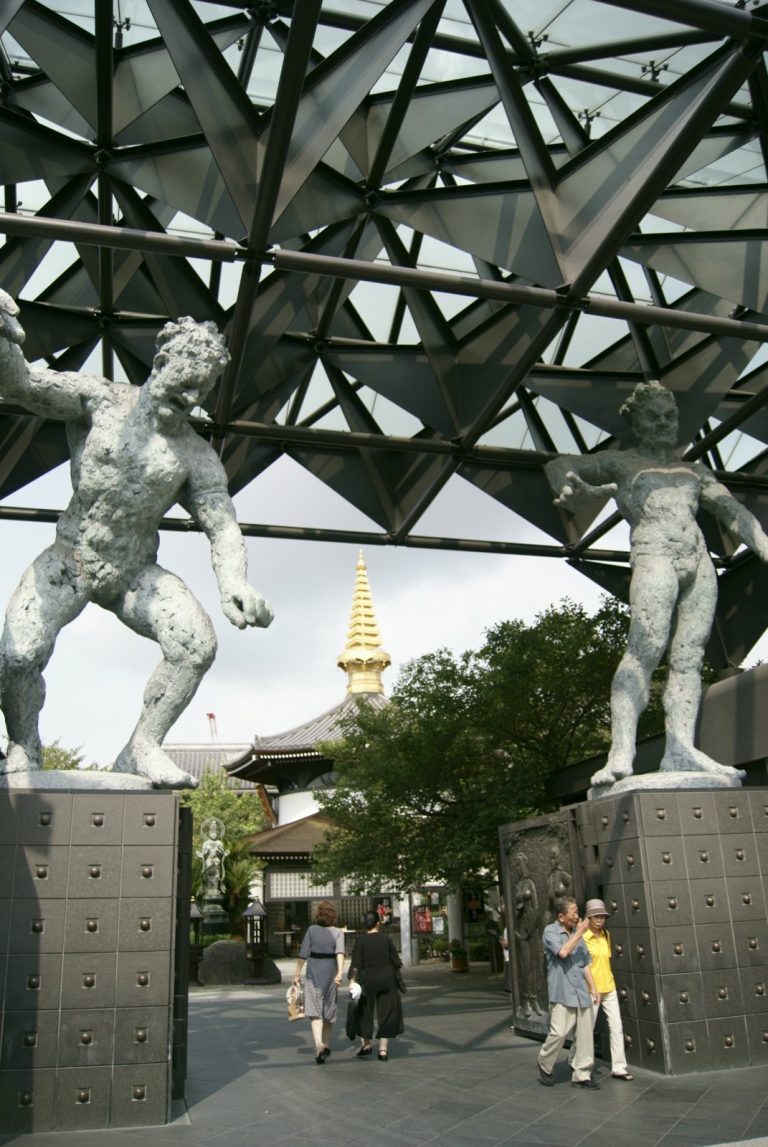
Hōraku-ji’s surviving complex includes a main hall and a main gate. Parts of buildings formerly belonging to the Oda family, lords of the Uda-Matsuyama domain in Yamato Province, were transferred to the temple through the efforts of the Saiga family. Elements of those former residences survive in the present main gate and main hall. The site also preserves Buddhist works associated with its religious history and a large camphor tree.
Temple buildings
Main gate
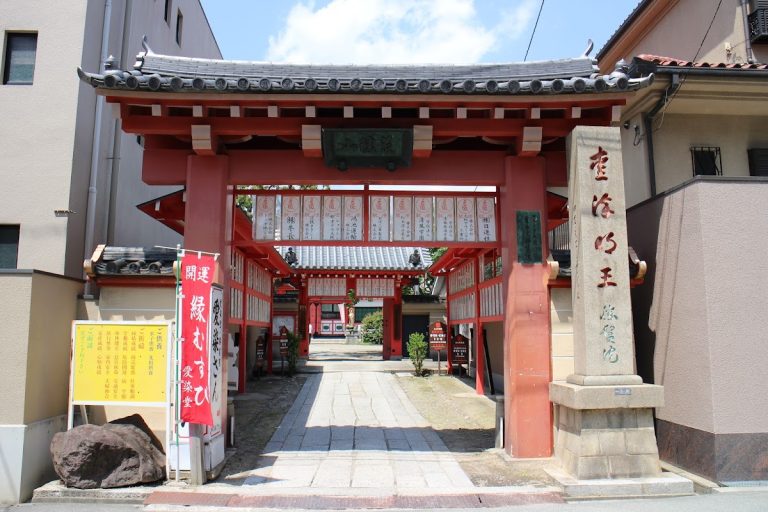
The main gate incorporates elements from buildings once used as residences by the Oda family, lords of the Uda-Matsuyama domain in Yamato Province. Their transfer to Hōraku-ji was achieved through the efforts of the Saiga family, giving the gate a physical connection with the temple’s later architectural history.
Main hall
The main hall also contains surviving elements from the former Oda residences. Together with the main gate, it represents the continued presence of architectural material transferred to Hōraku-ji after the buildings’ earlier association with the domain lords.
Buddhist artworks
Fudo Myoo with Two Attendants
The silk painting Fudo Myoo with Two Attendants is considered to date from the first half of the thirteenth century. Its imagery closely resembles a depiction of Fudo Myoo’s head and two attendants in the Daigo version of Fudo Myoo imagery, which bears a note attributing it to Gensho of Asuka-dera. Comparison of the images indicates that the Hōraku-ji painting passed through several stages of copying rather than reproducing that model directly and fully. The rock and waves beneath Fudo Myoo, together with the forceful flames, reflect artistic characteristics of the Kamakura period. The painting is deposited with the Osaka City Museum of Fine Arts.
Standing statue of Zao Gongen
A bronze standing statue of Zao Gongen was made during the Heian period. The statue is deposited with the Osaka City Museum of Fine Arts and forms part of the artistic heritage associated with Hōraku-ji.
Camphor tree
The Hōraku-ji camphor tree has a trunk circumference of approximately 8.0 meters and reaches approximately 26.0 meters in height. Its age is traditionally given as about 800 years. The tree is described as healthy, with almost no damage, and is among the cultural properties designated by Osaka Prefecture.