Sumiyoshi Taisha: Japan’s Ancient Maritime Shinto Shrine


Site at a Glance
- Rating
- 4.5
- Popularity
- High
- Country
- Japan
- Primary era
- Modern
- External website
- Open
- Eras represented
- Early Modern, Modern
- Civilizations
- Japanese, Tokugawa, Toyotomi regime
- Site type
- Religious
- Remains
- Sanctuary
On this page22 sections
History
Sumiyoshi Taisha is a Shinto shrine in Japan, in Osaka, traditionally founded in AD 211 during the regency of Empress Jingu. Shinto is Japan’s indigenous religious tradition, centered on reverence for kami, sacred beings or powers associated with deities, ancestors, natural features, and historical traditions. Sumiyoshi Taisha is the head shrine of more than 2,000 Sumiyoshi shrines across Japan and is traditionally counted among the Three Great Sumiyoshi Shrines, together with the shrines at Shimonoseki and Fukuoka.
Foundation and maritime worship
The shrine’s foundation story says that Empress Jingu’s fleet was unable to continue its voyage when the three Sumiyoshi deities instructed her to enshrine their beneficent spirits at the place occupied by the shrine. The historical date of the foundation remains uncertain. Proposed origins range from an early establishment connected with the ancient Yamato polity to a foundation in the third century or later, while the first secure documentary reference dates to AD 686.
The shrine’s central deities are Sokotsutsu no Onomikoto, Nakatsutsu no Onomikoto, and Uwatsutsu no Onomikoto, collectively known as the Sumiyoshi Okami, together with Empress Jingu, also called Okinagatarashi-hime no Mikoto. The three male deities occupy the First, Second, and Third Main Shrines, while Empress Jingu is enshrined in the Fourth Main Shrine.
The Sumiyoshi deities were associated with the ancient ports of Sumiyoshi-tsu and Naniwa-tsu, which supported the diplomatic and maritime networks of the Yamato polity. Sumiyoshi therefore became a protector of seafarers, ports, fishermen, merchants, and official missions, including embassies to Tang China. Members of the hereditary Tsumori priestly family served on some of these missions.
Growth during the Heian period
Records of offerings to Sumiyoshi Okami survive from AD 686 and AD 692. The shrine’s divine rank rose to Junior Second Rank in AD 784 and Junior First Rank in AD 806, and it had reached Senior First Rank by the tenth century. It received imperial prayers for rain and was included among the major ritual institutions listed in the Engishiki, a compilation completed in AD 927.
By about AD 1039, Sumiyoshi was counted among the Twenty-Two Shrines. It later became the ichinomiya, or chief-ranking shrine, of Settsu Province, which covered much of present-day northern Osaka and southeastern Hyogo. Imperial and aristocratic patronage continued during the Heian period. Emperor Uda visited in AD 898, while aristocrats offered poems and prayers. The shrine also appears in works such as the Tales of Ise, the Tale of Genji, and the Eiga Monogatari.
As maritime worship declined after the suspension of the embassies to Tang China, the shrine’s association with purification and waka poetry became more prominent. Aristocratic visits, pilgrimages to Kumano, and the coastal landscape helped strengthen this literary identity. Sumiyoshi was later counted among the Three Gods of Waka, alongside Tamatsushima Myojin and the poet Kakinomoto no Hitomaro.
Medieval patronage and conflict
Sumiyoshi received support from military leaders as well as the court. In AD 1195, Minamoto no Yoritomo sent offerings and a sacred horse through Kajiwara Kagetoki. During the Mongol invasions, the monk Eison repeatedly prayed at the shrine for the defeat of foreign enemies between AD 1268 and 1275.
The Tsumori family supplied the shrine’s chief priests for many centuries. It traced its lineage to Tamomi no Sukune, the traditional founder and priestly ancestor associated with Sumiyoshi Taisha. From the Kamakura period into the Nanbokucho period, members of the family also exercised political authority in Settsu. Their connections with the Daikakuji imperial faction and the Southern Court brought the shrine into the politics of the period. Emperors Go-Murakami and Chokei temporarily established the Sumiyoshi Temporary Palace near the shrine.
The shrine’s influence declined during the Muromachi period. Repeated fires during the Sengoku period, an era of prolonged civil warfare, destroyed buildings and disrupted the traditional rebuilding cycle. In AD 1576, the shrine and its associated Buddhist temple complex burned during the Ishiyama War.
Early modern reconstruction
Toyotomi Hideyoshi’s land survey of AD 1594 assigned Sumiyoshi 2,060 koku of red-seal domain land. A koku was a historical unit of land or agricultural yield. Toyotomi Hideyori ordered a major restoration in AD 1606 and 1607. Tokugawa Ieyasu granted the shrine a prohibition order in AD 1614, and its 2,060-koku domain continued under the Tokugawa government from AD 1615 through the Edo period.
Sumiyoshi traditionally maintained a twenty-year cycle of rebuilding, known as shikinen sengu, the periodic renewal of a shrine’s principal buildings. A change from rebuilding all shrine buildings to rebuilding only the main halls was recorded in AD 812. The cycle continued regularly until AD 1434, after which warfare and financial difficulties caused longer intervals. The present Main Shrine buildings were constructed in AD 1810. Later major rebuildings took place in 1878 and 1879, 1901 to 1907, 1936, 1961, 1991, and 2011.
During the Edo period, feudal lords travelling through western Japan, merchants, and ordinary worshippers visited the shrine. More than 600 stone lanterns were donated, many by shipping and maritime-trade associations. Literary pilgrims included Ihara Saikaku in 1684 and Matsuo Basho in 1694.
Modern status and continuing rites
From 1871 to 1946, the shrine was ranked a Kanpei-taisha, the highest category in the pre-1946 system of state-supported shrines. Its official name changed from Sumiyoshi Shrine to Sumiyoshi Taisha in 1946, and it was listed by the Association of Shinto Shrines in 1952. The precinct and its historic remains are designated a historic site by Osaka City. The four Main Shrine halls are National Treasures, while other buildings and objects have national, prefectural, or municipal cultural-property status. The former Sumiyoshi Temporary Palace site is also a nationally designated historic site.
Excavation on a substantial scale began within the precinct in 2006, including part of the former Sumiyoshi Jingu-ji site. Finds concentrated in two broad phases, from the late Kofun to Asuka periods and from the medieval period.
Sumiyoshi Jingu-ji developed beside the shrine within the former system of combined Shinto and Buddhist worship. Traditionally dated to AD 758, it included a main hall, Buddhist halls, monks’ quarters, a bell tower, and two pagodas. The complex burned with the shrine in AD 1576, was rebuilt under Toyotomi Hideyori in AD 1606, destroyed again during the Osaka Summer Campaign of AD 1615, and rebuilt under Tokugawa Hidetada in AD 1618. It was abolished after the separation of Shinto and Buddhism in 1873. Its former goma hall, a Buddhist ritual hall used for fire ceremonies, survives as the Shokonsha, while its west pagoda was moved to Kirihata-dera in Tokushima.
The Sumiyoshi Festival, centered on the annual festival of July 31, is traditionally understood as a purification of Osaka. Its sequence includes the Mikoshi Washing rite, in which the portable shrine is purified with seawater, the Natsukoshi purification rite and passage through a sacred chinowa ring on July 31, and the August 1 procession to Shukuinton-gu in Sakai, where the Aranigo purification rite is performed.
The Otaue Shinji takes place on June 14 in the shrine’s sacred rice field. This historically important rice-planting rite is a nationally designated Important Intangible Folk Cultural Property. The Natsukoshi rite is an intangible folk cultural property of Osaka Prefecture. Other continuing observances include the U-no-ha rite, Hatsutatsu-related rites, the Mikoshi Washing rite, the Treasure Market rite, and the autumn Moon-Viewing Festival. Through these traditions, the shrine’s sacred identity encompasses agriculture, rainmaking, purification, maritime travel, and poetry.
Remains
Sumiyoshi Taisha stands at the western edge of the Uemachi Plateau and faces west toward the sea. In antiquity, the shoreline lay closer to the shrine, and the western approach extended from the coast along a long pilgrimage route. The present precinct is organized into the Main Shrine area, the western approach, a southern ceremonial zone, eastern storehouses and subsidiary shrines, and the former Jingu-ji area to the north.
Main shrine complex
Four Main Shrines
The four Main Shrines face west toward the sea. The Third, Second, and First Main Shrines form a north-south line from west to east, while the Fourth Main Shrine stands south of the Third. This arrangement of three principal halls in a line is described as unique in Japan.
Each complex contains a honden, or main sanctuary, a connecting watari-den, or corridor, and a heiden, the hall used for offerings. The four honden were built in AD 1810 in the distinctive Sumiyoshi-zukuri style. This early Japanese shrine style is characterized here by a gabled roof with the entrance at the gable end, cypress-bark roofing, red-and-white surfaces, and a two-room interior.
The sanctuaries have straight roof lines without curvature, round columns resting on foundation stones, and two internal rooms arranged front to back. The central front column is replaced by a plank door. Vermilion structural members, rafters, and bargeboards contrast with white-plastered walls. Each roof carries five square-section katsuogi, or ridge logs, and chigi, the crossed finials at the roof ends. The chigi on the First through Third Main Shrines are cut vertically, while those on the Fourth are cut horizontally.
The buildings have no surrounding veranda and retain two enclosures. The inner mizugaki conceals the lower part of each sanctuary, while the outer tamagaki forms a further boundary. The four honden are National Treasures.
Offering halls and connecting corridors
The First Main Shrine’s heiden is five bays wide and has a gabled roof with a front chidorihafu and an eaves karahafu, two forms of decorative gable. It is divided into a central passage and two rooms. The offering halls of the Second, Third, and Fourth Main Shrines are three bays wide and follow the same general arrangement, with narrower side rooms.
The four watari-den are two bays by one bay and have cypress-bark roofs. Each connects a main sanctuary to its offering hall and incorporates a vermilion, square-post torii. The four combined offering-hall and corridor units are nationally designated Important Cultural Properties.
Gates, stages, and storehouses
Takakura storehouses
Behind the First Main Shrine stand the North and South Takakura, high-floor storehouses built in 1607. Each measures three bays by two bays and uses board-built log-wall construction beneath a hipped tile roof. Their construction without nails gave them the name “nail-less treasure vaults.” The North Takakura measures approximately 5.40 by 4.81 meters, and the South Takakura approximately 4.85 by 4.24 meters. Both were moved within the precinct in 1970. Formerly used for sacred treasures, they now store ritual equipment.
South Gate and Music Offices
The South Gate and the East and West Music Offices date from Toyotomi Hideyori’s restoration of 1607. The South Gate is a four-legged gate with a gabled, tile-covered roof and heavy timber proportions associated with Momoyama architecture. The East Music Office is eleven bays by two bays, with a hipped-gabled roof to the east and a gabled roof to the west. The five-bay-by-two-bay West Music Office reverses this arrangement. All three buildings are Important Cultural Properties.
Stone Stage
The Stone Stage stands south of the First Main Shrine on a stone girder bridge over a pond. The bridge is approximately 11 meters wide and 12 meters long, while the stage is about 6 meters square and 0.5 meters high. A stairway is attached to its front, and a wooden balustrade is installed for bugaku, court and religious dance accompanied by instrumental music. The stage was built during the 1607 restoration and is counted among Japan’s Three Stages.
Soribashi and Kakutorii
The Soribashi, also called the Taikobashi or Drum Bridge, crosses the pond on the western approach near the Kakutorii. The present bridge dates from 1981, while its stone legs and beams date from the Keicho period and are attributed either to Toyotomi Hideyori or to his wife Yodogimi. The bridge rises 4.4 meters and is associated with the historic shoreline and a possible surviving trace of an ancient lagoon.
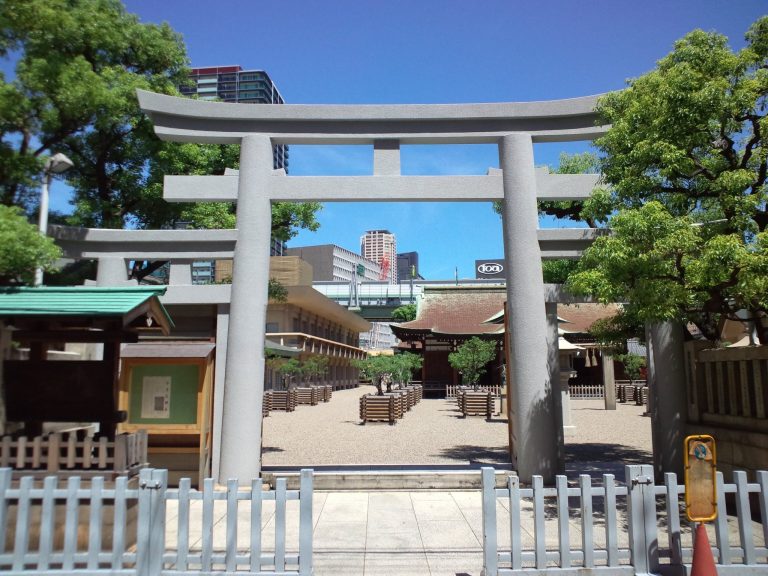
The Kakutorii south of the Main Shrine has square-section posts and square-section cross members. Its central lintel does not project beyond the vertical posts. It stands before the Koju-mon, the gate on the west side of the Third Main Shrine, and is also called the Sumiyoshi Torii. Its plaque bears calligraphy by Prince Arisugawa.
Ritual landscape and subsidiary shrines
Gosho Gozen and the sacred rice field
Gosho Gozen is an enclosed area south of the First Main Shrine containing a sacred cedar. Shrine tradition identifies the place as where three white herons indicated the site chosen by Empress Jingu. It may earlier have served as a place for the arrival of the deities. The U-no-ha rite is performed there, and a local practice associates stones marked with the characters for “five,” “great,” and “power” with protective amulets.
The Tanjoseki, or Birth Stone, near the Kakutorii is associated with the tradition that Tango no Tsubone gave birth there to Shimazu Tadahisa, founder of the Shimazu clan. The sacred rice field, called the Onda, occupies the southern part of the precinct and provides the setting for the June 14 rice-planting rite.
Subsidiary shrines and related buildings
The precinct contains four sessha, formally associated subsidiary shrines, and twenty-five massha, smaller subordinate shrines. Twenty-one are within the main precinct and four are outside it. The group includes Daikai Jinja, Shiga Jinja, Funatama Jinja, Wakamiya Hachimangu, Tate-sha, Hoko-sha, Omoto-sha, Godo-sha, Nankun-sha, Ichiebisu-Daikoku-sha, Tanekashi-sha, Koyasu-sha, Amago-sha, Tatsu-sha, Hassho-sha, Shingu-sha, Tachigiki-sha, Kifune-sha, Hoshimiya, Go-sha, Usuzumi-sha, Kononushi-sha, Imanushi-sha, Shokonsha, and the outlying Ootoshi-sha, Asasawa-sha, Minato Sumiyoshi Jinja, and Shukuinton-gu.
Several subsidiary buildings preserve earlier structures or later relocations. The North and South Small Gates of Daikai Jinja date from the late Edo period and were moved to the shrine in the nineteenth century. The Omoto-sha buildings were built in 1822 and repaired in 1930. The Tatsu-sha, Tachigiki-sha, Kifune-sha, and Godo-sha buildings are late-Edo structures relocated during the twentieth century. The Nankun-sha main hall dates from 1954, its worship hall from 1956, and the Go-sha main hall from 1964.
Shokonsha and the former Jingu-ji
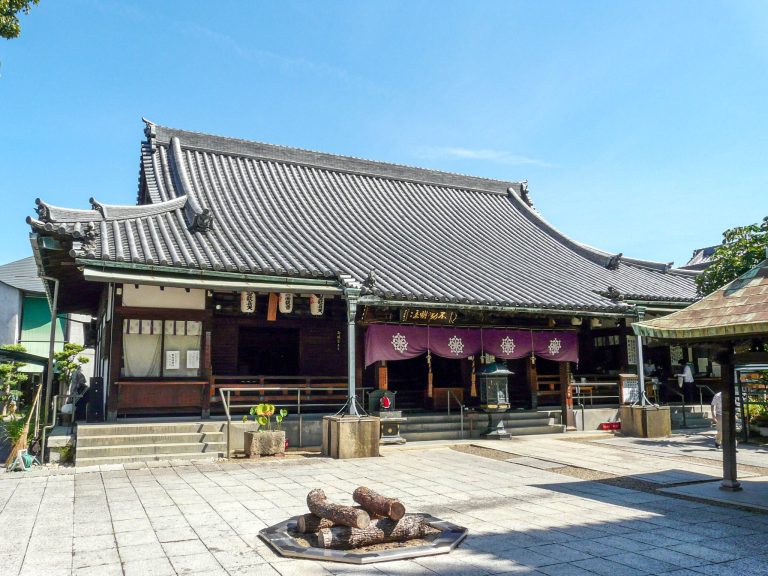
Shokonsha is the only surviving Buddhist-style building within the precinct. It was originally the Goma Hall of Sumiyoshi Jingu-ji, built in 1619. The building has a three-bay square plan, a hipped-gabled roof, a one-bay entrance canopy, and a tile roof. It is an Important Cultural Property.
The former Jingu-ji west pagoda survives as the Great Pagoda of Kirihata-dera in Tokushima, where it was moved in 1868. Built in 1618, it is a nationally designated Important Cultural Property. Sumiyoshi Bunka-kan, completed in 1977 on the former Jingu-ji site, houses the shrine’s sacred treasures.
Collections and historic fabric
Library and ritual objects
The Sumiyoshi Obunko is a plastered book storehouse founded in 1723 at the initiative of booksellers. Manuscripts and printed books were donated over subsequent centuries, and the collection is described as numbering approximately 50,000 volumes. The building is known as Osaka’s oldest library and is a designated tangible cultural property of Osaka Prefecture.
The shrine’s associated material heritage includes nine wooden bugaku masks dating from the Heian to Kamakura periods, a Kamakura-period sword inscribed “Moriie,” an Edo-period sword by Ono Shigehisa dedicated before Sumiyoshi Okami, and the Sumiyoshi Jindaiki. This sacred manuscript describes the shrine’s origin traditions, treasures, and estates. Although its colophon is dated 731, it is widely considered to have been composed from the early Heian period onward. Once kept secretly in the First Main Shrine, it became publicly known around the Meiji period and is now an Important Cultural Property.
Stone lanterns
Approximately 600 stone lanterns stand throughout the precinct. The oldest dates to 1644, and most were donated by maritime merchants and shipping associations from the Edo period onward. Together with the gates, halls, storehouses, stages, torii, subsidiary shrines, and former Buddhist buildings, they form the historic built heritage of Sumiyoshi Taisha.