Kōzu-gū: A Shinto Shrine Dedicated to Emperor Nintoku in Osaka


Site at a Glance
- Rating
- 4.3
- Popularity
- Medium
- Country
- Japan
- Primary era
- Medieval
- External website
- Open
- Eras represented
- Medieval
- Civilizations
- Japanese
- Site type
- Religious
- Remains
- Sanctuary
On this page13 sections
History
Kōzu-gū is a Shinto shrine in Osaka, Japan, dedicated principally to the deified Emperor Nintoku and founded in 866 during the ninth century. Shinto is Japan’s indigenous religious tradition, centered on reverence for kami, including deified ancestors and other sacred beings. The shrine was established on the order of Emperor Seiwa after a search for the former site of Takatsu-no-miya, the palace traditionally associated with Emperor Nintoku.
Foundation and imperial associations
A shrine building was erected at Ishiyama, in the northern part of the Uemachi Plateau, to worship Emperor Nintoku. He occupies the central position among the enshrined figures. Emperor Ōjin, Emperor Chūai, and Empress Jingū are placed on the left, while Empress Ashihime and Emperor Richū occupy the right. These figures belong to Japan’s early imperial tradition, and Ashihime is traditionally identified as Nintoku’s consort.
Kōzu-gū is linked by tradition to an imperial palace that stood in the area during the fourth century. Emperor Nintoku is also remembered in a story of benevolent rule. After seeing that no smoke rose from the homes of his subjects, which suggested widespread poverty, he is said to have suspended taxation for three years.
Relocations and changing status
The shrine is said to have moved to Higashi-Takatsu in 1124. Higashi-Takatsu-gū, also known as Moto-Takatsu, is associated with the former Takatsu site, although that identification remains uncertain.
In 1583, while Toyotomi Hideyoshi was constructing Osaka Castle, Kōzu-gū was moved from the grounds of Himekoso Shrine in Nishi-Takatsu to its present location. Hideyoshi was the late-sixteenth-century military ruler who unified much of Japan and initiated the castle’s construction. Himekoso Shrine became a subordinate shrine within the precincts and was enshrined as the local tutelary deity, a protective kami associated with a particular place or institution.
Kōzu-gū was classified as a prefectural shrine in 1872. It was later included among the Beppyo shrines, a specially listed group recognized by the Association of Shinto Shrines.
War, rebuilding, and cultural life
The shrine buildings were destroyed in the Osaka air raids of March 13 and 14, 1945, while the mikoshi storehouse survived. The buildings were rebuilt in October 1961, restoring the principal shrine complex after the wartime destruction.
The shrine has long been connected with Osaka townspeople’s culture and with classical rakugo, a Japanese storytelling tradition in which a seated performer presents comic or dramatic narratives through dialogue and changes of voice. Works associated with Kōzu-gū include Kōzu no Tomi, Takakura Kitsune, and Sutoku-in. The precinct assembly hall, Kōzu no Tomitei, became a venue for rakugo and bunraku performances. The fifth-generation Katsura Bunshi school took part in performances there, including Bunshi’s final performance of Kōzu no Tomi at the Kuromon Yose.
A stone monument commemorating Katsura Bunshi was erected in the precincts in March 2006, the year after his death. In 1899, Osaka Prefecture erected a monument marking the site of Takatsu-no-miya at Osaka Prefectural Takatsu High School. This took place during a festival at Kōzu-gū and Namba Shrine commemorating the 1,500th anniversary of Emperor Nintoku.
From the mid-1950s, shrine priests planted approximately 100 cherry trees, including Yoshino cherries, in the precincts and the adjacent Takatsu Park. The planting established the setting for an annual cherry-blossom festival held from late March to early April.
Remains
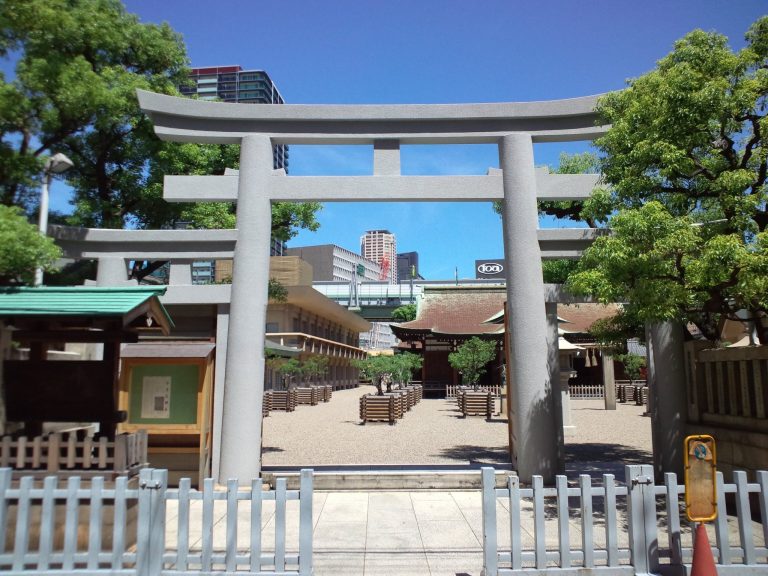
The present precinct combines the rebuilt shrine buildings with subordinate shrines, an assembly hall, commemorative features, paths, slopes, and planted grounds. The principal buildings use wood and stone, while the main shrine has an irimoya-zukuri roof, a hip-and-gable form. The southern approach is bordered on both sides by Takatsu Park, and the western side rises in a steep slope crossed by three paths.
Principal and subordinate shrines
Main shrine
The main shrine building is the central architectural feature of Kōzu-gū. Its wood-and-stone construction supports an irimoya-zukuri roof, whose combined hipped and gabled form gives the building its characteristic profile. The rebuilt structure belongs to the postwar reconstruction of October 1961 and serves as the place where Emperor Nintoku is worshipped at the center of the shrine’s enshrined group.
Himekoso Shrine
Himekoso Shrine stands within the precincts as a subordinate shrine. It was moved into this religious relationship when Kōzu-gū came to its present location in 1583 and was enshrined as the land’s tutelary deity. Himekoso is regarded as one of the candidate locations for the Himekoso Shrine named in the Engishiki as a Myōjin taisha, a major shrine in that tenth-century system of shrine and court regulations.
Inari shrines
Takakura Inari Shrine and Yasui Inari Shrine are also subordinate shrines within the precincts. Inari is a kami traditionally associated with rice, agriculture, prosperity, and commerce. Three further subsidiary shrines, Shiragiku Shrine, Sennen Shrine, and Tsunekō Shrine, stand below the cliff.
Approaches and slope paths
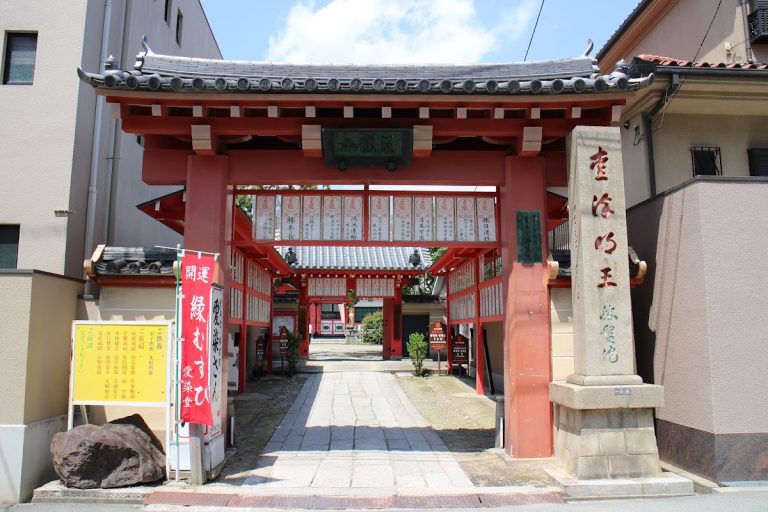
The southern front approach runs between the two areas of Takatsu Park. On the western side, a steep slope contains three paths. The northernmost is called Enkiri-zaka, or Breakup Slope. The other two are called Aiaizaka and Enmusubi-zaka, names translated as the Marriage-Bonding Slopes.
A brush mound was erected beside the approach in 1959 to commemorate the thirteenth memorial observance for the Japanese painter Kitano Tsunetomi. Its position along the approach makes it part of the precinct’s commemorative landscape.
Assembly hall and commemorative monument
Kōzu no Tomitei
Kōzu no Tomitei is the name of the precinct assembly hall. Its use for rakugo and bunraku performances connects the physical shrine grounds with the performance traditions associated with Kōzu-gū and Osaka’s townspeople’s culture.
Katsura Bunshi monument
A stone monument dedicated to Katsura Bunshi stands within the shrine precincts. It was erected in March 2006, the year after the death of the prominent rakugo performer and master of a major rakugo school.