Shōman-in Temple: A Buddhist Branch Temple and Aizen Sacred Site in Osaka


Site at a Glance
- Rating
- 4.2
- Popularity
- Low
- Country
- Japan
- Primary era
- Early Modern
- External website
- Open
- Eras represented
- Early Modern
- Civilizations
- Tokugawa, Toyotomi regime
- Site type
- Religious
- Remains
- Temple
On this page10 sections
History
Shōman-in Temple is a Buddhist temple in Osaka, Japan, traditionally founded in 593 by Prince Shōtoku as the Pharmaceutical Institution, one of four charitable institutions associated with Shitennōji. Its main hall enshrined an image of Lady Shōman, a Buddhist figure associated with the Mahayana text known as the Shōman Sutra, and the temple also became linked with Prince Shōtoku’s lectures on that text. These associations gave rise to the name Shōman-in.
From the Heian to Kamakura periods
From the Heian period onward, Aizen Myōō became the temple’s principal image. This Buddhist Wisdom King is associated with transforming desire into spiritual devotion and with esoteric Buddhist practice. The change in religious focus led to the alternative name Aizendō. Shōman-in belongs to the Washū Buddhist school, serves as a branch temple of Shitennōji, and is the principal training center for the Shōman lineage of Shingon Buddhism, a Japanese esoteric tradition centered on ritual, mantra, mandala, and specialized practice.
During the Kamakura period, the temple is said to have received landed endowments from Hōjō Tokiyori, the fifth regent of the Kamakura shogunate. At the end of the thirteenth century, the monk Ninshō established the Shingon Institute at Shōman-in, strengthening its role as a center for Buddhist study and training.
Warfare and reconstruction
The temple complex was destroyed by fire during the Ishiyama War, fought from 1570 to 1580 between Oda Nobunaga and the forces of Osaka Honganji. Toyotomi Hideyoshi restored the complex in 1597, including the rebuilding of its pagoda.
Shōman-in was again damaged during the Summer Siege of Osaka in 1615, the campaign in which Tokugawa forces defeated the Toyotomi regime centered on Osaka Castle. The main hall was rebuilt in 1618 under the patronage of Tokugawa Hidetada, shogun of the Edo shogunate.
During the first Osaka air raid of the Pacific War, on 13–14 March 1945, neighboring Ōe Shrine and Shitennōji were almost completely burned. Shōman-in escaped damage. Its pagoda is an Important Cultural Property, while the main hall has been designated a tangible cultural property by Osaka Prefecture. A wooden seated image of Dainichi Daishō Kongō associated with the temple is a tangible cultural property designated by Osaka City.
Religious traditions and designations
The Shōman Aizen Festival takes place from 30 June to 2 July. Its observances include opening the principal image for public worship and distributing traditional flower charms known as hanamori. In 2018, the religious observances continued, but street stalls, the recruitment of Aizen maidens, and the ceremonial palanquin procession were suspended after repeated neighborhood complaints about noise, reckless motorcycle riding, illegal bicycle parking, littering, and public urination.
Shōman-in is the first sacred site on the Western Japan Seventeen Aizen Sacred Sites pilgrimage and the twenty-ninth site on the pilgrimage associated with Prince Shōtoku. The temple has the mountain name Araryōzan and is also known as Aizendō or Aizen-san.
Remains
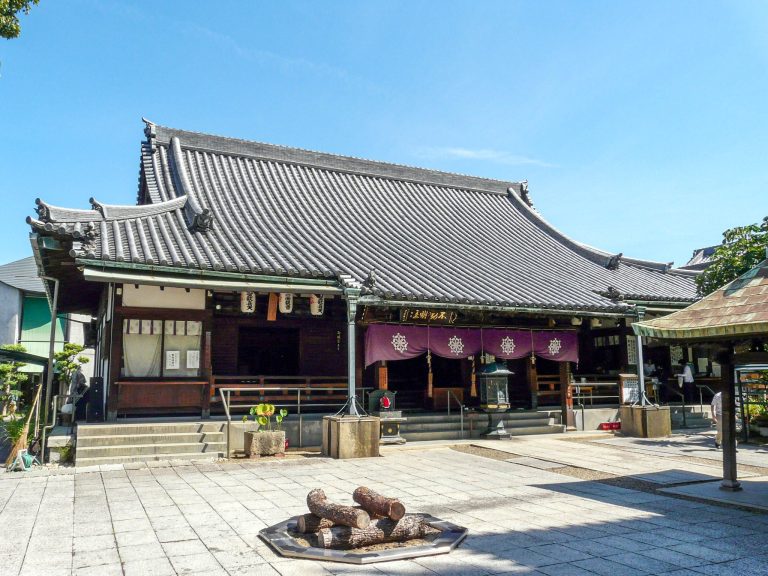
The surviving complex includes a wooden tahōtō pagoda and the main hall, also called Aizendō, where Aizen Myōō is enshrined. A tahōtō is a Japanese Buddhist pagoda type with a square lower level and a rounded upper structure. The buildings reflect the temple’s continuing religious identity and its reconstruction after successive wartime disasters.
Wooden religious buildings
Tahōtō pagoda
The pagoda is a wooden tahōtō and is described as the oldest surviving wooden structure in Osaka City. Its form combines the square lower portion characteristic of the type with a rounded upper structure. The building survives from the complex restored after its destruction in the Ishiyama War and was rebuilt in 1597.
Main hall
The main hall, or Aizendō, houses the temple’s principal image, Aizen Myōō. It was rebuilt in 1618 after the wartime damage suffered during the Summer Siege of Osaka. The hall remains a central physical and religious feature of Shōman-in.
Associated sculpture
Seated image of Dainichi Daishō Kongō
A wooden seated image of Dainichi Daishō Kongō is associated with Shōman-in. The sculpture forms part of the temple’s surviving religious heritage and has been designated a tangible cultural property by Osaka City.
Nearby sites