San Raffaele Church: A Late Renaissance Catholic Church in Milan


Site at a Glance
- Rating
- 4.6
- Popularity
- Low
- Country
- Italy
- Primary era
- Early Modern
- External website
- Open
- Eras represented
- Medieval, Early Modern, Modern
- Civilizations
- Carolingian, Duchy of Milan, Italian, Spanish
- Site type
- Religious
- Remains
- Church
On this page9 sections
History
San Raffaele Church is a Catholic church in Milan, Italy, dedicated to the Archangel Raphael and rebuilt on medieval foundations in the 1570s in the late Renaissance. It follows the Ambrosian rite, the Catholic liturgical tradition of the Archdiocese of Milan, and stands beside the Duomo on Via San Raffaele, near the former site of Santa Maria Maggiore.
Medieval origins
The church is first mentioned in the will of Bishop Andrea da Cantiano in 903. It was one of six minor churches surrounding ancient Santa Maria Maggiore, and the group helps reconstruct the topography of medieval Milan’s central area. The six churches may have originated around 835 under Archbishop Angilberto II. San Raffaele is the only surviving church among them. The ruins of the baptisteries of San Giovanni alle Fonti and Santo Stefano alle Fonti also remain, while the churches dedicated to the Archangels Gabriel, Michael, and Uriel have disappeared.
Sixteenth-century rebuilding
The present church developed through the initiative of the Compagnia del Santissimo Sacramento, a lay Catholic confraternity devoted to the Eucharist. Its design is attributed chiefly to Pellegrino Tibaldi, also known as il Pellegrini, with Galeazzo Alessi also associated with the project. Tibaldi was a late Renaissance architect and painter who was favored by Carlo Borromeo, the Archbishop of Milan and an important Catholic reformer after the Council of Trent. Borromeo consecrated the rebuilt church in 1582.
Decoration followed the rebuilding in at least two phases. The first campaign included paintings by Giovanni Ambrogio Figino and Camillo Procaccini, while later works were produced mainly from the early seventeenth century through its first quarter. These successive additions established the artistic character that remains inside the church.
Facade, preservation, and status
The facade remained unfinished until around 1890–1891, when Paolo Cesa Bianchi completed its upper level in a neo-sixteenth-century design. The original design was not known at that time and was discovered later in the State Archives. In 1902, a proposal threatened the church with demolition and reconstruction elsewhere. Protests from the Società Storica Lombarda and Milanese mayor Gaetano Negri, together with an unfavorable opinion from the Administration of Antiquities and Fine Arts in Rome, helped secure its preservation. San Raffaele is recognized as an Italian national monument.
Remains
Adjoining buildings closely contain San Raffaele Church, whose surviving fabric combines medieval foundations, a late-sixteenth-century lower facade, and a nineteenth-century upper section. The interior has three aisles, four chapels, and a quadrangular choir. Its relatively simple arrangement provides the setting for paintings and frescoes produced during the church’s successive decorative campaigns.
Facade
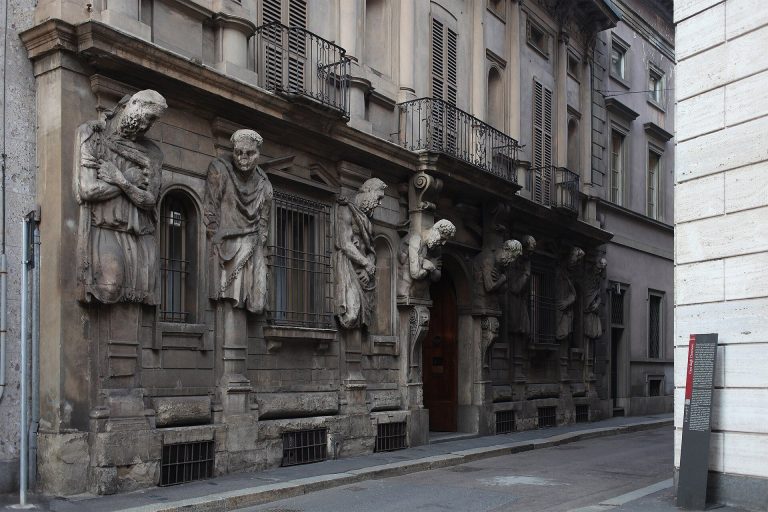
The facade rises in two levels. The lower section belongs to the late sixteenth century and contains three portals with tall herms, sculptural architectural supports ending in male heads. It remained incomplete until the late nineteenth century. The upper section, added around 1890–1891, follows a neo-sixteenth-century design. Two columns and two pilasters frame its central portion, which contains a window topped by a pediment.
Interior structure
Inside, the three aisles lead to four chapels and a quadrangular choir. The choir vault is covered with frescoes by Giovan Battista Della Rovere, known as il Fiammenghino. The high altar uses Melchiorre Gherardini’s Deposed Christ as its frontal, a decorative panel attached to the front of an altar.
Painted decoration
The early decorative phase includes Giovanni Ambrogio Figino’s Saints Matthew and the Angel and Saint Paul, painted around 1586. Camillo Procaccini’s Saint Jerome, from the late 1580s, also belongs to this phase and was restored in 2017. Later additions include Morazzone’s The Dream of Elijah, made around 1610, and Cerano’s The Disobedience of Jonathan, painted in 1618. These works remain in place as part of the church’s layered interior decoration.
Pipe organ
A Dutch-made pipe organ installed in 1996 completes the furnishings described for the church. René Speet built it entirely with mechanical action, and its neo-Baroque design includes an elegantly decorated wooden case.