Hōtō-ji Temple: A Nichiren Buddhist Temple in Kyoto


Site at a Glance
- Rating
- 4.2
- Popularity
- Low
- Country
- Japan
- Primary era
- Medieval
- External website
- Open
- Eras represented
- Medieval
- Civilizations
- Ashikaga shogunate
- Site type
- Religious
- Remains
- Monastery
On this page11 sections
History
Hōtō-ji Temple is a Nichiren Buddhist temple in Kyoto, Japan, whose history reaches back to a Shingon Buddhist foundation initiated during the Kashō era, around 848–851. It is affiliated with the Nichiren school, a Japanese Buddhist tradition centered on the Lotus Sutra, and its principal object of worship is the Three Treasures, meaning the Buddha, the Buddhist teachings, and the monastic community.
From Gokuraku-ji to a Nichiren temple
The temple is traditionally traced to Gokuraku-ji, a Shingon temple whose foundation was begun by Fujiwara no Mototsune, a court noble of the Heian period. After Mototsune died, his son Fujiwara no Tokihira completed the temple in 899. The monk Shōbō is regarded as its founding monk. Gokuraku-ji is also mentioned in the “Wisteria Leaves” chapter of The Tale of Genji.
At the end of the Kamakura period, the temple became involved in a religious debate between Nichizō and its abbot, Ryōkei. Ryōkei became Nichizō’s follower in 1307, and the former Shingon temple converted to the Nichiren school during the Enkyō era, around 1308–1311. Nichizō was a disciple of Nichirō, one of Nichiren’s disciples.
Nichizō and the temple’s later names
Nichizō died at Myōken-ji in 1342. In accordance with his wishes, he was cremated and buried at Hōtō-ji, which was then renamed Kakurin-in. A stone monument bearing the title of the Lotus Sutra had been erected by Nichizō at one of Kyoto’s seven highway entrances. It was later moved to his mausoleum, and this transfer led to the temple’s renaming as Hōtō-ji.
The presence of Nichizō’s mausoleum and a bone relic of Nichiren gave the temple the devotional names “Western Minobu” and “Sacred Mountain of the Southeast.” Hōtō-ji’s former head temple was Myōken-ji, and the temple remains part of a Nichiren Buddhist lineage. A head temple is the principal institution in a religious or lineage network.
War, destruction, and rebuilding
Hōtō-ji was completely burned during the Ōnin War in 1467, although its tahōtō survived. The temple was rebuilt, but the buildings were again destroyed, apart from the tahōtō, during the Tenmon Disturbance, a sixteenth-century conflict associated with Kyoto’s Nichiren Buddhist institutions. After a long period without reconstruction, the temple buildings were rebuilt in 1590 by its eighth abbot.
The precinct historically contained several subtemples, smaller temple institutions located within or historically attached to a larger temple. These included foundations or rebuilding phases in 1536, 1585, 1594, 1597, 1648, and 1657. A further subtemple was later merged into the one founded in 1657. The subtemple established in 1597 served as the ancestral temple of the Shimomura family, founders of the Daimaru department-store enterprise, and enshrines successive family heads and deceased family members.
The main hall, tahōtō pagoda, and main gate are designated Important Cultural Properties of Japan, reflecting the importance of the surviving buildings within Hōtō-ji’s long religious history.
Remains
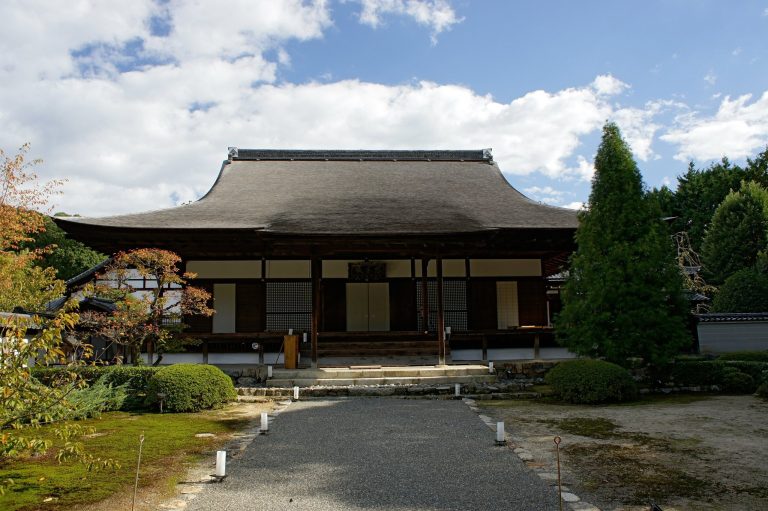
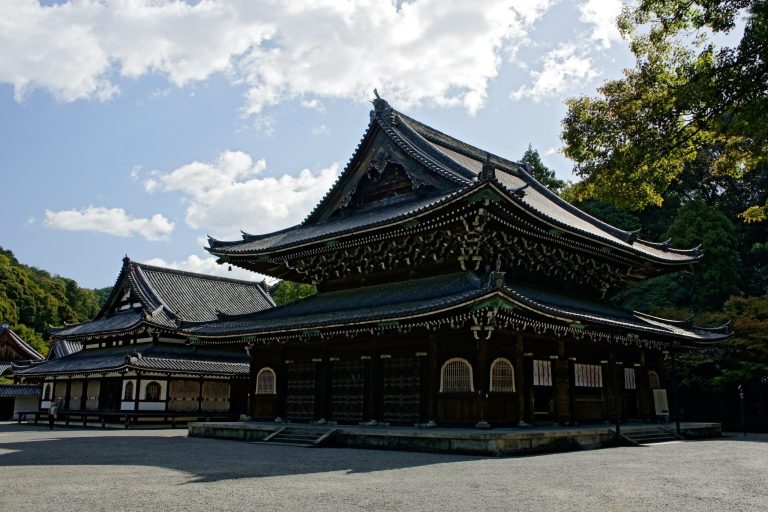
Hōtō-ji’s surviving precinct includes a main hall, a main gate, and a two-story tahōtō pagoda. The buildings combine the temple’s later Nichiren identity with architectural elements that survived the destruction of earlier precinct buildings. The tahōtō is noted as the oldest example of its type in Kyoto.
Gate and principal buildings
Main gate
The main entrance is a four-legged gate known as a shikyakumon. Both the gate and the tahōtō date from the Muromachi period, the Japanese historical period that lasted roughly from 1336 to 1573. The gate forms part of the surviving group that includes the main hall and pagoda.
Tahōtō pagoda
The tahōtō is a Japanese Buddhist pagoda with a square lower story and a rounded upper story. Its two levels are clearly distinct in form. The pagoda survived both major fires that destroyed the surrounding temple buildings, making it a physical link between the Muromachi-period temple and the later rebuilt precinct.
Memorial and sacred objects
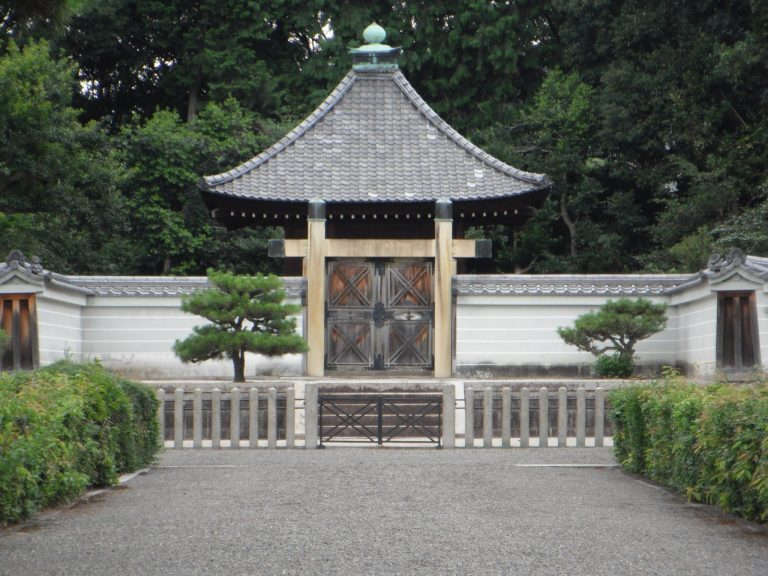
Nichizō’s mausoleum
A stone monument inscribed with the title of the Lotus Sutra marks Nichizō’s mausoleum within the temple precinct. The monument was transferred there from one of Kyoto’s seven highway entrances, where Nichizō had originally erected it.
Relic of Nichiren
The temple also houses a bone relic of Nichiren. Together with Nichizō’s mausoleum, this relic contributes to Hōtō-ji’s devotional identity and its traditional names, “Western Minobu” and “Sacred Mountain of the Southeast.”