Fushimi Inari-taisha: Head Shrine of Inari Worship in Japan


Site at a Glance
- Rating
- 4.6
- Popularity
- Very High
- Country
- Japan
- Primary era
- Medieval
- External website
- Open
- Eras represented
- Medieval, Early Modern, Modern
- Civilizations
- Ashikaga shogunate, Japanese, Tokugawa, Toyotomi regime
- Site type
- Religious
- Remains
- Sanctuary
On this page20 sections
History
Fushimi Inari-taisha is a Shinto shrine in Kyoto, Japan, traditionally founded in 711 during the Wadō era at the western foot of Mount Inari. It is regarded as the head shrine of Inari worship and of approximately 30,000 Inari shrines across Japan. Inari, a divine presence associated first with rice and agriculture, later came to be connected with production, commerce, household safety, transportation, and the performing arts.
Foundation and imperial recognition
The shrine’s foundation tradition links its establishment to Hata no Irogu and the Hata clan, an influential lineage active in the Fukakusa area and Yamashiro Province. Inari is said to have first been enshrined on Mount Inari in 711. Another tradition connects the shrine’s creation with imperial prayers during poor harvests and unsettled climatic conditions. The early history of the shrine is preserved through traditions concerning Hata no Irogu, the Hata clan, and the deity’s appearance on the mountain.
The shrine’s name was originally written in an older form. Its present written form first appeared in an imperial decree of 827. In that year, during the illness of Emperor Junna, trees were cut on Mount Inari for the construction of a pagoda at Tō-ji, the Buddhist temple also known as Kyōōgokoku-ji. The cutting was interpreted as an offence against the mountain deity. The court responded by granting Inari an official divine rank, beginning the shrine’s imperial recognition and its association with Kyoto’s southeast.
Fushimi Inari became connected with Tō-ji during the Heian period and was regarded as the temple’s tutelary deity. A later tradition says that the monk Kūkai encountered Inari in the form of an elderly man carrying rice. Kūkai, also known as Kōbō Daishi, was the founder of Japanese Shingon Buddhism. The written forms of this story were composed centuries after the events they describe.
Fujiwara no Tokihira is recorded as having renovated or sponsored three shrine buildings in 908. By 927, Fushimi Inari appeared in the Engishiki as a high-ranking Myōjin-taisha of Yamashiro Province and as one of the upper seven of the Twenty-Two Shrines. In 942, it received the rank of Shōichi-i, the highest regular divine rank.
Heian and medieval development
Festivals and pilgrimage made the shrine prominent in the Heian period. Inari festivals were counted among Kyoto’s major festivals alongside the Aoi and Gion festivals. The shrine appears in works such as The Pillow Book, The Kagerō Diary, and Konjaku Monogatari. Pilgrims traveling toward Kumano also visited Fushimi Inari and took branches of sacred cedar as protective tokens.
The shrine’s original threefold arrangement of deities later became a fivefold arrangement. Tanaka no Ōkami and Shi no Ōkami had been incorporated into the Inari festival by 1266 and were eventually enshrined with the other three deities in the main hall. Their origins remain uncertain, although Fushimi Inari regards them as local or land-protecting deities associated with Inari.
Medieval worship combined Shinto and Buddhist elements. Inari was interpreted through Buddhist forms including Dakiniten, while Buddhist traditions associated the five divine seats with different buddhas. Foxes came to be venerated as Inari’s attendants, and these practices spread through religious confraternities and the wider population.
The shrine’s relocation history is uncertain. One tradition associates a transfer from the mountain to the foothills with Kūkai in the early ninth century. Another places the movement from the mountain’s three peaks to the present foothill site in 1438, under the authority of Ashikaga Yoshinori and by order of Emperor Go-Hanazono. Earlier worship appears to have centered on the three principal peaks of Mount Inari.
During the Ōnin War, the military commander Honekawa Dōken established a position at the shrine while serving the eastern army of Hosokawa Katsumoto. He attacked forces associated with Yamana Sōzen and was killed in March 1468. The shrine, including its buildings on the mountain, was burned during the conflict.
Reconstruction followed under Buddhist monks connected with the shrine’s Buddhist foundation. Aizen-ji, a temple affiliated with Tō-ji, served as the shrine’s Buddhist temple and managed construction, repairs, fundraising, and travelling displays of sacred objects. The main sanctuary was rebuilt after the war, and a ceremony transferring the five deities took place in 1499.
Early modern expansion
Toyotomi Hideyoshi made a major donation to Fushimi Inari in 1588 after praying for the recovery of his mother, Ōmandokoro. Hideyoshi was the late-sixteenth-century military ruler whose patronage is traditionally associated with the shrine’s great gate, built during the late sixteenth century.
During the Edo period, Inari worship spread throughout the Kinai region and across Japan. Fushimi Inari and Aizen-ji participated in the division and re-enshrinement of Inari’s spirit in other shrines, temples, and households, greatly extending the reach of the cult. Merchants commonly made offerings in thanksgiving for successful business ventures, and the custom of donating torii became widespread.
Kada no Azumamaro, a major Edo-period scholar of National Learning, came from the shrine’s hereditary priestly family. His former residence remains within the precincts. The independent Azumamaro Shrine was established beside it in 1903, with Azumamaro as its deity.
Modern institutional history
The government’s separation of Shinto and Buddhism in 1868 formally dismantled the shrine’s former combined religious institutions. Aizen-ji, Jōan-ji, Saikō-ji, Buddhist halls, and Buddhist images in the precincts were abolished or removed. The shrine also lost its landed estates, and its precinct land was reduced to approximately one quarter of its previous extent. A ritual connection with Tō-ji nevertheless survives: on the final day of the Inari Festival, Tō-ji monks place offerings before the eastern gate and recite prayers for the returning procession.
In 1871, the shrine was classified as a Kanpei-taisha under the modern state shrine system and formally called Inari Shrine. After that system was abolished, the modern shrine organization became an independent religious corporation in 1946. The name Fushimi Inari-taisha was adopted to distinguish it from the many other Inari shrines. The institution did not join the national Association of Shinto Shrines because it did not accept that association’s interpretation of Ise Shrine’s primacy.
Fushimi Inari-taisha remains an independent Shinto corporation. It is classified as a former Kanpei-taisha, a Shikinaisha of the Myōjin-taisha rank, and one of the upper seven of the Twenty-Two Shrines. Its principal annual festival is held on May 3. Other important observances include the Hatsuuma festival commemorating Inari’s first enshrinement on the mountain, the rice-planting festival, the Motomiyasai lantern ceremony, the Ōyamasai harvest and prosperity rites, the Hitakisai fire ritual, and the year-end Ōharae purification ceremony.
The main hall was ceremonially transferred in March 1961. Modern conservation included restoration of the main hall in 1882 and repairs to the mountain approaches in 1911. The main hall was designated a National Treasure in 1909 and is now treated as an Important Cultural Property. The outer worship hall, temporary main hall, inner shrine, Byakkosha, and several subsidiary shrines also have Important Cultural Property status. Other protected properties include the Matsunoshitaya residence and tea-house complex, a Momoyama-period shrine map, an Edo-period painting, and ten textile fittings from a festival float.
Remains
Main precinct and principal buildings
The precinct occupies the western foot of Mount Inari, the southernmost peak of the Higashiyama Thirty-Six Peaks. Its principal approach runs approximately east to west. The first torii, great gate, outer worship hall, inner worship hall, and main hall stand in succession, while the ritual area, Senbon Torii paths, and mountain sacred sites extend behind the main hall.
Great gate and worship halls
The great two-storey tower gate, or rōmon, stands at the end of the main approach. It is traditionally linked with Toyotomi Hideyoshi’s donation of 1588 and is unusually large for a Shinto shrine. A secondary approach, the urasandō, also forms part of the precinct layout.
Fushimi Inari has two separate worship halls. The outer worship hall, between the great gate and the main hall, has an irimoya roof, which combines a gabled roof with hipped slopes, and was completed in 1840 near the end of the Edo period. The inner worship hall directly before the main hall was built in 1961.
Main hall
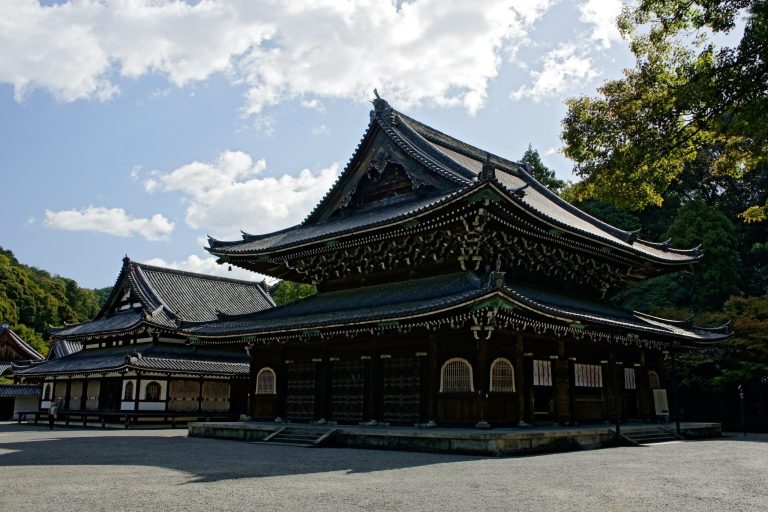
Completed in 1499, the main hall is a large example of the shrine’s distinctive Inari-zukuri tradition. Its roof follows the nagare-zukuri form, in which the front slope projects outward to create a sheltered verandah. The exterior is red and white, with gilded decoration containing early features associated with the later Azuchi-Momoyama style.
The five deities are enshrined together in one sanctuary. Ukanomitama no Ōkami occupies the central Lower Shrine seat, Satahiko no Ōkami the Middle Shrine seat to the north, and Ōmiyanome no Ōkami the Upper Shrine seat to the south. Tanaka no Ōkami occupies the northernmost subsidiary seat, while Shi no Ōkami occupies the southernmost.
Temporary main hall
The temporary main hall, or gonden, stands north of the main hall. Built in 1635 in the nagare-zukuri style, it provided a temporary location for the sacred objects when the main hall required repair.
Associated precinct buildings
South of the great gate is the former residence of Kada no Azumamaro. The precinct also contains the shrine office and the headquarters of the independent religious organization administering Fushimi Inari-taisha.
A tea house built in 1641 was donated by Emperor Go-Mizunoo. Its architecture combines features of the shoin and sukiya styles. The Matsunoshitaya residence and the tea house known as Zuihōken form part of the documented cultural-property buildings within the precinct. The former Matsunoshitaya complex includes a residence, Zuihōken, a gate, and a waiting structure. A Momoyama-period ink drawing preserves the shrine’s layout, while an Edo-period painted panel depicts tethered horses. Ten textile fittings from the Inari Festival float known as Tengu Sakaki are also preserved as cultural property.
Mountain sanctuary and pilgrimage landscape
Mount Inari rises to 233 metres and has three principal peaks, Ichinomine, Ninomine, and Sannomine. Ainomine lies between Sannomine and Ninomine, while Kōjingamine lies north of Sannomine. The three principal peaks were formerly burial mounds, and circular tombs have been identified on each. A mirror bearing two human and two animal figures was excavated from Sannomine.
The mountain itself is treated as the shrine’s sacred body, the natural feature understood to embody or house a divine presence. Routes across its summit extend for approximately 4 kilometres and lead to smaller shrines, sacred sites, and stone altars known as otsuka. During the Meiji period, the mountain was divided into seven officially recognized sacred-site areas. Privately donated otsuka, bearing names such as White Fox and White Dragon, surround these areas.
Inner shrine and Byakkosha
The inner shrine, or Okumiya, stands between the main buildings and the Senbon Torii. Built during the Azuchi-Momoyama period, it has a three-bay nagare-zukuri form and a cypress-bark roof. It enshrines the fivefold Inari deity.
Beside the inner shrine is Byakkosha, dedicated to the white fox regarded as Inari’s attendant. It is the only subsidiary shrine at Fushimi Inari specifically dedicated to this attendant deity. Moved to its present location in 1694, Byakkosha has a one-bay Kasuga-zukuri form, characterized by a projecting front gable, and a cypress-bark roof.
Senbon Torii and mountain altars
The Senbon Torii consists of densely spaced torii gates along the route toward the inner mountain shrines. The practice of donating torii developed during the Edo period, when gates were offered after a wish had been fulfilled or in hope of fulfillment. Approximately 10,000 donated torii stand on the mountain, with roughly 800 forming the principal Senbon Torii passages. Their sizes range from large gates to small votive examples.
Small votive shrines and stone tablets accompany the routes through the mountain. Many otsuka bear individually chosen names for manifestations of Inari. Worshippers have traditionally recited Buddhist and Inari scriptures before them, preserving material evidence of the older combination of Buddhist and Shinto practice.
Mountain sacred sites
The seven principal sacred sites include the shrines at Ichinomine, Ninomine, and Sannomine, associated respectively with Suehiro Ōkami, Aoki Ōkami, and Shiragiku Ōkami. Ainomine is associated with Ise Ōkami, Kōjingamine with Gondayu Ōkami, Mitsurugisha with the Chōja Shrine sacred site, and Gozendani with a mountain worship area. These mountain deity names differ from the five deities in the main hall, and the reason for the difference is uncertain.
Mitsurugisha contains the Sword Stone, or Tsurugi-ishi, and a well called Yakiba no Mizu, meaning the water of the sword-forging place. The Sword Stone is associated with the Noh play Kokaji, in which a Heian-period swordsmith forges a sword with Inari’s assistance.
Gozendani lies at the northern edge of Mount Inari and is associated with the simultaneous worship of the mountain’s three principal peaks. During the mountain rite of the Ōyamasai on January 5, sake is offered there in 70 small earthen cups.
Secondary shrines and ritual features
Okusha Hōhaisho
The Okusha Hōhaisho, also called the Okunoin, lies in Myōbudani east of the torii passages. A shrine existed there in some form by the late fifteenth century. The present structure dates from the late eighteenth century and was moved to its current position in 1975. It is known for the Omokaruishi, a divination stone whose perceived weight is used in a traditional test of whether a prayer will be fulfilled.
Subsidiary shrines
Important subsidiary structures include Kumano Shrine, rebuilt in 1649 and moved to its present location in 1959, and Fujio Shrine, rebuilt in 1680. Chōja Shrine, associated with the ancestral deity of the Hata priestly family, was moved to its present location in 1649. Kada Shrine, associated with the ancestral deity of the Kada priestly family, was re-established there in the same year. Ryōgū Shrine, dedicated to Amaterasu and Toyouke, was also re-established in 1649.
Tamayama Inari Shrine was first worshipped within the imperial palace by Emperor Higashiyama. After the emperor’s death, it was transferred to the private residence of Matsumuro Shigeoki, a priestly member of the Tsukiyomi Shrine tradition, and then moved to its present location at Fushimi Inari in 1874.
Fox imagery and the object of worship
Numerous fox sculptures stand in the main precinct. Foxes are regarded as messengers or attendants of Inari rather than as the principal deity. Some sculptures hold a key to a rice storehouse in their mouths. The main object of worship is represented by a mirror that remains openly visible, an arrangement noted as unusual in comparison with many other Shinto shrines.
Festival procession and associated remains
The shrine’s principal festival processions use five mikoshi, portable shrines that carry the deities during ritual movement. During the Inari Festival, they travel through surrounding parish areas and remain at an associated otabisho, a temporary resting place for the procession, east of Tō-ji before returning to the main shrine. The otabisho stands at the northwest corner of the intersection of Aburanokōji and Tōji-michi.