Shōkoku-ji Temple: A Rinzai Zen Head Temple in Kyoto


Site at a Glance
- Rating
- 4.3
- Popularity
- Medium
- Country
- Japan
- Primary era
- Early Modern
- External website
- Open
- Eras represented
- Early Modern, Modern
- Civilizations
- Tokugawa, Toyotomi regime
- Site type
- Religious
- Remains
- Monastery
On this page15 sections
History
Shōkoku-ji Temple in Kyoto, Japan, is a Rinzai Zen head temple founded by the Japanese shogun Ashikaga Yoshimitsu in 1382 during the Muromachi period. Dedicated to Shakyamuni Buddha, it was established beside Yoshimitsu’s Muromachi palace and became associated with the Ashikaga shogun family and the Fushimi-no-miya and Katsura-no-miya princely families.
Foundation and institutional rise
Yoshimitsu imagined a monastic community where between fifty and one hundred disciplined monks could live, while he could periodically practise Zen with them. The planned compound occupied land formerly associated with a religious center founded by Gyoki and with the Kamo Shakado, which was linked to the Buddhist teacher Honen. Residences and another temple on the intended site were moved to make way for the new foundation.
The name Shōkoku-ji was selected in 1382. Shun’oku Myōha proposed it in reference to Yoshimitsu’s office as Minister of the Left, whose Chinese-style title was “shōkoku.” Gidō Shūshin connected the name with the Chinese monastery traditionally regarded as the beginning of the Five Mountain system, a state-supported ranking system for major Zen monasteries.
Yoshimitsu first invited Shun’oku Myōha to become the founding abbot. Myōha instead asked that the honor go to his deceased teacher, Musō Soseki, who was installed posthumously as the temple’s invited founding master. Myōha became the second abbot, and the formal decision recognizing Soseki was proclaimed in 1385. The temple received the formal name Mannen-zan Shōkoku Jōten Zenji in 1384 and was completed in 1392 after about a decade of construction. Yoshimitsu marked its dedication with a large banquet for senior court officials and military leaders.
Shōkoku-ji was ranked second among the Kyoto Five Mountain temples in 1386. Yoshimitsu temporarily raised it to first place in 1401, but it returned to second place in 1410 after his death. The temple became a major center of Five Mountain literature and Zen artistic culture. Its later artistic tradition included the monk-painters Tenshō Shūbun, Sesshū Tōyō, and Jōsetsu, as well as the painter Itō Jakuchū. Sesshū practised Zen at Shōkoku-ji, while Kanō Masanobu directed its art academy.
Fire, warfare, and repeated rebuilding
In 1394, a fire that began in the monks’ residential buildings destroyed the entire complex. At Yoshimitsu’s request, the former abbot Kūkyoku Myōō returned to supervise reconstruction. The Buddha Hall and Founder’s Hall were rebuilt from 1395, followed by the Dharma Hall in 1396.
A seven-storied pagoda was completed in 1399 during the tenure of the sixth abbot, Zekkai Chūshin. Lightning destroyed it in 1403. It was rebuilt at Yoshimitsu’s Kitayama villa, where lightning struck it again in 1416. A third pagoda was then erected on its original site, but it was destroyed by lightning in 1470.
The temple burned again in 1425 and was rebuilt, with the Hōkai Gate among the structures completed by 1463. During the Onin War, a civil conflict that divided Kyoto and weakened the Muromachi government, the Hosokawa side used Shōkoku-ji as a military position in 1467, and the temple was burned. Reconstruction was interrupted once more in 1551, when the complex became involved in the conflict between Hosokawa Harumoto and Miyoshi Nagayoshi and suffered another total destruction.
Early-modern revival
Saishō Jōtai became abbot in 1584 and is regarded as the principal figure in the temple’s revival. Toyotomi Hideyori financed the rebuilding of the Dharma Hall in 1605, and Tokugawa Ieyasu donated the Mountain Gate in 1609. Another fire followed in 1620.
The Great Tenmei Fire of 1788 destroyed most of the buildings. The Dharma Hall, bathhouse, and nine subtemples survived. Most of the present complex was reconstructed during the Bunka era, from 1804 to 1818. The Abbot’s Quarters and Monks’ Quarters were among the buildings rebuilt during the nineteenth century, and an imperial-family building became a new Founder’s Hall in 1807.
In 1765, Itō Jakuchū presented Shōkoku-ji with a Shakyamuni triad and his series Colorful Realm of Living Beings. In 1889, the temple presented the series to Emperor Meiji and received 10,000 yen, which helped maintain its grounds, then covering about 18,000 tsubo.
Modern institutional role
Anti-Buddhist policies and movements in the early Meiji period forced many subtemples to merge or close and left Shōkoku-ji financially distressed. Much of the land formerly occupied by those subtemples was later lost and used for Doshisha University, Kyoto Prefectural Kamoi High School, and Kyoto Municipal Karasuma Junior High School.
Shōkoku-ji is now the head temple of one of fourteen autonomous Rinzai branches. Its branch headquarters oversees more than ninety affiliated temples, including Kinkaku-ji and Ginkaku-ji, while thirteen subtemples remain within the compound. The former Rokuon-in served as the administrative center of the Five Mountain system, and its abbots also held the office of sōroku, the chief monastic registrar responsible for institutional affairs, until that office was abolished in the early Meiji period.
The temple’s continuing religious traditions include the Kannon Repentance Rite, held on June 17. Kannon is the bodhisattva of compassion, and the rite involves repentance before Kannon accompanied by distinctive Shōkoku-ji Buddhist liturgical chant. Memorial rites honor Yoshimitsu, Shun’oku Myōha, Musō Soseki, and Emperor Go-Mizunoo. The temple’s artistic collections are represented in the Jōtenkaku Museum. Its surviving buildings and associated works include nationally and prefecturally protected cultural properties.
Remains
Compound layout and principal halls
Shōkoku-ji occupies an extensive compound immediately north of the Kyoto Imperial Palace and beside Doshisha University. At its greatest extent, the precinct reached from Teramachi Street in the east to Ōmiya Street in the west, and from Ichijō Street in the south to the boundary of Kamigoryō Shrine in the north. The original Zen monastic plan included a Buddha Hall, Dharma Hall, Founder’s Hall, Mountain Gate, residential buildings, subtemples, and a seven-storied pagoda.
Dharma Hall
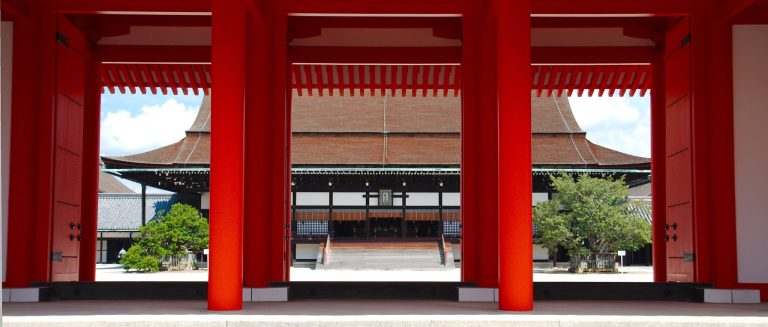
The Dharma Hall was rebuilt in 1605 with Hideyori’s support. It is recognized as the oldest surviving building of its type in Japan and as an important cultural property, as well as the oldest example of Muromachi-period Zen architecture. After the Onin War, the Mountain Gate and Buddha Hall were not rebuilt, and the Dharma Hall also served as the Buddha Hall from the early-modern period onward, housing the principal image.
Inside, a slightly domed ceiling carries a large dragon painting by Kanō Mitsunobu, who lived from 1565 to 1608. The paved stone floor and domed ceiling create a reverberation when hands are clapped, producing an effect compared with the thunder of the dragon.
Mountain Gate and Founder’s Hall
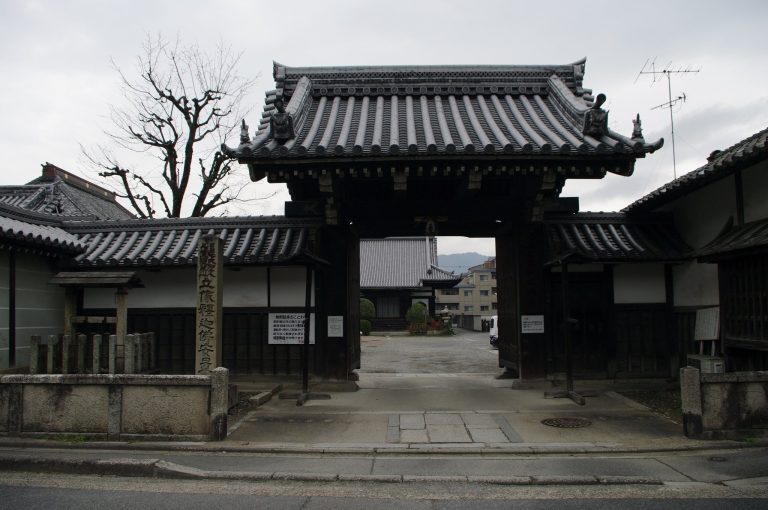
Tokugawa Ieyasu donated the Mountain Gate in 1609. The Founder’s Hall incorporates an imperial palace building donated by Emperor Go-Mizunoo. Another building given by the imperial family became a new Founder’s Hall in 1807. A Founder’s Hall commemorates and enshrines a temple’s founding master or lineage.
Service buildings and collections
Bathhouse and bell tower
The bathhouse, called a senmyō, was first built in 1400. The present structure dates from 1596 and appears in the illustrated scroll Images of Various Buildings of the Five Great Chinese Temples. The bell tower was rebuilt in 1844.
Sutra repository
The sutra repository, or kyōzō, dates from 1859 to 1860. It contains a complete copy of the Korean Buddhist canon, known as the Tripitaka. A memorial mound nearby holds hair attributed to Emperor Go-Mizunoo after his tonsure ceremony. A structure associated with this area burned in 1788.
The Jōtenkaku Museum stands within the temple grounds. A National Treasure associated with Shōkoku-ji consists of four calligraphic scrolls by Mugaku Sogen. Important Cultural Properties include the Dharma Hall, a monochrome ink painting of apes and bamboo, and sixteen color paintings on silk depicting the Sixteen Arhats, Buddhist disciples traditionally revered as enlightened guardians of the Buddha’s teaching.
Subtemples, pond, and associated shrines
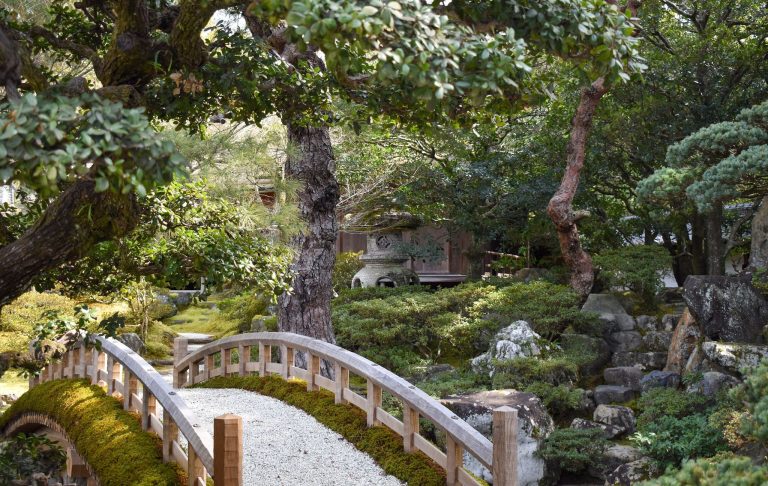
A lotus pond lies at the southern end of the main north-south route through the compound. Subtemples are situated around the pond and farther within the precinct. They include Rinkō-in, Gyokuryū-in, Daikōmyō-ji, Fukō-in, Jiun-in, Jishō-in, Hōkō-ji, Chōtoku-in, Yōgen-in, Kōgen-in, Zuishun-in, and Daitsū-in. The compound also contains Shinto shrines dedicated to Inari, Benten, and Hachiman.
Daikōmyō-ji
Daikōmyō-ji was founded in 1339 as a memorial temple for an empress. It later became a family temple of the Fushimi-no-miya family and was transferred into the Shōkoku-ji compound in 1651.
Fukō-in
Fukō-in was founded in 1401 as Yoshimitsu’s residence after he retired as shogun. It acquired its present name after the death of shogun Ashikaga Yoshinori. In 1510, it was given responsibility for a former Reizei-family estate and the tomb of Fujiwara Sadaie. The subtemple burned in 1788 and was rebuilt between 1814 and 1848.