Sennyū-ji Temple: Kyoto’s Imperial Memorial Temple


Site at a Glance
- Rating
- 4.3
- Popularity
- Medium
- Country
- Japan
- Primary era
- Early Modern
- External website
- Open
- Eras represented
- Medieval, Early Modern, Modern
- Civilizations
- Japanese, Tokugawa
- Site type
- Religious
- Remains
- Monastery
On this page15 sections
History
Sennyū-ji Temple is a Japanese Buddhist temple in Kyoto, Japan, whose early origins are uncertain but whose foundation is traditionally placed in 855. It became a major Kamakura-period center modeled partly on the institutions and architecture of Song China, and later served as a mortuary and memorial temple for Japan’s Imperial House. As the head temple of the Sennyū-ji branch of Shingon Buddhism, it is also known as Mitera, meaning “the Imperial Temple.”
Early foundations and revival
One tradition places the temple’s beginning in 855, when the court minister Fujiwara no Otsugu gave his mountain villa to the monk Shinshū. Shinshū established a temple called Hōrin-ji, later renamed Senyū-ji. Since Otsugu had died in 843, this account presents the foundation as a memorial act carried out according to his wishes. Another tradition attributes the original Hōrin-ji to Kōbō-Daishi Kūkai, the monk traditionally regarded as the founder of Shingon Buddhism in Japan, either in 807 or during the Tenchō era from 824 to 834. These accounts point to an early Heian-period predecessor that had declined by the late Heian period.
In 1218, the military official Utsunomiya Nobufusa donated the neglected Senyū-ji to the monk Tsukinowa Shunjō. Nobufusa had served Minamoto no Yoritomo as a retainer, governed Buzen Province, and followed Shunjō’s teachings. Shunjō had studied Buddhism in Song China from 1199 and returned to Japan in 1211 after about thirteen years abroad. His studies included Tendai Buddhism and the Vinaya, the body of Buddhist monastic rules, and he brought books, religious objects, and other cultural materials back to Japan.
Kamakura-period expansion
Shunjō secured extensive donations, including major support from Retired Emperor Go-Toba and Prince Morisada, later known as Go-Takakura-in. He rebuilt and enlarged Sennyū-ji as a substantial monastic complex shaped by the architectural and religious forms of Song China. Its principal buildings were completed in 1226. During the rebuilding, a sacred spring emerged on the grounds. The temple then took the name Sennyū-ji, using a character associated with bubbling or springing water while retaining the pronunciation of the earlier Senyū-ji.
Sennyū-ji developed into a center for the study and practice of several Buddhist traditions. These included the Vinaya, Tendai, Shingon esoteric Buddhism, Zen, and Pure Land Buddhism. The institution is therefore described as a four-school center, or as a five-school center when the Vinaya tradition is counted separately. Retired Emperors Go-Toba, Tsuchimikado, and Juntoku, Prince Morisada, and the warrior figures Hōjō Masako and Hōjō Yasutoki are recorded as having received Buddhist precepts under Shunjō. In 1224, Emperor Go-Horikawa designated Sennyū-ji an imperial prayer temple, an institution assigned to conduct prayers for the imperial house.
Emperor Go-Horikawa was buried within the temple precincts. When his son, Emperor Shijō, died in 1242, his funeral was held at Sennyū-ji, and his mausoleum was established there as well. Shijō was reportedly buried near Shunjō’s founder’s hall in accordance with his wish. From the reign of Retired Emperor Go-Kōgon during the Nanbokuchō period, Sennyū-ji took responsibility for imperial funerals. Go-Kōgon is also said to have founded the branch temple Unryū-in in 1372.
Destruction and reconstruction
The Ōnin War, a late fifteenth-century conflict that caused widespread destruction in Kyoto, reached Sennyū-ji in 1468. Fire destroyed the entire complex. The temple was later rebuilt with support associated with Oda Nobunaga and Toyotomi Hideyoshi. Hideyoshi confirmed temple lands amounting to 494 koku, a historical land-yield measure, in 1585. Tokugawa Ieyasu confirmed more than 601 koku in 1615.
The temple’s connection with the imperial court continued to develop during the Edo period. In 1611, the imperial palace’s Shishinden was transferred to Sennyū-ji and converted into the Kaikaidō, although that building no longer survives. Sennyū-ji conducted the funerals of emperors and empresses from Emperor Go-Yōzei through Emperor Kōmei. It also became the imperial family’s institution for incense and flower memorial rites, a role that reinforced the honorific name Mitera.
Meiji transformation and modern survival
The Meiji government’s separation of Buddhism and Shinto ended Sennyū-ji’s performance of imperial funerals and transferred the associated rites to Shinto practice. In 1873, the imperial palace’s Buddhist memorial institution Kyōmeigū was moved to Sennyū-ji and made into the Kaikaidō. Imperial memorial tablets and personal Buddhist images from the palace were transferred there in 1876. In 1878, the mausolea within the precincts were placed under the management of the Mausolea Office of the Imperial Household Ministry, now part of the Archives and Mausolea Department of the Imperial Household Agency. By imperial instruction, the ministry also repaired temple buildings and provided routine maintenance allowances for the protection of the memorial tablets.
Sennyū-ji established the independent Sennyū-ji branch of Shingon Buddhism in 1907 and became its head temple. After the Second World War, the constitutional separation of religion and state ended government financial support. In 1966, supporters formed the association for the protection of Mitera Sennyū-ji, initially chaired by Prince Takahito of Mikasa and later by Prince Fumihito of Akishino.
The temple also retains a strong connection with Gedatsu-kai, a new religious movement. Its founder, Okano Seiken, supported Sennyū-ji when postwar defeat had made the temple’s maintenance and administration difficult. After his death, a pagoda containing his remains was erected within the precincts in 1954. Gedatsu-kai regards Sennyū-ji, Ise Grand Shrine, and Kashihara Shrine as its three sacred sites.
Remains
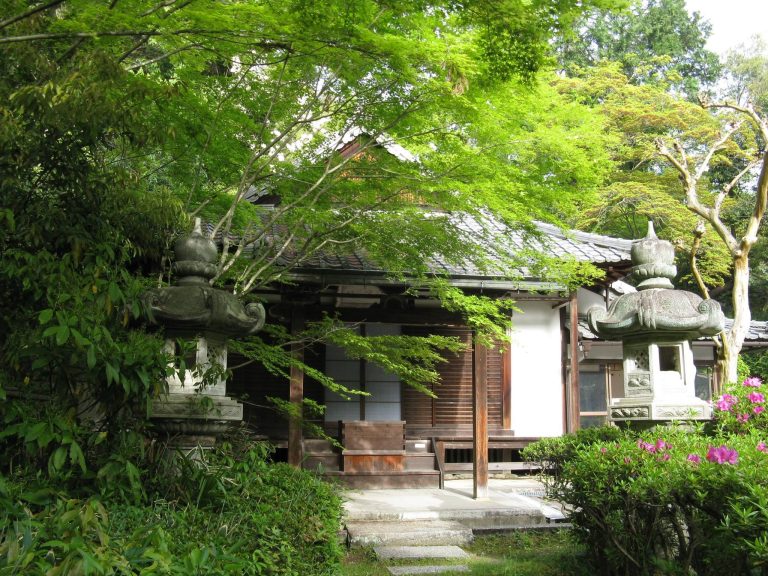
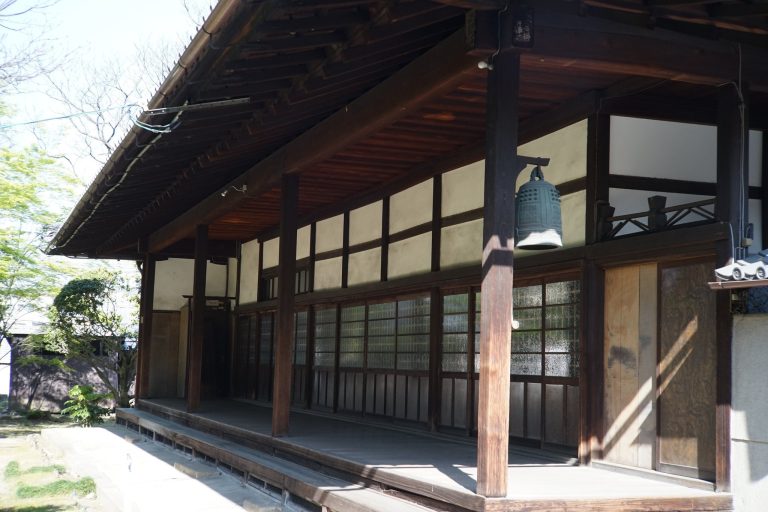
Sennyū-ji occupies a long, sloping site at the foot of Mount Tsukinowa, one of the peaks of Higashiyama. A spring remains within the grounds, recalling the meaning of the temple’s name. The approach begins at the outer gate, or Sōmon, and follows a long path lined with several subtemples. The main gate, or Daimon, stands at the upper end. Beyond it, the Yang Guifei Kannon Hall is on the left, while the Buddha Hall and Reliquary Hall form the central group. The Reimeiden and Gozasho stand behind them, with the imperial mausolea farther to the rear.
Central worship buildings
Buddha Hall
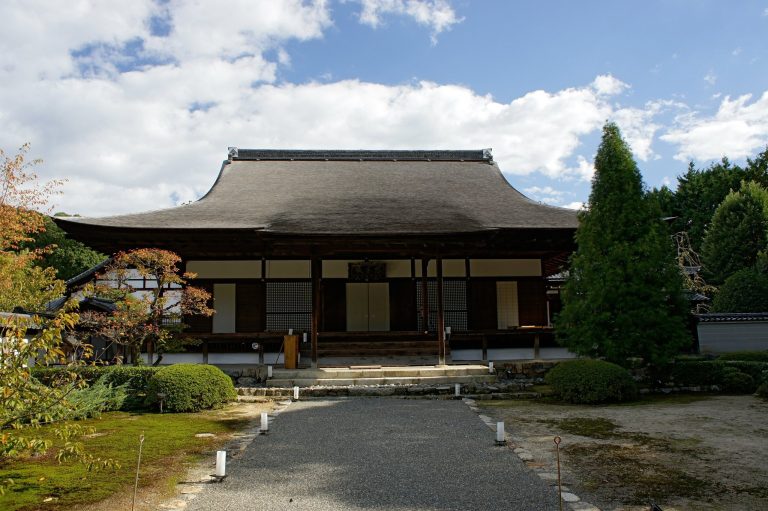
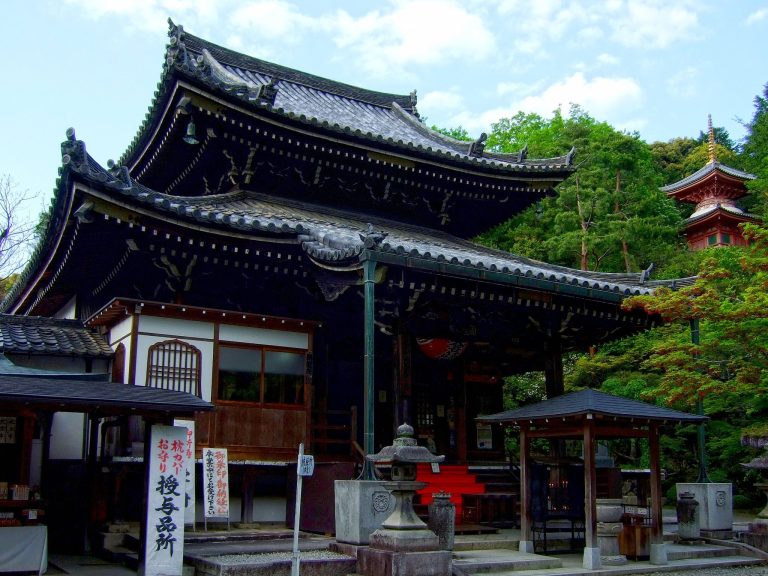
The Buddha Hall was rebuilt in 1668 with assistance from Tokugawa Ietsuna. It is the principal hall of Sennyū-ji, but its use of the Song-style name “Buddha Hall” reflects the temple’s historical connection with Chinese architectural and monastic forms. The building combines a shrine-like earthen floor with columns, windows, fittings, and ceiling features associated with Zen architecture. Inside are three Tathagata images representing past, present, and future: Shakyamuni, Amitabha, and Maitreya. Kanō Tan’yū painted the ceiling dragon, the flying beings behind the principal images, and the White-robed Avalokiteshvara on the rear wall.
Reliquary Hall
The Reliquary Hall stands behind the Buddha Hall. It was formed during the Keichō era by moving and adapting a building from the Kyoto Imperial Palace. The hall houses a tooth relic of the Buddha brought from Southern Song China by Tankai in 1228, together with a gilded Kamakura-period hōtō, a pagoda-like Buddhist reliquary structure. It also contains images that Tankai is said to have brought from Southern Song China in 1230.
Kanō Sansetsu painted the hall’s ceiling dragon, which is also called the “dawn dragon.” Removable wall panels carry paintings of the sixteen arhats, Buddhist disciples who have attained spiritual liberation, by Kimura Yōtaku VI. The paintings were completed in 1668. The standing images of Weituo and the traditionally identified Yuegai Elder are also regarded as Southern Song works brought by Tankai. The three statues of the Yang Guifei Kannon, Weituo, and Yuegai Elder were designated Important Cultural Properties in 1997.
Yang Guifei Kannon Hall
The Yang Guifei Kannon Hall contains a seated statue traditionally said to have been modeled on the appearance of Yang Guifei, consort of the Tang emperor Xuanzong. The image is also identified as a Sacred Avalokiteshvara or Willow Avalokiteshvara, and its style and materials are regarded as those of a Southern Song work. Tradition holds that Tankai brought it from Southern Song China in 1230. Formerly a secret image shown only once every hundred years, it has been publicly displayed since 1955, the seven-hundredth anniversary of its arrival in Japan.
Rear complex and memorial buildings
Gozasho and Reimeiden
The Gozasho, associated with a construction date of 1818, now occupies a building moved to Sennyū-ji from a former imperial palace residence used by Emperor Meiji in 1884. Its rooms include the court-lady’s room, monzeki room, imperial-family room, chamberlain’s room, imperial envoy’s room, and imperial-seat room. The imperial-seat room served as a resting place for the emperor and empress during visits. During the Heisei period, it was used for imperial ceremonies and reports connected with the enthronement, the 1,200th anniversary of the transfer of the capital to Heian-kyō, the tenth anniversary of the reign, and the abdication and succession ceremonies of 2019.
The Reimeiden houses memorial tablets for successive emperors, empresses, and members of the Imperial Family. The Kaikaidō is a small hall with a square plan, associated with a building transferred from the imperial palace. The founder’s hall, or Kaisandō, is also square in plan and was built during the Kanbun era for Shunjō.
Imperial mausolea
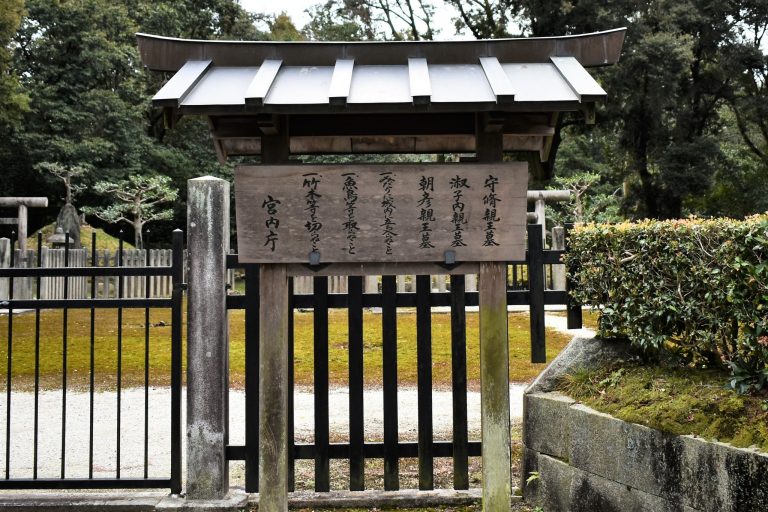
The imperial mausolea are distributed through the grounds within a walled burial area. The Tsukinowa group consists of the Tsukinowa and Nochi-no-Tsukinowa mausolea, while the wider complex also includes the Nochi-no-Tsukinowa-Higashiyama and Nochi-no-Tsukinowa-Higashiyama-Hokutō mausolea. In total, the grounds comprise 25 imperial mausolea, five ash mounds, and nine other graves. The tomb of Emperor Kōmei is the Nochi-no-Tsukinowa-Higashiyama mausoleum, and the mausoleum of Empress Dowager Eishō is the Nochi-no-Tsukinowa-Higashiyama-Hokutō mausoleum.
Subtemples and grounds
The subtemple complex includes Unryū-in, Hiden-in, Raigō-in, Zennō-ji, Imakumano Kannon-ji, Shinzenkō-ji, Hōon-in, Kaikō-ji, and Sokujō-in. Shinzenkō-ji was transferred into the precincts by imperial order in 1473. Kaikō-ji was moved and revived there in 1645, Hiden-in was moved and revived within the grounds in 1646, and Sokujō-in was transferred from Fushimi in 1902.
Raigō-in contains Kansui-ken, a tea house built by Ōishi Kuranosuke before the Akō Incident, the event associated with the later Chūshingura tradition. Sokujō-in has a principal hall containing an image of Amitabha surrounded by 25 bodhisattvas, Buddhist figures who seek enlightenment while assisting other beings. Its grounds also contain the graves of Fujiwara no Toshitsuna, Nasu Yoichi, and Itō Kashitarō.
Objects, paintings, and monuments
The grounds contain the Liberation Vajra Pagoda, erected in 1954 for the remains of Okano Seiken. Near the spring-house stands a stone monument bearing a poem from the Hyakunin Isshu anthology, installed in 1974 at a location associated with the former Tsukinowa Villa.
Sennyū-ji possesses the Sennyū-ji Kan’en-sho, a calligraphic fundraising and foundation document written by Shunjō to solicit donations for the revival and renaming of the earlier temple. It records the beginnings of the institution and is also regarded as an important work of calligraphy. Another document, the Fuhōjō, was written by Shunjō shortly before his death as proof that he had transmitted his Buddhist teaching to his disciple Shinkai. Related treasures include a color painting on silk by the Song-dynasty Zen priest Wuzhun and writings connected with him.
The temple also owns a monumental painting of the Buddha’s death measuring approximately 8 by 16 meters. It is described as the largest work of its type in Japan and is displayed only rarely. Important Cultural Properties include the Buddha Hall, Daimon, and Kaisandō. The Reliquary Hall, Bathhouse, and spring-house are among the structures designated as tangible cultural properties by Kyoto Prefecture.