Hornby Castle: A Historic Medieval Castle in England
Visitor Information
Google Rating: 4.4
Popularity: Very Low
Official Website: www.hornbycastle.com
Country: United Kingdom
Civilization: Early Modern, Medieval European, Modern
Site type: Military
Remains: Castle
History
Hornby Castle is situated in the village of Hornby, England, and was originally established by the medieval Neville family, prominent landholders in the 13th century. Its origins trace back to this period, with the earliest component identifiable as the base of the castle’s rear tower dating from the same century. Records from 1285 confirm the property was held by Margaret de Neville, illustrating the family’s early association with the site.
In the 16th century, the castle saw significant additions under Sir Edward Stanley, 1st Baron Monteagle, who likely commissioned the distinctive polygonal tower that still shapes the castle’s silhouette. His lineage played a key role in national affairs, notably participating in the suppression of the Rising of the North in 1536 and acting against the Gunpowder Plot in 1605, events reflecting the family’s involvement in the turbulent political landscape of Tudor and Stuart England.
During the English Civil War in the mid-17th century, Hornby Castle was a contested stronghold. In 1643, it was captured by Colonel Assheton, allied with the Parliamentarian forces. Five years later, it was garrisoned by the Scottish army under the Duke of Hamilton. The subsequent forfeiture of the estate followed due to the family’s support for the Royalist cause. However, the Nevilles eventually regained ownership before selling it in 1663 to Robert Brudenell, 2nd Earl of Cardigan, signaling a transition in stewardship.
The early 18th century brought the Castle under the control of Colonel Charteris, whose family undertook remodeling work around 1720 that reflected contemporary tastes. Later, in 1789, John Marsden acquired the estate, although legal disputes ensued before Admiral Sandford Tatham purchased it in 1838. Upon his death, the castle passed to his nephew Pudsey Dawson, who initiated a major reconstruction project between 1847 and 1850. Architects Sharpe and Paley were commissioned to carry out this extensive rebuilding, which established much of the castle’s present appearance.
Subsequent ownership passed to John Foster, a local mill owner, during whose tenure architects Paley and Austin added further extensions from 1879 to 1882. Later contributions by the firm W. and R. Mawson took place in 1890. The Foster family maintained possession into the 20th century, overseeing additional alterations, including the creation of a courtyard through the removal of some eastern rooms and the elimination of the original main staircase inside the house.
Remains
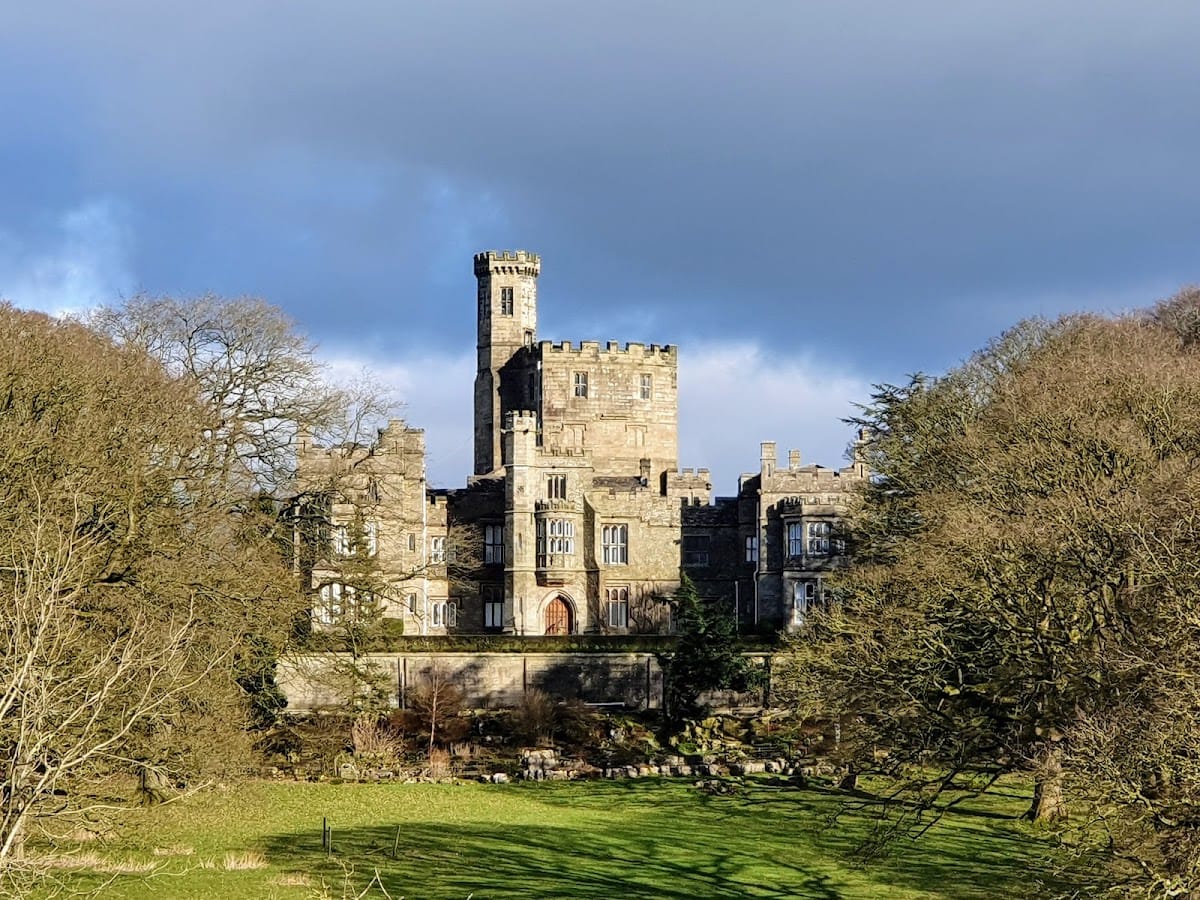
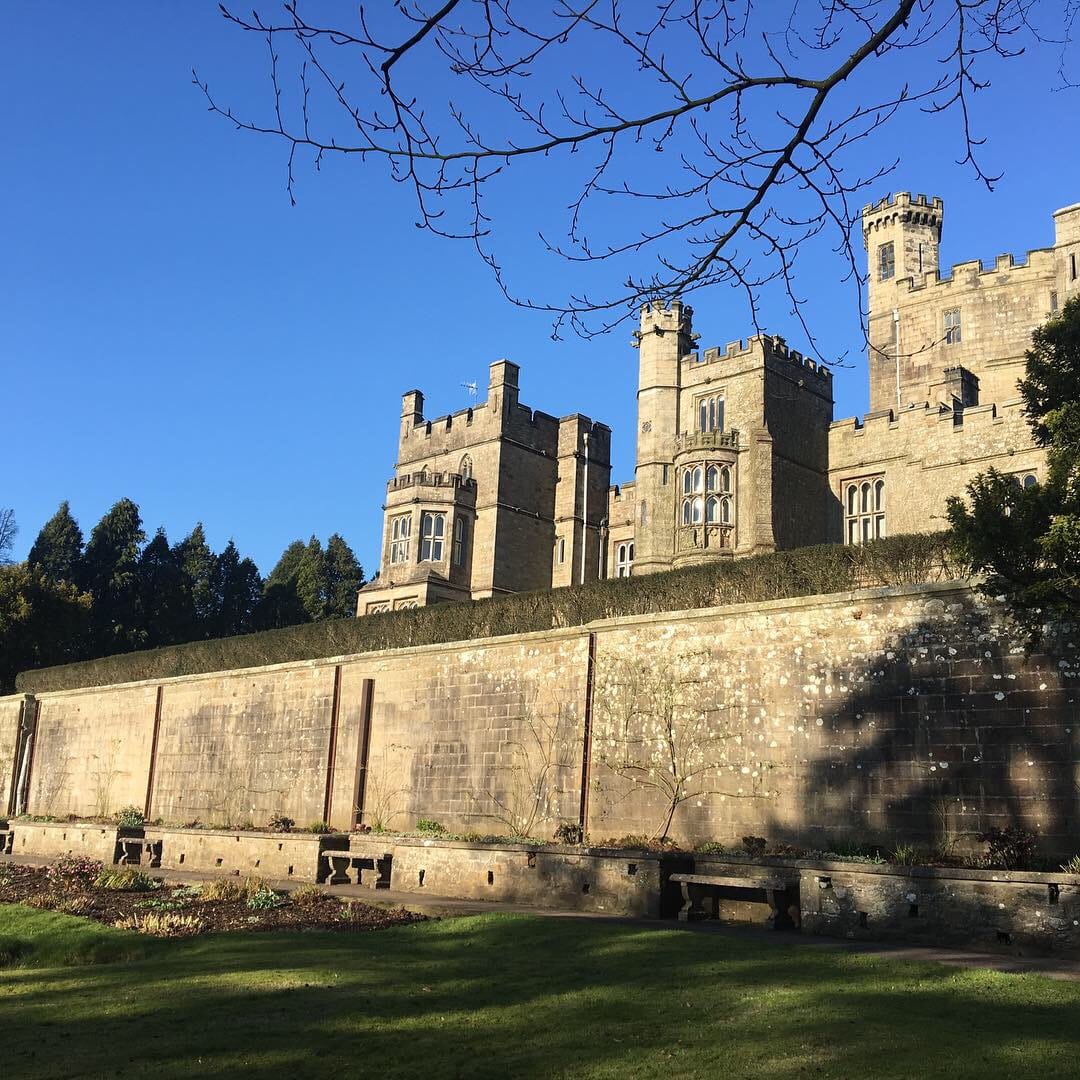
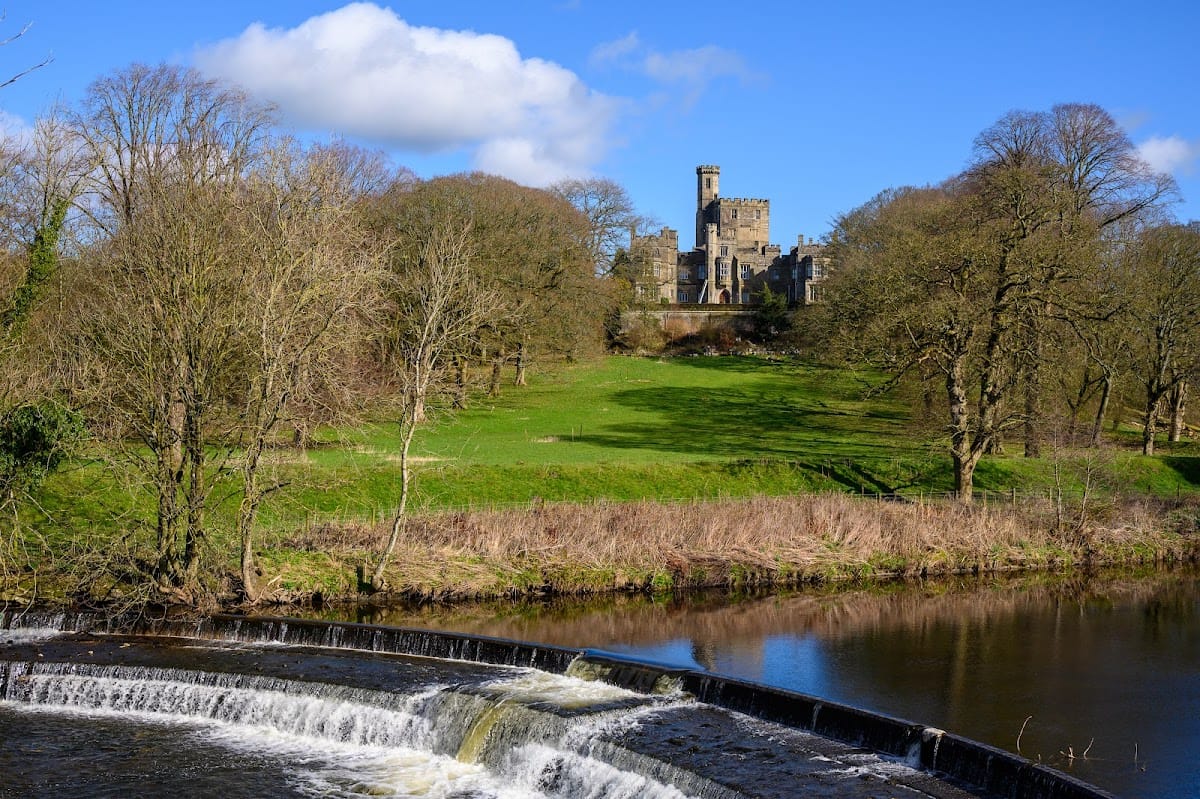
Hornby Castle presents an irregular layout primarily built from rough sandstone blocks, capped with slate roofs. The structure typically rises two stories high, featuring battlemented parapets that reflect Gothic architectural influences, particularly the Perpendicular Gothic style notable for its vertical emphasis and decorative stonework.
The front entrance, facing southwest, is symmetrically arranged with seven sections or bays. On each side, the outer bays are prominent, projecting forward with angled bay windows—window structures that curve outward to expand interior space and light. The left of these bays includes additional windows above. At the center stands a three-story porch marked by an eight-sided turret on its left and a diagonal support called a buttress on the right, emphasizing the entrance’s prominence.
Directly behind the porch are two towers showing different periods of construction. One is square and slightly offset, housing a Venetian window—named for its three openings with a distinctive arched center—that has been partially blocked over time. Adjacent to this is a taller and narrower polygonal tower dating back to the 1500s, reflecting the 16th-century addition commissioned by the Stanley family.
Window designs throughout combine mullions, which are vertical stone divisions, often paired with transoms, or horizontal dividing bars, creating a grid of smaller panes. The porch itself includes a bay window that juts out on the middle floor and a three-light window above, each contributing to the building’s layered appearance.
Inside, the vaulted ceiling of the porch is decorated with carved bosses featuring stylized leaves, known as foliated bosses. The main hall provides a spacious interior accessed through a Tudor-style arch characterized by its gentle pointed shape, framed by a timber screen with Gothic-inspired glazed panels. A sandstone fireplace also displays a Tudor arch form. Stained glass windows from the late 19th century, relocated here during the 20th century, introduce colored light and enhance the historic atmosphere.
The castle’s library contains finely crafted woodwork attributed to Gillows, renowned furniture makers known for quality and design. Upper rooms include a billiard room adorned in Gothic motifs and a drawing room distinguished by a curved, vaulted ceiling with supporting pendents that create an elaborate overhead structure.
Outside, an older courtyard lies to the northeast, now enclosed by converted apartments, with access marked by a gatehouse featuring a pointed archway. Sandstone terraces from the 1800s flank the castle’s southwest and southeast sides, each terrace connected by three descending flights of steps and culminating in a small semicircular defensive bastion at the northern end.
Along the former entrance drive once stood a lodge building with a distinctive angled front and a steeply pitched slate roof topped with an embattled turret, resembling miniature battlements. Nearby gate piers display carved roundels incorporating imagery of green men—traditional woodland spirits—and the crest of the Pudsey Dawson family. These external features, comprising boundary walls, the lodge, and gate piers, have been recognized for their heritage value and designated as Grade II listed structures, preserving the character of the castle’s approach in addition to the main house.
Nearby sites