Hollenfels Castle: Medieval Fortress and Youth Center in Luxembourg


Site at a Glance
- Rating
- 4.1
- Popularity
- Low
- Country
- Luxembourg
- Primary era
- Medieval
- Eras represented
- Medieval, Early Modern, Modern
- Civilizations
- Duchy of Luxembourg, Holy Roman Empire
- Site type
- Military
- Remains
- Castle
On this page13 sections
History
Hollenfels Castle is a medieval fortress in Luxembourg, in the village of Hollenfels, and its donjon was built in 1380. It forms part of the Valley of the Seven Castles, a historic landscape along the Eisch River containing seven notable castles and fortified residences.
Medieval origins and noble ownership
A castle called Heimansiburud stood at Hollenfels in the tenth century. The site was first recorded as Hollenfels in 1041, when Isenbald von Holfels was identified as its lord. Later records name Ludolf and Sara in 1129 and Eckerhardus von Holefels in 1238, indicating that a predecessor fortress probably existed by the eleventh century.
The von Holfels family built the donjon, the principal fortified tower of a medieval castle, in 1380. For about two centuries, the von Holfels and von Elter families occupied Hollenfels. After their male lines died out, sisters and extended family members continued to live at the castle until 1599.
From the late fifteenth to the seventeenth century, ownership was divided among several families and sometimes among several lords at once. The von Beumburg, de Raville, Greifenklau, Raugraf, and von Ippenborn families held shares, alongside the Hollenfels, Autel, and Elter lines.
Sebastian von Thynner and the seventeenth century
Between 1599 and 1624, Sebastian von Thynner gradually consolidated the different shares in Hollenfels and lived there with his wife. Around 1600, he established an iron-producing furnace in the valley. After 1629, he founded a school at Hollenfels and paid for further education for its most successful pupils.
Von Thynner had no children. In 1632, he transferred the estate and castle to Lucia von Hohenstein, the widow of Pieter van Broeckhoven. Her son, Jan Martijn van Broeckhoven, later inherited the estate and acquired Arendonk in 1643. In 1649, he transferred his properties to Amalia van Solms.
War, rebuilding, and aristocratic residence
French forces under Louis XIV occupied Hollenfels in 1681. Louis XIV was king of France from 1643 to 1715, and his reign was marked by extensive military expansion in western Europe. Spanish troops expelled the French in 1683, but a French counterattack retook the castle. The fighting, including bombardment, heavily damaged the village and castle, which was rebuilt afterward.
The medieval donjon was not adequately secured and deteriorated over the following centuries. After the war, Hollenfels passed to the Luxembourg branch of the French de Brias family. Jean-Baptiste de Brias ended the medieval residential arrangement and demolished walls damaged during the conflict. A representative residential building was added northeast of the donjon in 1729. In 1787, Hollenfels became a county, and Jean-Frédéric-Joseph de Brias received the title Count of Hollenfeltz.
Decline, restoration, and institutional use
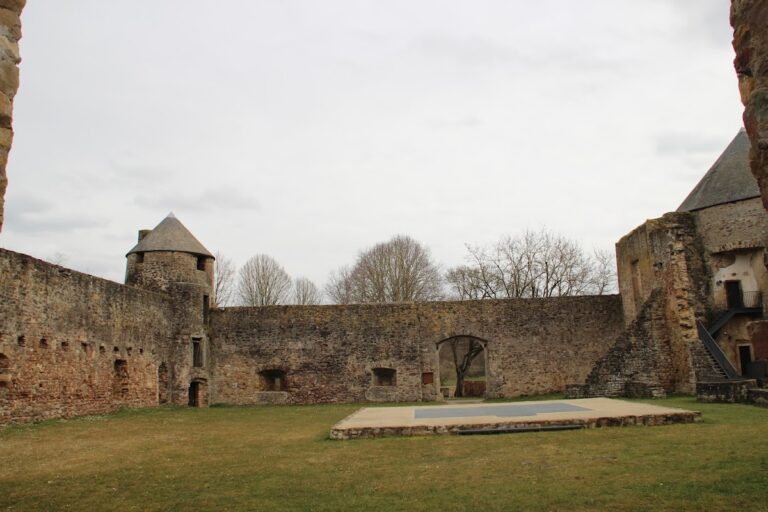
Louis-Antoine de Brias sold Hollenfels in 1818 to Jean-Baptiste Thorn, governor of the Belgian province of Luxembourg and owner of Schoenfels Castle. Thorn sold both castles to the Brussels senator Engler in 1840, and Engler later left them to his son-in-law, Baron Goethals. Hollenfels remained uninhabited from 1820 to 1920 and gradually fell into ruin. The towers and buildings around the inner courtyard were demolished in 1850, and fire damaged part of the castle in 1885.
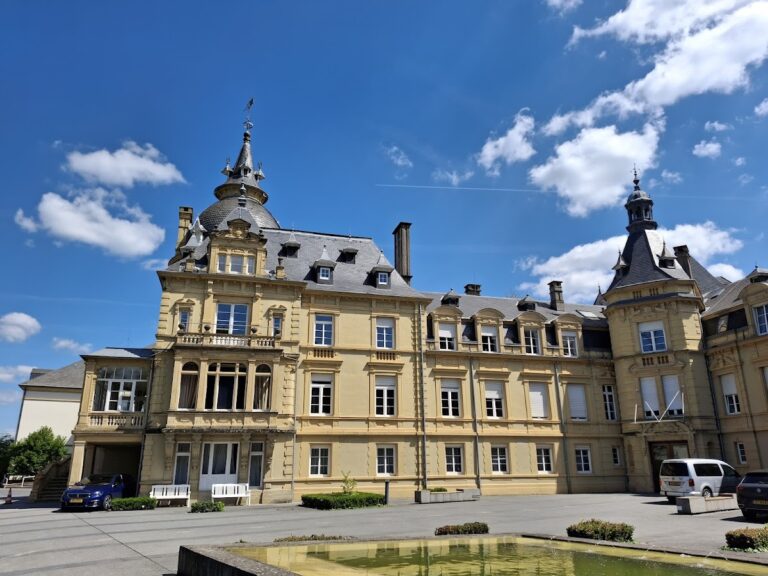
Charles van den Poll acquired the castle in 1920. The residential building was remodeled in 1921 in a neo-Baroque style, and the complex was restored by about 1929 by the Luxembourg architect J. Schoenberg. Conservation of the donjon began in 1952. Concrete stabilized the tower, although moisture later spread into the Gothic vaults on its second floor. In the early 1970s, authorities added a roof to protect the tower, and its interiors were renovated for institutional use.
From 1940 to 1945, Hollenfels served as a training center for girls belonging to the Bund Deutscher Mädel, the girls’ branch of the Hitler Youth, the Nazi regime’s state-controlled youth organization. From 1945 to 1948, the castle housed Russian prisoners of war and forced laborers awaiting repatriation and also operated as a prisoner-of-war camp.
The Luxembourg state acquired Hollenfels in 1948 and established a youth hostel there. A youth ecology center followed in 1975, later becoming a center for education for sustainable development. The complex is now operated as the Hollenfels Youth Center by Luxembourg’s National Youth Service. Hollenfels was designated a national monument on 11 February 2022. During renovation work at the youth hostel, archaeological investigations announced in December 2024 revealed additional medieval fortifications, including a stone bridge and two defensive towers.
Remains
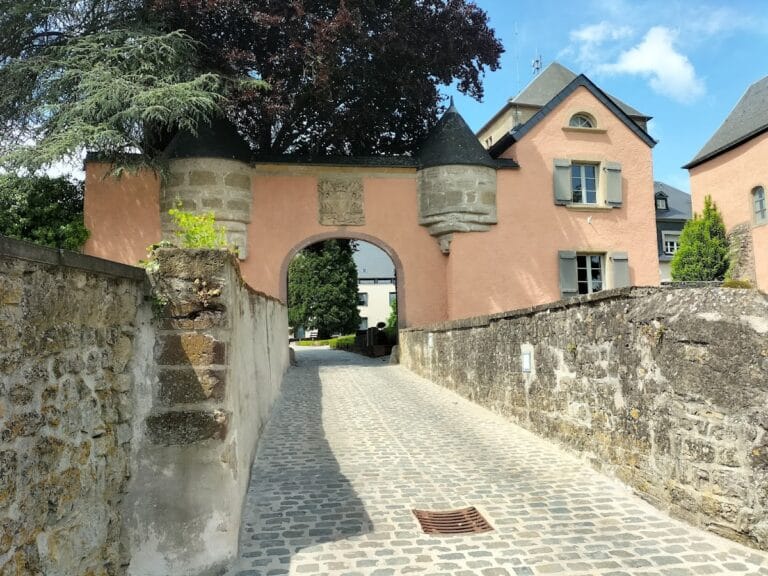
Hollenfels Castle occupies a rocky ledge about 60 by 35 metres in size, at approximately 315 metres above sea level and roughly 80 metres above the Eisch valley. Cavities and underground passages in the rock are associated with the name Hollenfels, meaning “hollow rock.” The surviving complex brings together the medieval donjon, a residential section, a corner tower, and an adjoining curtain wall, a fortified perimeter wall connecting defensive towers or other strongpoints. Access crosses a bridge over the moat, while archaeological work has revealed another medieval stone bridge within the defensive system.
The medieval fortified core
The donjon
The five-storey donjon measures approximately 14 by 12.5 metres in plan. Including its roof, it rises about 39 metres, with walls reaching roughly 23 metres and the roof structure adding about 16 metres. A narrow spiral staircase connects its floors. The vaulted rooms include a lowest level with an oven and kitchen, a servants’ dining room, a Gothic hall for the castle lords, a chapel also used as a bedroom, and an armoury.
Windows are set into the donjon’s thick walls, and large open fireplaces feature carved decoration. The tower contains weapons, sculptures, and a medieval toilet area. Its Gothic vaulted rooms and large carved fireplaces remain well preserved, while the principal fireplace in the hall is still functional. The chapel has an altar decorated with stained glass. Other rooms contain exhibitions mainly devoted to local ecological subjects, and the hall is used occasionally for communal knightly meals.
The well and defensive passages
A well provides an entrance to a secret passage. During a siege, the passage allowed food to be brought into the castle discreetly and provided a way for people to evacuate. Boards above the opening could be removed so that unwanted visitors fell into the well or were delayed. Sections of the passage remain accessible.
Newly revealed fortifications
Archaeological investigations carried out during renovation revealed previously unknown sections of the medieval defensive system. These include a stone bridge and two defensive towers, adding to the understanding of how the castle was approached and protected.
Residential and educational buildings
The residential section
The residential building beside the donjon was added in 1729 and remodeled in 1921 as a neo-Baroque structure. The forecourt building now contains youth-hostel facilities, including sleeping halls, a kitchen, sanitary installations, classrooms, common rooms, and a biological laboratory equipped with microscopes.
Educational use of the complex
The wider complex accommodates youth and educational activities. Its rooms combine the surviving historic fabric with spaces adapted for ecological study, education for sustainable development, and the continuing work of the Hollenfels Youth Center.
Nearby sites