Schoenfels Castle: A Historic Fortified Residence in Luxembourg
Site at a Glance
- Rating
- 4.1
- Popularity
- Low
- Country
- Luxembourg
- Primary era
- Medieval
- Eras represented
- Medieval, Modern
- Civilizations
- Holy Roman Empire
- Site type
- Military
- Remains
- Castle
On this page7 sections
History
Schoenfels Castle is a historic castle in Luxembourg, situated in the village of Schoenfels beside the Mamer River. A fortified residence was probably built there in 1292 by Friedrich von Schoenfels, and the castle later became part of the Valley of the Seven Castles, a historic landscape associated with castles along the Eisch and Mamer rivers. Its present appearance also reflects a nineteenth-century remodelling in the Neo-Gothic style, a revival of medieval Gothic forms.
Medieval origins and noble ownership
The village of Schoenfels appears in an 846 reference as Scindalasheim. Its name may come from scindula, meaning “shingle,” or from Schinder, meaning “roofer.” Theodorius de Schonevels was mentioned in the twelfth century. After Friedrich von Schoenfels established the fortified residence, ownership passed through marriage first to the lords of Ansembourg and later to the lords of Sassenheim.
At the beginning of the sixteenth century, Schoenfels came into the possession of Henri Schloeder, also known as Heinrich Schliederer, von Lachen. He became lord of Schoenfels and Busbach, and the entrance to the castle tower carries the arms of the Schloeder von Lachen family. In 1700, ownership was divided between Ch.-Antoine Schliederer von Lachen and Théodore de Neunheuser. Pierre-François de Gaillot de Genouillac became lord of Schoenfels in 1759 through his marriage to Marie-Catherine de Neunheuser.
Destruction and changing political boundaries
French troops associated with Louis XIV, the French king from 1643 to 1715, dismantled Schoenfels’s fortifications in 1683 because the feudal castle had little strategic value. On 22 June 1690, a dispute between Théodore de Neunheuser and the lord of Brandenburg led to the complete burning of the castle and village.
François-Romain de Gaillot sold the Schoenfels estate to Jean-Baptiste Thorn on 18 August 1813. Thorn was a Luxembourg lawyer who later served as governor of the Belgian province of Luxembourg from 1831 to 1839, and he also acquired Hollenfels Castle in 1818. Schoenfels became involved in the unsettled territorial arrangements that followed the creation of the Grand Duchy of Luxembourg at the Congress of Vienna in 1815 and Luxembourg’s annexation to Belgium in 1830.
On 17 April 1832, Frédéric-Guillaume de Goedecke, an Orangist governor associated with support for the House of Orange, ordered the arrest and imprisonment of Thorn at Schoenfels. Although the castle lay three leagues north of the area theoretically controlled by the grand duke, the Prussian fortress commander General Frédéric Dumoulin applied an older convention defining the controlled area as four leagues, bringing Schoenfels within that zone. After the definitive separation of the Grand Duchy of Luxembourg on 19 April 1839, the castle and estate lay entirely within Luxembourg.
Nineteenth- and twentieth-century changes
In 1840, Thorn sold Schoenfels to Jacques Engler, a Belgian senator, industrialist, and politician. Engler transferred the castle two years later to his son-in-law, Baron Auguste Goethals. Goethals built a manor house beside the tower in 1870 and probably added the tower’s Neo-Gothic roof. The property later passed by inheritance to the Van den Poll family of The Hague.
Camille Weiss, a timber merchant, acquired the estate and surrounding forests in 1948. He transferred the property to the Luxembourg state on 16 March 1971. The state demolished the manor house in 1976. The donjon is undergoing restoration, after which the state planned to use the site for a visitor centre for the Mamer Valley nature reserve and offices for the Luxembourg forestry administration.
Remains
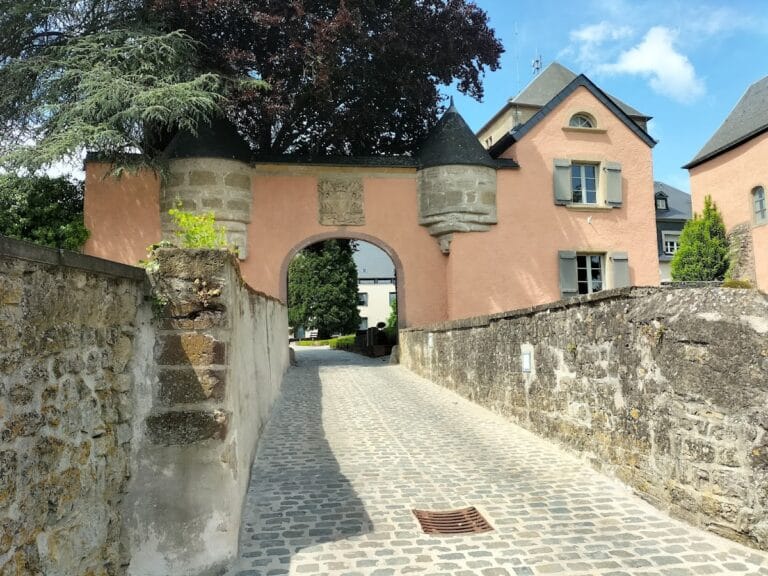
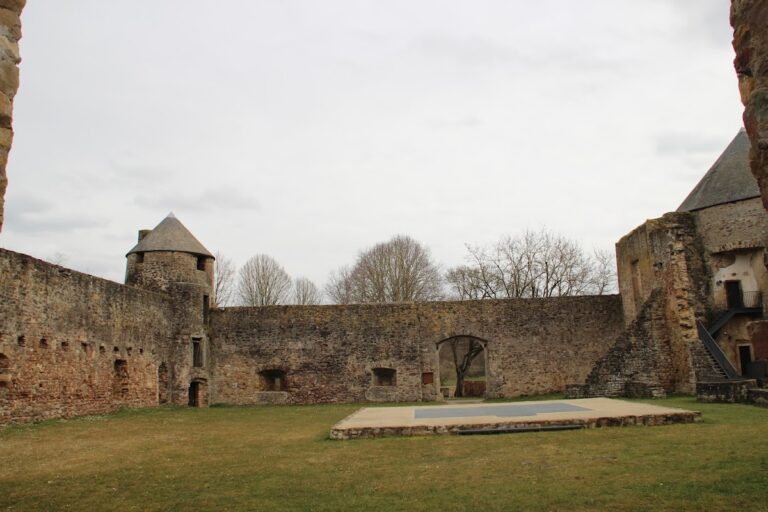
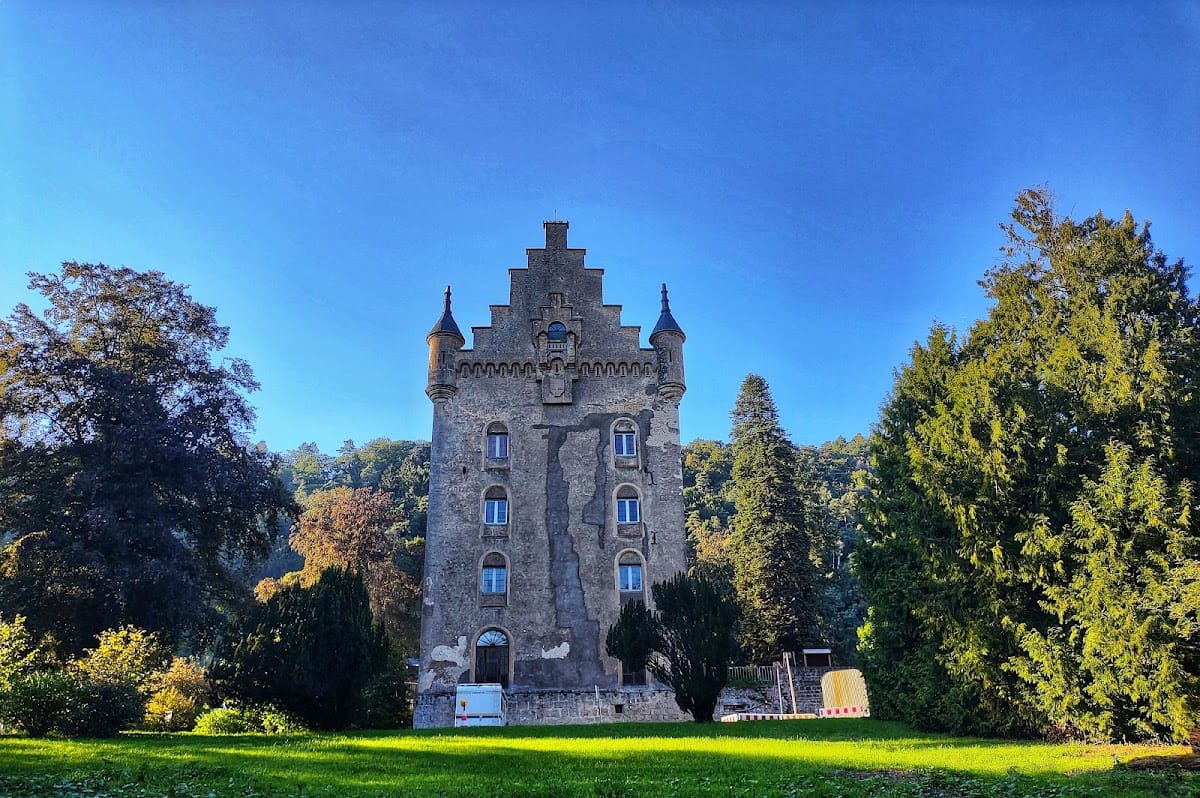
Schoenfels Castle stands beside the Mamer River in the Mamer Valley, between Kopstal and Mersch. The principal surviving element is a massive donjon, or principal fortified tower, measuring approximately 17 by 13 metres and rising 21 metres high. Its four corner turrets give the tower a strongly fortified form, while later Neo-Gothic work shaped its nineteenth-century appearance.
Donjon
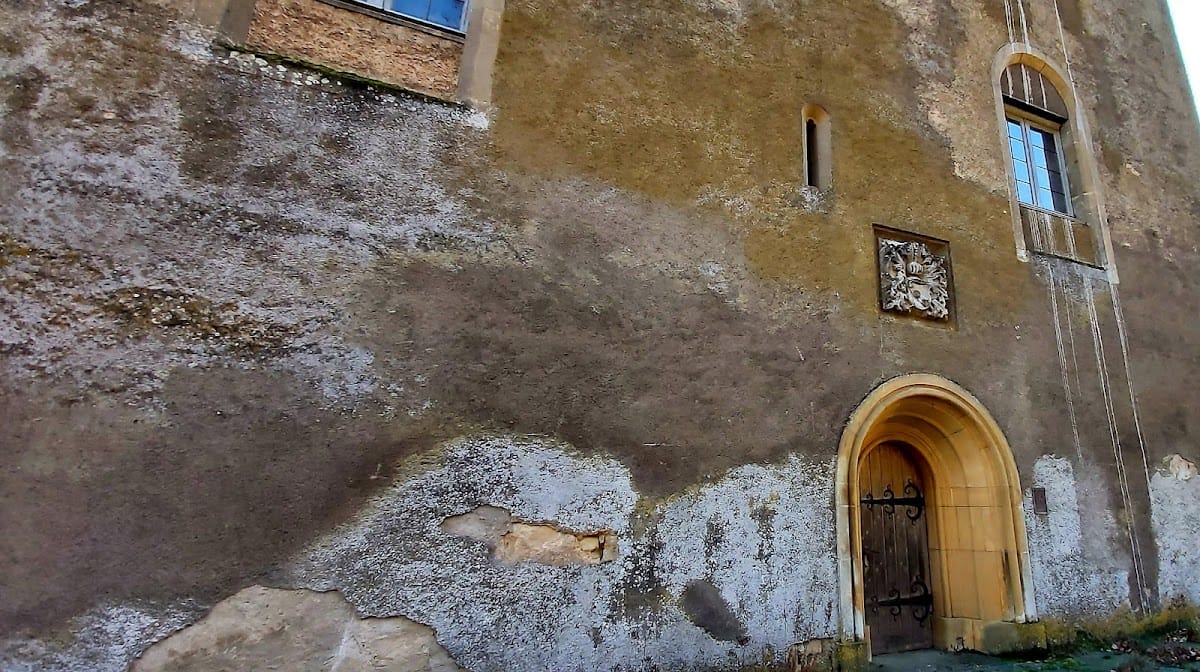
The donjon forms the core of the surviving castle. Its entrance is decorated with the arms of the Schloeder von Lachen family, linking the tower’s physical fabric with the family’s ownership of Schoenfels at the beginning of the sixteenth century. The tower’s Neo-Gothic roof was probably added by Auguste Goethals during the nineteenth-century remodelling. Restoration work is continuing on the structure.
Manor house site
A manor house stood beside the donjon from 1870, when Auguste Goethals constructed it, until the Luxembourg state demolished it in 1976. Its former position reflects the transformation of Schoenfels from a medieval fortified residence into a nineteenth-century estate centred on the older tower and a newer residential building.
Nearby sites