Heisenji Hakusan Shrine: A Historic Center of Hakusan Mountain Worship in Japan


Site at a Glance
- Rating
- 4.5
- Popularity
- Medium
- Country
- Japan
- Primary era
- Medieval
- External website
- Open
- Eras represented
- Medieval, Modern
- Civilizations
- Ashikaga shogunate
- Site type
- Military
- Remains
- Fortified Town
On this page14 sections
History
Heisenji Hakusan Shrine is a historic shrine in Japan that traditionally traces its opening to 717, when Taichō, a Buddhist ascetic associated with Shugendō, began developing the site. Shugendō combined religious devotion, mountain pilgrimage, and ascetic training. Heisenji became the Echizen-side center of Hakusan mountain worship and a base on the pilgrimage route to Mount Hakusan, while its later remains preserve the scale of a powerful medieval religious settlement.
From mountain worship to Buddhist institution
Until the Meiji-period separation of Shinto and Buddhism, Heisenji was known as the Buddhist temple Reiozan Heisenji. From the Heian period onward, it came under the influence of Enryakuji, the head temple of the Tendai school, a major Japanese Buddhist tradition centered historically on Mount Hiei. Heisenji became an Enryakuji subordinate temple in 1084, transferred to Onjōji in 1147, and later returned to Enryakuji’s control after an appeal to the retired Emperor Toba.
The institution brought together mountain asceticism with local practices and elements of pre-Buddhist Shinto, Taoism, and Buddhism. Mountain priests and warrior-monks gathered at Heisenji, and its religious influence eventually rivaled that of Toyoharaji. In 1172, during its period as an Enryakuji subordinate temple, the Great Lecture Hall was rebuilt. Eiben, an Enryakuji scholar-monk, served as chief officiant at the hall’s consecration ceremony.
Warrior-monks and medieval politics
Heisenji was drawn into the conflicts of the late twelfth century. During the Genpei War, the struggle between the Taira and Minamoto factions, its chief administrator Saimei abandoned Kiso Yoshinaka and joined the Taira side at the Battle of Hiuchi Castle in 1183. Saimei was captured and executed after the Battle of Kurikara. Yoshinaka later donated the seven districts of Fujishima to Heisenji, which by this time already possessed a powerful organization of warrior-monks, armed religious personnel attached to major temple institutions.
A later tradition connects Heisenji with Minamoto no Yoshitsune and his companion Benkei. According to the tradition, they stopped at the temple while disguised as mountain ascetics during their flight toward the Northern Fujiwara family. Legends concerning Yoshitsune and Benkei remain associated with the site.
During the Nanboku-chō period, the fourteenth-century conflict between the Southern and Northern imperial courts, Heisenji first supported Emperor Go-Daigo and the Southern Court. Its position changed after Shiba Takatsune secured possession of the Fujishima estate for the Northern Court. Heisenji forces occupied Fujishima Castle and fought the Southern Court army. Nitta Yoshisada was attacked and killed at Tōmyōji Nawate in 1338 while traveling to reinforce the assault on the castle.
Expansion under the Shiba and Asakura families
Protected by the Shiba family, the military governors of Echizen, Heisenji grew stronger during the Muromachi period. A fire in August 1440 destroyed the entire complex. The Muromachi shogunate then authorized the collection of building taxes from seven Hokuriku provinces to pay for reconstruction. Extensive use of stone walls began after this rebuilding.
At its late-Muromachi height, Heisenji was a fortified religious city with earthworks, moats, stone walls, shrines, temples, and residences. It contained 48 shrines, 36 halls or temples, approximately 6,000 clerical and institutional residences, and a warrior-monk force of about 8,000. The precincts extended about 1.2 kilometers from east to west and 1 kilometer from north to south. The South Valley contained approximately 3,600 residential units, while the North Valley contained about 2,400.
The two valleys had different social and physical arrangements. Celibate monks were associated with the North Valley, while the more systematically planned South Valley was occupied by married clergy and included straight, stone-paved roads. Place-names such as Tokuichi, Yasagaichi, and Onigaichi preserve evidence of an urban district within the wider religious settlement.
In 1543, conflict began between Heisenji, the Echizen pilgrimage center, and Shirayama Hime Shrine, the Kaga center, over control of Mount Hakusan’s summit and the collection of entry fees. During the Warring States period, Heisenji became a power comparable to the Asakura rulers of Echizen. The estates of Hōkō-in and Daishō-in together produced 8,000 koku, a historical measure of the productive capacity and revenue of an estate, while several influential clerical residences held another 3,000 koku collectively.
Heisenji maintained a particularly close relationship with the Asakura family. When Asakura Yoshikage went to assist Azai Nagamasa in northern Ōmi, Heisenji sent forces from institutions including Gyokusenbō and Hōkō-in. In 1573, Gyokusenbō surrendered after defending Yōno Castle against the army of Oda Nobunaga.
Destruction and revival
After the fall of the Asakura domain, Gyokusenbō bypassed Hōkō-in and Daishō-in by presenting Nobunaga with a treasured celadon tea utensil. He obtained a seal warrant granting administrative control of the entire complex, then controlled Heisenji’s estates and sacred objects and levied gold from subordinate institutions. On January 23, 1574, during the rebellion that had begun with Tomita Nagashige’s killing of Katsurada Nagatoshi, Hōkō-in and its allies killed Gyokusenbō and his son.
Hōkō-in then allied with Asakura Kageaki in an attempt to restore the former administration. When Kageaki fled to Heisenji after the Echizen Ikkō-ikki attacked his castle in February 1574, the temple sheltered him and became a target of the uprising. On April 15, while Heisenji and Kageaki’s forces were attacking Muraokayama Castle, an Ikkō-ikki army led by Wada Hongakuji attacked Heisenji itself. The defenders were defeated, Kageaki was killed, many warrior-monks died or fled, and the complex was burned and destroyed.
In 1583, the monk Kengai returned with his disciples Senkai and Nikai and began the institution’s revival. The restored Heisenji received the devotion of Toyotomi Hideyoshi and others, but its territory had been reduced to less than one-tenth of its former extent. During the Edo period, contributions came from the Fukui and Echizen-Katsuyama domains. Heisenji then comprised six clerical residences and two temples and held an estate of 330 koku.
Hakusan authority and the Shinto shrine
In 1743, the Edo shogunate’s magistrate for temples and shrines settled the long-running dispute with Shirayama Hime Shrine. The ruling assigned Hakusan’s Gozengamine and Ōnanjimine summits to Heisenji and Mount Bessan’s summit to Chōryūji, giving Heisenji ritual authority over the main shrine at Hakusan’s summit. A contrary ruling in 1872 transferred ownership of Hakusan’s summits and principal pilgrimage routes to Shirayama Hime Shrine.
The Meiji government’s policy separating Shinto and Buddhism ended Heisenji’s Buddhist institutional identity. The temple name was abandoned, the site was operated as a Shinto shrine, and buildings associated with the temple were dismantled. The former Gensei-in garden, once connected with the temple administrator and later used as the residence of the shrine’s head priest, was designated a National Place of Scenic Beauty in 1930. The precincts became a National Historic Site in 1935 under the name Hakusan Heisenji Castle Ruins. The protected area was expanded in 1997, when the designation was renamed Former Precincts of Hakusan Heisenji.
The shrine precincts cover approximately 150,000 square meters within a specially protected zone of Hakusan National Park. The site has also been selected for the lists known as the 100 Historic Landscapes of Beautiful Japan and the 100 Fragrant Landscapes. Its principal annual festival is held on April 20, and the main sanctuary is opened for public viewing once every 33 years.
Remains
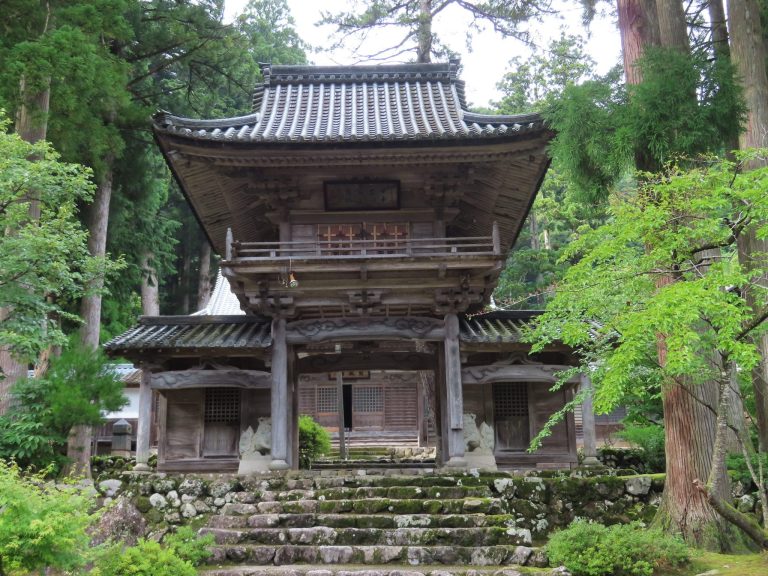
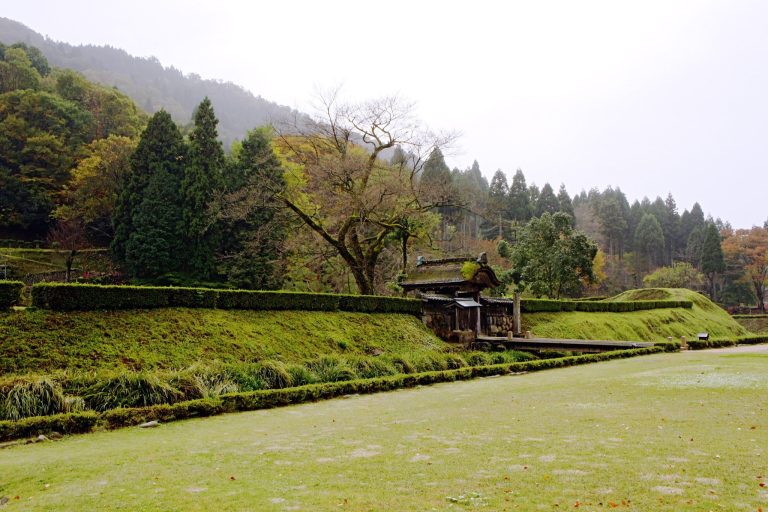
Heisenji’s surviving landscape combines the present shrine precinct with the buried and ruined remains of the former Buddhist complex. Stone walls, moats, defensive earthworks, stone-paved roads, and the foundations of former temples and residences extend through woodland and fields. The preserved layout reflects both the fortified character of the late-medieval institution and the separate settlement patterns of the North and South Valleys.
Shrine buildings and former Buddhist halls
Main sanctuary and subsidiary shrines
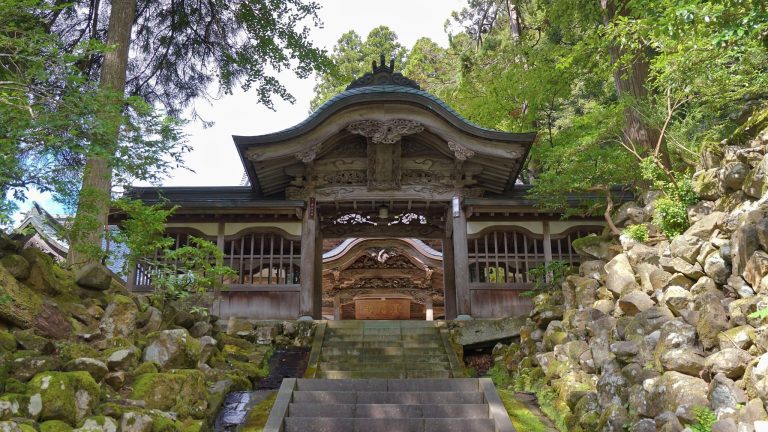
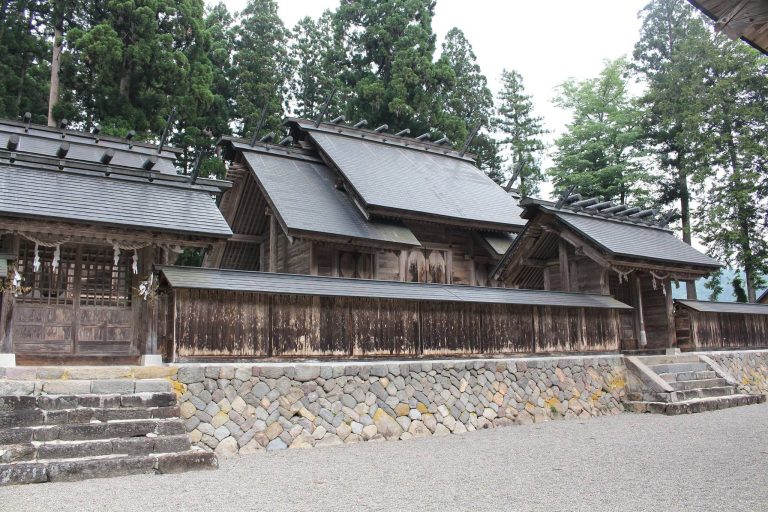
The main sanctuary enshrines Izanami-no-Mikoto and is built in the irimoya-zukuri form, a roof design combining a ridged central section with sloping sides. Its roof is made from shingles of split timber boards. Bessan Shrine stands to the right and enshrines Ame-no-Oshihomimi-no-Mikoto, while Onamuchi Shrine stands to the left and enshrines Ōnamuchi-no-Mikoto.
Great Lecture Hall
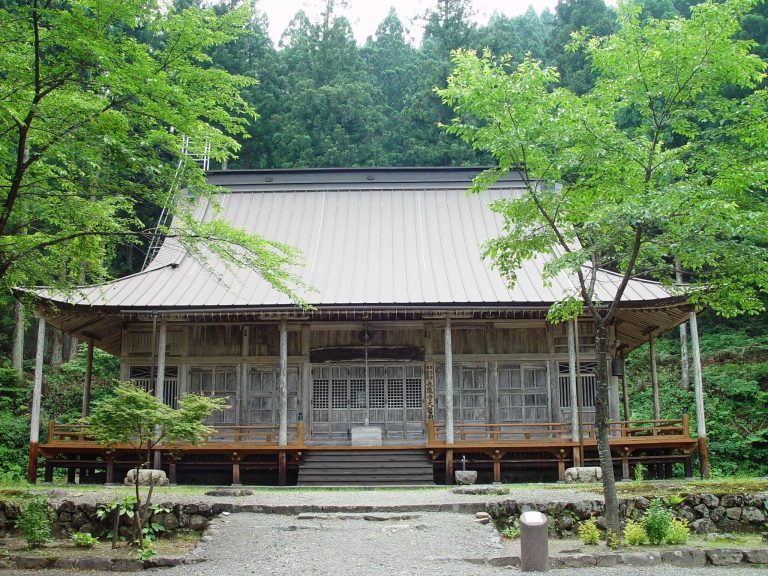
The Great Lecture Hall stood in front of the present worship hall and measured seven bays by four bays. Its inner sanctuary held six Buddhist images: Shakyamuni, Amitabha, Bhaisajyaguru, Avalokiteshvara, Fudō Myōō, and Bishamonten. The hall’s rebuilding in 1172 belongs to the period when Heisenji was under Enryakuji’s authority.
Valleys, defenses, and settlement remains
The North Valley and South Valley retain contrasting traces of the former settlement. The South Valley preserves planned divisions and straight stone-paved roads, reflecting its more systematic organization and association with married clergy. The North Valley is associated with celibate monastic residence. Across both areas, extensive stone walls, moats, earthworks, and ruined or buried buildings preserve the physical structure of a fortified religious city.
Moss-covered approach and historic garden
Middle Shrine Heisenji Approach
The approximately 1.2-kilometer Middle Shrine Heisenji Approach leads through old cedar and beech trees, with some trees traditionally said to be about 1,000 years old. Mature sara and Japanese pear trees also line the route. Its stone paving is traditionally attributed to Muromachi-period ascetics, who are said to have passed stones from the bed of the Kuzuryu River hand to hand in a communal construction project.
In 1912, a road beside the old approach was created by widening the former carriage road while preserving the stone paving. The approach was selected for the 100 Selected Roads of Japan in 1986, the New 100 Japanese Street-Tree Landscapes in 1994, and the 100 Historic Roads in 1996.
Moss landscape and Gensei-in garden
The approach to the worship hall is shaded by trees and lined with moss. Nearly 120 kinds of moss grow around the hall. The surrounding mountains and heavy winter snowfall maintain high humidity, creating conditions favorable to this growth and giving the site its familiar name, the “Moss Temple.” The moss gardens and surviving stonework form major elements of the preserved historic landscape.
The former Gensei-in garden remains a designated scenic garden within the precincts. Together with the stone walls, paved approach, woodland, and archaeological remains, it preserves elements of both the former temple landscape and the later shrine setting.